NASA has been developing large ultra-lightweight structures commonly referred to as Gossamer space structures for many years to reduce launch costs and to exploit the unique capabilities of particular concepts. For instance, dish antennas are currently being pursued because they can be inflated in space to sizes as large as 30 meters and then rigidized to enable high data rate communications.
- Measurements on large area surfaces thinner than paper;
- Air mass loading under ambient conditions was significant, thus requiring in-vacuum tests;
- High modal density required partitioning of the surface into manageable areas.
Laser vibrometry has proven to be a critical sensing technology for validating the dynamical characteristics of these Gossamer structures, due to its precision, range, and non-contacting (zero-mass loading) nature.
Measurement Setup
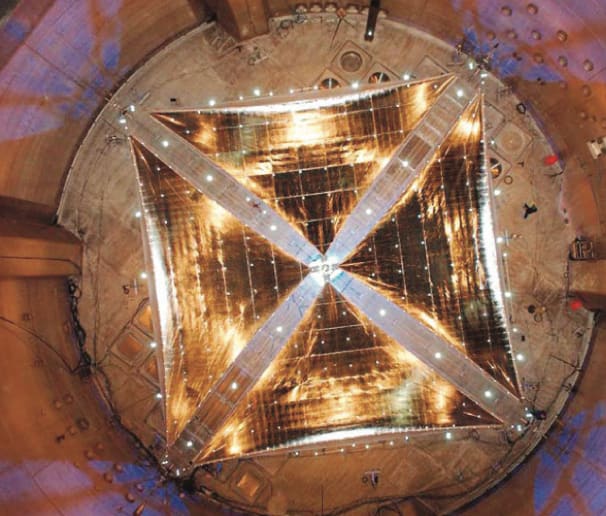
The team of ATK Space Systems, SRS Technologies, and NASA Langley Research Center, under the direction of the NASA In-Space Propulsion Office (ISP), has developed and evaluated a scalable solar sail configuration (Figure 1) to address NASA’s future space propulsion needs. A Polytec Scanning Laser Vibrometer system (PSV-400) was the main instrument used to measure the vibration modes. The laser scan head was placed inside a pressurized canister to protect it from the vacuum environment. The canister had a window port from which the laser exited, and a forced air cooling system prevented overheating.
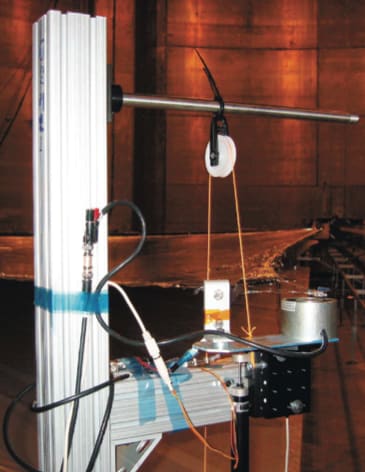
A Scanning Mirror System (SMS) was developed and implemented that allowed full-field measurements of the sail from distances in excess of 60 meters within the vacuum chamber. The SMS was mounted near the top of the vacuum chamber facility and centered over the test article, while the vibrometer head was mounted above the door frame of one of the large chamber doors. The SMS contained a stationary mirror that reflected the Polytec laser beam to a system of two orthogonal active mirrors. These mirrors were used to scan the surface of the sail to find retro-reflective targets previously attached to the sail surface. These targets were essential to getting a good return signal and overcoming the specular nature of the reflective sail surface. A specially developed target tracking algorithm enabled automatic centering of the laser beam on each retro-reflective target.
The initial laser system alignment, target tracking process, and entire data acquisition procedure were automated using the Microsoft Visual Basic (VB) programming language. Polytec’s VB Engine and PolyFileAccess allowed the program to control all the functional capability of the Polytec system. This fully automated test procedure was considered critical, since many tests could take over 5 hours to run.
Excitation of Sail Motion
 This technique allowed for adequate excitation of the entire sail system and for the identification of major system level vibration modes. To reduce test time, the full sail system test only measured 5 sail membrane locations per quadrant and two mast tip measurements per mast. Since the test article configuration did not change from the quadrant tests to full sail system tests, the high spatial resolution quadrant test results with 44 measurements per quadrant could be compared with the lower spatial resolution system test results with only 5 measurements per quadrant.
Solar Sail Dynamics
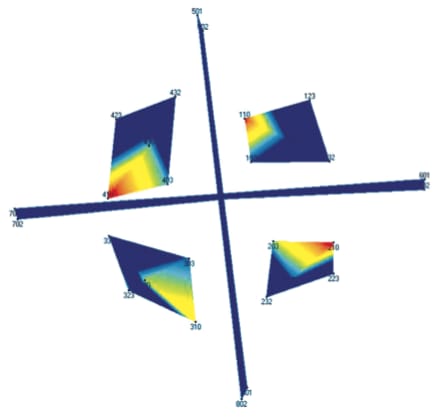
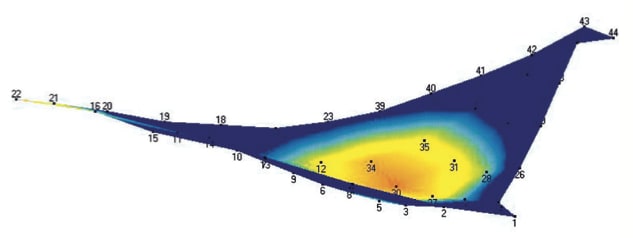
The 1st fundamental system mode of the solar sail identified was a “Pin Wheel Mode” with all quadrants rocking in-phase (Figure 3) at a frequency of 0.5 Hz. In this mode all the mast tips are twisting in-phase and the quadrants follow the motion by rocking and pivoting about the quadrant centerline. The 1st sail membrane mode, that has low mast participation, is a breathing mode (Figure 4) at 0.69 Hz. In this mode, the sail quadrant undergoes 1st bending through its centerline. Other higher order sail dominant modes were also found in which the long edge of the quadrant is in 1st bending, but the centerline undergoes either 2nd or 3rd order bending. These test results are important for updating structural analytical models that can be used to predict the on-orbit performance of the solar sail, free of gravity, to aid in further design iterations.
Conclusions
Laser vibrometry was successfully used to identify the fundamental solar sail system modes for structural model correlation. Also, higher order sail membrane modes were identified through a combination of many tests on each quadrant. The methodology described in this article is being further utilized for other Gossamer test programs, such as the antenna technology development program to validate large space based communication antennas.
This article was written by James L. Gaspar, Research Engineer, Structural Dynamics Branch, NASA Langley Research Center (Hampton, VA). For more information, contact Mr. Gaspar at