A method of correcting for the distorting effects of the atmosphere upon a laser beam used in free-space optical communication has been proposed. The original version of the method would be applied to a system in which a laser beam would be transmitted from a ground station to a precisely flat and precisely oriented mirror on a spacecraft in orbit around the Earth, then relayed to a distant spacecraft by reflection from the mirror (see figure). Because propagation of the beam in outer space would be distortionless, the method addresses only the distortions that would arise along the ground-station/near-Earth-spacecraft path.
In the original application, in order to send a sufficiently strong signal to the distant spacecraft, it would be necessary to deliver an approximately diffraction-limited, undistorted laser beam to the orbiting mirror for relay to the distant spacecraft. Therefore, at the ground station, adaptive optics would be used to apply compensatory predistortions to cancel the optical distortions (tilt and scintillation) introduced by the atmosphere. The control signals for the adaptive optics would be generated as explained next.
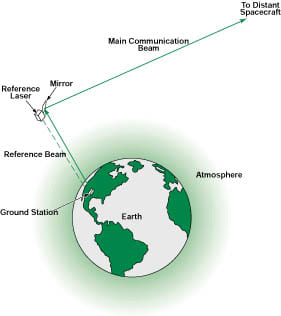
A small laser aboard the near-Earth spacecraft would transmit a reference beam to the ground station. Because it would propagate along the same path as that of the main communication beam, the reference beam would undergo essentially the same distortions. Thus, measurement of the tilt and scintillation of the reference beam arriving at the ground station would provide the information needed to control the adaptive optics to apply the compensatory predistortions.
To compensate for the predictable aberration caused by orbital motion of the relay mirror, the reference laser would have to be offset from the relay mirror by an angle (as seen from the ground station) of 2v/c radians in the plane of relative motion, where v is the component of orbital velocity orthogonal to the optical path and c is the speed of light. For a typical orbit, the offset distance for this angle would be no more than about 8 m.
The reference beam arriving at the ground station must be bright enough that measurements and corrections can be completed within an interval of about 1 millisecond, which is dictated by the temporal variation of atmospheric optical distortion. This requirement turns out not to be especially severe: for example, it has been estimated that even during the day, the beam from a reference laser with a wavelength of 0.5 µm, a power of 1 mW, and optics with an aperture diameter of about 10 cm, located in a geosynchronous orbit, would be sufficiently bright for measurement through a ground telescope with an aperture diameter of about 1 m and a band-pass optical filter.
This work was done by John Armstrong, Cavour Yeh, and Keith Wilson of Caltech for NASA's Jet Propulsion Laboratory.
NPO-20506
This Brief includes a Technical Support Package (TSP).
Correcting for Atmospheric Effects in Optical Communication
(reference NPO20506) is currently available for download from the TSP library.
Don't have an account?
Overview
The document presents a novel approach to optical communication between Earth and distant spacecraft, addressing the challenges posed by atmospheric distortions. The proposed solution involves a beam relay system that utilizes adaptive optics to ensure the transmission of a diffraction-limited optical beam, which is crucial for high-data rate communications.
The core concept of the system is to position a relay mirror in Earth’s orbit, above the distorting effects of the atmosphere. A reference beam generated by a small onboard laser on the spacecraft provides the necessary information for a ground-based adaptive optics system to correct atmospheric distortions. This allows for the delivery of a high-quality, diffraction-limited beam to the relay mirror, which then directs the corrected signal to the spacecraft.
Key design considerations for the relay system include the power of the reference beam, which must be sufficiently bright to enable rapid corrections for tilt and higher-order distortions. The document outlines the signal-to-noise ratio (SNR) for the adaptive optics system, emphasizing that even modest-power lasers can achieve adequate SNR for effective communication. For instance, calculations indicate that a 1mW laser can produce a satisfactory SNR even when accounting for background noise from the sky.
The proposed beam relay system offers several advantages over traditional methods of atmospheric compensation. It allows for real-time monitoring of the compensation achieved on the uplink, as optical detectors can be placed between mirror segments to assess the optical power distribution. This capability enhances the reliability of the communication link by providing continuous feedback on the performance of the system.
Overall, the document highlights the potential of this innovative beam relay system to significantly improve optical communication with spacecraft, particularly for applications requiring high data rates and coherent signal transmission. By effectively mitigating the effects of atmospheric turbulence, this technology could pave the way for more robust and efficient interplanetary communication systems, ultimately enhancing our ability to explore and communicate with distant celestial bodies.