

The ability to record simultaneous framing images and streak images has long been a requirement in the research fields of detonation, electrical discharge, biomedical and many other applications. Early systems incorporating both framing and streak cameras used external beam splitting optics with light gathering limitations that required critical alignment of the external splitting optics. Later systems incorporated framing cameras and streak cameras, built into one mainframe, using available beam splitters. This allowed for simultaneous framing and streak, however, this type of beam splitter limited access to streak optics, and primarily limited the performance of the streak camera due to the smaller format streak tubes.
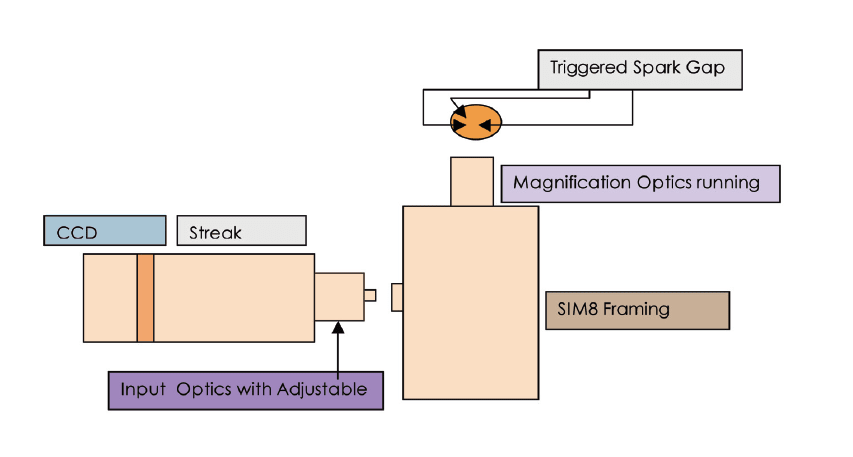
An Ultra Fast Framing Camera built around a newly designed beam splitter optimized for spatial resolution with no geometric distortions and configured for up to 16 output ports was the primary imaging system. The system used for this test was configured with 9 ports, eight of which were used for 8 channels of ICCDs for framing operation. The 9th optical port allowed a full sized Ultra Fast Streak Camera to be coupled to the system. Having the streak camera external to the framing camera allowed the use of a large format streak camera with a fullsized 8-35mm photocathode and a large 20-40mm output screen ensuring long time windows. It also offered full access to the input streak optics. The adjustable slit and efficient lens coupling also allowed 88 filters and spectrographs to be inserted if needed. The beam splitter maintains an optical spatial resolution >70 lp/mm (line pairs per millimeter) to ensure maximum image quality for both framing and streak modes.
This system was configured as a proof of principle in February 2007 at the Optronis GmbH laboratory in Kehl Germany. The two cameras were optically coupled as described above. As a virtual image plane is present 46 mm from the output port, setup and alignment was easily performed using the real time focus modes of both the framing camera and the streak camera with the same optical axis.
System Configurations


The Ultra Fast Streak Camera was programmed to streak at 100ns/mm (nanoseconds per millimeter) giving a 2 μsec (microsecond) time window and using a 100μm (micrometer) slit, giving a time resolution of 10ns, which matched the exposure time of the framing camera. The 2:1 de-magnification of the streak camera input optics allowed the use of a 16mm slit on the image plane of the 9th optical port of the Framing Camera.
To prove the operation of this Dual Camera System a triggered spark gap with a 2mm main gap was imaged. The main gap was imaged into the primary image plane of the framing camera using a Nikon lens set of 50mm (f1.4) and 105mm (f2.5) lenses configured front to front to give ≈2X magnification. Having access to the input optics of the streak camera, the alignment of the images into the framing camera and streak camera was easily achieved using the real time focus modes of both cameras.
Both cameras were programmed for the appropriate operating parameters such that the framing camera pre-triggered the spark gap. Knowing the trigger delay of the triggered spark gap, a time delay of about 1.52μsec was programmed into both the framing camera and streak camera so that the breakdown would coincide with the recording time window of both cameras.
Several test shots were taken to ensure the jitter of the triggered spark gap in air would repeatedly occur during our recording time window. Trigger jitter of the air spark gap was typically 100 to 250 nsec.
Test Results
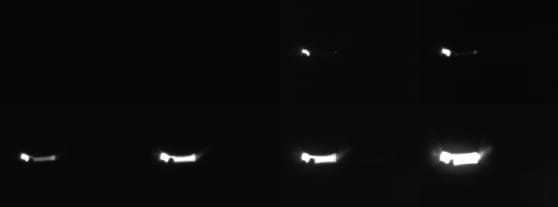
Framing results (Figure 2) show two dimensional images of the initial breakdown of the trigger gap that occurred sometime between frames F2 and F3, followed slightly later by the main gap break down. In the framing data we see the breakdowns occur but, as there is dead time between frame recording times, data is lost during that dead time. Programming the framing camera with no dead time between frames will minimize lost data but the total recording time window will be reduced proportionally.
The streak image (Figure 3), with time measurements made from the data, shows that the initial trigger breakdown (lower earlier portion of the streak) takes place about 50ns prior to the main breakdown. The Streak Data also shows continuous recorded data as the main breakdown grows in magnitude with a rise time of about 400ns, with no dead time in the recording data. In the intensity profile trace (Figure 4) you can easily see the initial trigger pulse breakdown ahead of the main gap breakdown.
The commercial version of this system is now available with both the framing camera and streak camera rigidly attached to a single mounting plate with adjustable critical alignments for x-y-z positions and with 90° turning optics so that both cameras sit in the same orientation (Figure 5). The footprint is about 800mm long and 500mm wide allowing both horizontal and vertical mounting of the system for microscopy applications. Both cameras can be run independently if needed or combined and controlled from one computer. Both systems are controlled via Ethernet communications allowing both wire and fiber optics for long distance or high noise environments applications.
Conclusion
A commercially available Ultra Fast Framing and Streak Camera configuration can easily be set up and operated with extreme accuracy in data acquisition. Data also shows that the framing camera offers the advantage of two dimensional recording of image data over a large field of view. Conversely the streak camera data shows continuous recording of spatial, intensity and temporal data in the single dimension of the slit width. The framing camera could have been programmed for a minimum or for no dead time between frames but this would have limited the total record window. The streak speed could have been increased by orders of magnitude to see greater detail in the first 50 to 200ns of the initial breakdown, but this would have shortened the total record time.
This article was written by Frank Kosel, Senior Sales & Applications Engineer for high speed imaging systems at IMC/Photo-Sonics, Inc. (Burbank, CA); Dr. Patrick Summ, Managing Director of Optronis GmbH (Kehl, Germany); and Wai Chan, Managing Director of Specialised Imaging Ltd. (Hertfordshire, UK). For more information, contact Mr. Kosel at







