Miniature, single-aperture optoelectronic instruments called "multi-function telescopes" are being developed for use in both scientific observations and laser communications aboard microspacecraft that are expected to be launched in the next few years. These instruments could also be adapted to imaging and communication applications on Earth.
As now envisioned, a multi-function telescope would serve as (1) a conventional telescope for scientific imaging, (2) a telescope for celestial navigation, (3) an infrared spectrometer, and (4) a laser communication system. A prototype multi-function telescope called "a combined laser-communication and imager for microspacecraft" (ACLAIM) has been built and tested to demonstrate two of these functions: laser communication and scientific imaging. The prototype instrument was assembled from mostly commercially available parts.
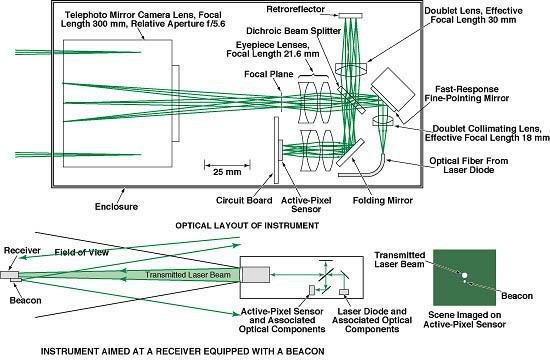
The figure schematically depicts the prototype instrument. All incoming and outgoing light passes through a telephoto mirror camera lens. Within the instrument, there are three partly overlapping optical channels: a receiving channel, a transmitting channel, and a boresight channel. The three channels intersect at a dichroic beam splitter, which makes it possible to use the same path through the telephoto lens for both receiving and transmitting.
The receiving channel extends from the telephoto lens to the beam splitter to an Active-Pixel Sensor (APS). Light to be transmitted is generated by modulating the power supplied to a laser diode equipped with a pigtail optical fiber, and the transmitting channel is considered to extend from the output end of the optical fiber to the beam splitter, then from the beam splitter out through the telephoto lens. The beam splitter exhibits high reflectance at wavelengths from 500 to 900 nm, except in a 40-nm-wide band at the laser wavelength of 670 nm, where it exhibits 70-percent transmittance.
The boresight channel includes a retroreflector, which sends a small portion of the laser beam to the APS . A laser beacon at a distant receiver is also imaged onto the APS. The positions of the spots of light from the beacon and the laser beam are measured and used to compute the angle between the transmitted beam and the line of sight to the beacon.
In the original intended use aboard a spacecraft, the spacecraft would be turned to aim the telescope at an astronomical target of scientific interest and image data would be acquired by use of the APS. The image data would be stored in memory for subsequent transmission to the distant receiver via modulation on the outgoing laser beam.
In preparation for transmitting the image data, the spacecraft and telescope would be turned to bring the beacon at the receiver within the field of view of the telescope. Then a control system would adjust the orientation of the spacecraft and of a fast-response fine-pointing mirror in the instrument, in response to the angle measured as described in the preceding paragraph. The techniques for measuring the angle and aiming the telescope were described in more detail in four previous articles in NASA Tech Briefs; "Beam-Steering Subsystem for Laser Communication" (NPO-19069), Vol. 19, No. 6 (June 1995), page 32; "Digital Controller for Laser-Beam-Steering Subsystem" (NPO-19193), Vol. 19, No. 11 (November 1995), page 93; "More About Beam-Steering Subsystem for Laser Communication" (NPO-19381), Vol. 19, No. 11 (November 1995), page 93; and "Image Processing in Laser-Beam-Steering Subsystem" (NPO-19396), Vol. 20, No. 5 (May 1996), page 24.
This work was done by Hamid Hemmati and James Lesh of Caltech for NASA's Jet Propulsion Laboratory.
In accordance with Public Law 96-517, the contractor has elected to retain title to this invention. Inquiries concerning rights for its commercial use should be addressed to
Technology Reporting Office
JPL
Mail Stop 122-116
4800 Oak Grove Drive
Pasadena, CA 91109
(818) 354-2240
Refer to NPO-20388
This Brief includes a Technical Support Package (TSP).
Telescope for imaging and laser communication
(reference NPO20388) is currently available for download from the TSP library.
Don't have an account?
Overview
The document discusses the development of miniature, single-aperture optoelectronic instruments known as "multi-function telescopes," which are intended for scientific observations and laser communications aboard microspacecraft. These telescopes are expected to be launched in the coming years and can also be adapted for various imaging and communication applications on Earth.
The multi-function telescope is designed to perform several roles: it serves as a conventional telescope for scientific imaging, a tool for celestial navigation, an infrared spectrometer, and a laser communication system. A prototype called ACLAIM (a combined laser-communication and imager for microspacecraft) has been built and tested, demonstrating its capabilities in laser communication and scientific imaging. The prototype was constructed using mostly commercially available components, which helps reduce costs and delivery times.
The optical design of the instrument utilizes a telephoto mirror camera lens through which all incoming and outgoing light passes. It features three overlapping optical channels: a receiving channel, a transmitting channel, and a boresight channel. These channels intersect at a dichroic beam splitter, allowing the same optical path to be used for both receiving and transmitting signals. The receiving channel directs light from the telephoto lens to an Active-Pixel Sensor (APS), while the transmitting channel involves modulating a laser diode's power to generate light for transmission.
The document also provides technical specifications for the optical system, including the wavelength range for the laser (670 nm) and the beam splitter's high reflectance characteristics in the 500-900 nm region, with specific transmittance at the laser wavelength. The overall volume of the instrument is compact, measuring less than 10 x 10 x 20 cm, making it suitable for microspacecraft applications.
Additionally, the document includes a disclaimer stating that references to specific commercial products do not imply endorsement by the U.S. Government or the Jet Propulsion Laboratory. The work described was conducted at the Jet Propulsion Laboratory under a contract with NASA, emphasizing the collaborative nature of this technological advancement.
In summary, the document outlines the innovative design and capabilities of multi-function telescopes, highlighting their potential impact on space exploration and communication technologies.