

An optoelectronic metrology apparatus now at the laboratory-prototype stage of development is intended to repeatedly determine distances of as much as several hundred meters, at submillimeter accuracy, to multiple targets in rapid succession. The underlying concept of optoelectronic apparatuses that can measure distances to targets is not new; such apparatuses are commonly used in general surveying and machining. However, until now such apparatuses have been, variously, constrained to (1) a single target or (2) multiple targets with a low update rate and a requirement for some a priori knowledge of target geometry. When fully developed, the present apparatus would enable measurement of distances to more than 50 targets at an update rate >10 Hz, without a requirement for a priori knowledge of target geometry.
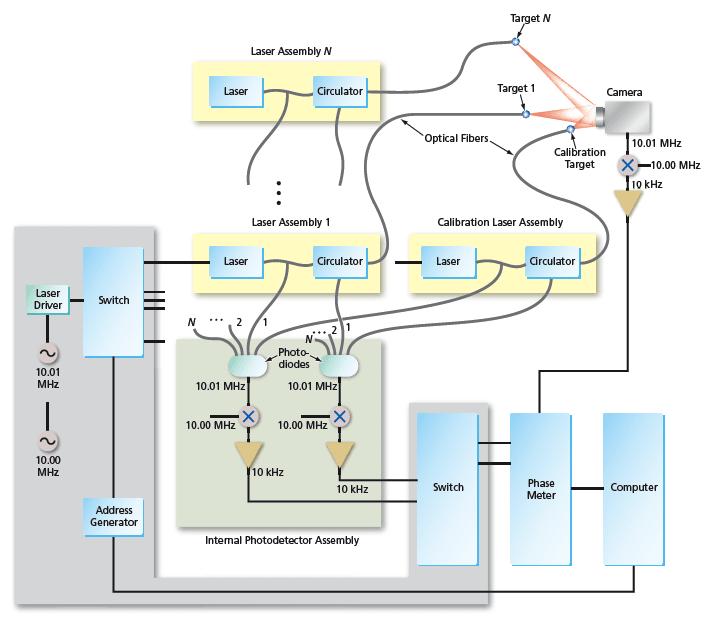
Both the outgoing and incoming 10.01-MHz laser signals are mixed with a 10-MHz local-oscillator to obtain beat notes at 10 kHz, and the difference between the phases of the beat notes is measured by a phase meter. This phase difference serves as a measure of the total length of the path traveled by light going out through the optical fiber and returning to the camera (photodetector) through free space.
Because the portion of the path length inside the optical fiber is not ordinarily known and can change with temperature, it is also necessary to measure the phase difference associated with this portion and subtract it from the aforementioned overall phase difference to obtain the phase difference proportional to only the free-space path length, which is the distance that one seeks to measure. Therefore, the apparatus includes a photodiode and a circulator that enable measurement of the phase difference associated with propagation from the LRU inside the fiber to the target, reflection from the fiber end, and propagation back inside the fiber to the LRU. Because this phase difference represents twice the optical path length of the fiber, this phase difference is divided in two before subtraction from the aforementioned total-path-length phase difference.
Radiation-induced changes in the photodetectors in this apparatus can affect the measurements. To enable calibration for the purpose of compensation for these changes, the apparatus includes an additional target at a known short distance, located inside the camera. If the measured distance to this target changes, then the change is applied to the other targets.
This work was done by Carl Christian Liebe, Alexander Abramovici, Randall Bartman, Jacob Chapsky, John Schmalz, Keith Coste, Edward Litty, Raymond Lam, and Sergei Jerebets of Caltech for NASA’s Jet Propulsion Laboratory. NPO-43240
This Brief includes a Technical Support Package (TSP).
Optoelectronic System Measures Distances to Multiple Targets
(reference NPO-43240) is currently available for download from the TSP library.
Don't have an account?
Overview
The document presents an innovative metrology system developed by NASA's Jet Propulsion Laboratory (JPL), detailed in Technical Support Package NPO-43240. This optoelectronic system is designed to measure distances to multiple targets simultaneously, overcoming limitations of existing technologies that typically focus on single targets or require prior knowledge of target geometry.
The primary novelty of this invention lies in its ability to perform high-frequency measurements—exceeding 10 Hz—across more than 50 targets without restrictions on their position or movement. This capability is particularly beneficial for applications requiring precise distance measurements over several hundred meters, such as in large radar antennas where structural deformations can significantly affect performance.
The system employs a laser ranging unit (LRU) that integrates a camera to image all targets within its field of view. Each target is connected to the LRU via optical fibers, which are terminated with lens systems aimed at the camera. The LRU utilizes multiple lasers, each corresponding to a target, illuminating them one at a time with modulated laser light. The reflected light is detected by the camera, and the phase difference between the outgoing and incoming signals is measured to determine the distance to each target.
To address challenges such as temperature-induced changes in optical distance within the fibers, the system incorporates a calibration mechanism. A photo diode at the start of each optical fiber measures the optical distance in the fiber, allowing for compensation in the final distance calculation. Additionally, a calibration target with a known distance is used to adjust measurements, ensuring accuracy despite potential radiation-induced changes in the photo receivers.
The document emphasizes the broader implications of this technology, suggesting its potential applications in various fields beyond aerospace, including surveying and machining. It highlights the importance of compliance with U.S. export regulations and the proprietary nature of the information contained within the package.
Overall, this metrology system represents a significant advancement in distance measurement technology, promising enhanced accuracy and efficiency for a wide range of applications. For further inquiries or assistance, the document provides contact information for JPL's Innovative Technology Assets Management.











