

A prototype ring laser in which a transparent microsphere serves as an electromagnetic-mode selector has been constructed in a continuing effort to develop optoelectronic oscillators for generating light signals amplitude-modulated by microwave signals, all with low phase noise. Optoelectronic oscillators could be used as signal sources in fiber-optic and microwave communication systems and in radar systems.
An optoelectronic oscillator is a hybrid of photonic and electronic components, designed to exploit coupling between optical and electronic oscillations. Optoelectronic oscillators have been described in several previous articles inNASA Tech Briefs, the most recent being "Optoelectronic Generation of Optical and Microwave Signals" (NPO-20090), Vol. 22, No. 9 (September 1998), page 50. An optoelectronic oscillator includes, among other things, a laser that operates in multiple modes, plus a high-speed photodetector that samples the laser output. The laser is designed so that the frequency intervals between its modes include the microwave frequency of interest; thus, the microwave frequency of interest appears as one of the beat notes in the photodetector output.

In some previously developed optoelectronic oscillators, long fiber-optic feedback loops were used to obtain low phase noise. Undesirably, a long fiber-optic loop adds considerably to the size and weight of an oscillator; it also makes the frequency intervals between modes so small that selection of the desired modes becomes difficult. In some optoelectronic oscillators developed more recently, fiber-optic loops were replaced with transparent microspheres configured as high-Q (whereQ is the resonance quality factor) resonators in conjunction with pump lasers operating under feedback control of frequency (see Figure 1). In a microsphere, propagation in a long fiber is replaced by equivalent orbiting of light by total internal reflection in "whispering-gallery" modes. It has been demonstrated experimentally that in visible light,Q ≈ 1010 can be achieved in a microsphere, corresponding to a propagation delay of about 3 µs in an optical fiber 0.7 km long.
Feedback control of pump-laser frequency in a microsphere oscillator of the type described above was necessary for locking the pump laser to one of the microsphere modes. The feedback frequency control added complexity and introduced a source of additional frequency and phase noise.
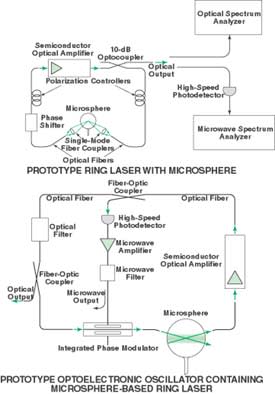
In the prototype ring laser, there is no need for feedback control of laser frequency because the microsphere is an integral part of the laser. The prototype ring laser (shown in the upper part of Figure 2) includes a high-purity silica microsphere and a semiconductor optical amplifier plus ancillary optical components connected in an optical loop. One of the components in the loop is an optocoupler for sampling the laser beam.
In early experiments on the prototype ring laser, the sampled laser beam was analyzed for its optical and microwave-modulation spectral contents. The laser was found to oscillate in multiple whispering-gallery modes of the microsphere. The microwave modulation spectrum included peaks at integer multiples of the whispering-gallery free spectral range of 5.93 GHz. At the time of reporting the information for this article, experiments on the apparatus shown in the lower part of Figure 2 were underway. This apparatus is designed to obtain stable single-frequency operation by introducing (1) optical selection of principal waveguide modes and (2) active microwave feedback as in a standard optoelectronic oscillator.
This work was done by Steve Yao, VladimirIltchenko, and Lute Maleki of Caltech for NASA's Jet Propulsion Laboratory.
In accordance with Public Law 96-517, the contractor has elected to retain title to this invention. Inquiries concerning rights for its commercial use should be addressed to
Intellectual Property group,
JPL
Mail Stop 202-233
4800 Oak Grove Drive
Pasadena, CA 91109
(818) 354-2240
Refer to NPO-20597
This Brief includes a Technical Support Package (TSP).
Closed-Loop Microsphere Laser for Optoelectronic Oscillator
(reference NPO20597) is currently available for download from the TSP library.
Don't have an account?
Overview
The document presents an innovative exploration of a closed-loop microsphere laser developed by a team at NASA's Jet Propulsion Laboratory, focusing on its potential applications in optoelectronic oscillators. This technology is designed to enhance communication systems by generating light signals that are modulated by microwave signals, which is crucial for improving the performance of fiber-optic and microwave communication systems.
The key features of the closed-loop microsphere laser include its ability to maintain low phase noise, which is essential for high-quality signal transmission. The document outlines the novelty of the approach, emphasizing how the integration of laser technology with microwave modulation can lead to significant advancements in communication efficiency and reliability.
The detailed description provided in the document highlights the underlying principles of the microsphere laser, including its design, operational mechanisms, and the advantages it offers over traditional communication methods. The team at NASA has conducted extensive research to optimize the performance of the laser, ensuring that it meets the stringent requirements of modern communication systems.
Furthermore, the document discusses the potential applications of this technology in various fields, including telecommunications, aerospace, and other industries that rely on high-speed data transmission. The closed-loop microsphere laser could serve as a critical component in next-generation communication networks, enabling faster and more reliable data transfer.
In summary, the document showcases a significant advancement in laser technology with the development of a closed-loop microsphere laser that promises to revolutionize optoelectronic oscillators and communication systems. By combining the precision of laser modulation with microwave signals, this innovation has the potential to enhance the performance of fiber-optic and microwave communication, paving the way for more efficient and effective data transmission in various applications. The research conducted by the NASA team represents a crucial step forward in the quest for improved communication technologies, highlighting the importance of continued innovation in this field.











