A scheme is proposed for referencing the propagation direction of the transmit laser signal in pointing a free-space optical communications terminal. This recently developed scheme enables the use of low-cost, commercial silicon-based sensors for tracking the direction of the transmit laser, regardless of the transmit wavelength. Compared with previous methods, the scheme offers some advantages of less mechanical and optical complexity and avoids expensive and exotic sensor technologies.
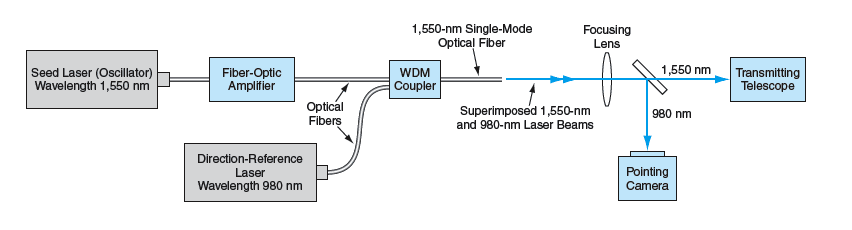
In free-space optical communications, the transmit beam must be accurately pointed toward the receiver in order to maintain the communication link. The current approaches to achieve this function call for part of the transmit beam to be split off and projected onto an optical sensor used to infer the pointed direction. This requires that the optical sensor be sensitive to the wavelength of the transmit laser. If a different transmit wavelength is desired, for example to obtain a source capable of higher data rates, this can become quite impractical because of the unavailability or inefficiency of sensors at these wavelengths. The innovation proposed here decouples this requirement by allowing any transmit wavelength to be used with any sensor.
We have applied this idea to a particular system that transmits at the standard telecommunication wavelength of 1,550 nm and uses a silicon-based sensor, sensitive from 0.5 to 1.0 micrometers, to determine the pointing direction. The scheme shown in the figure involves integrating a low-power 980-nm reference or boresight laser beam coupled to the 1,550-nm transmit beam via a wavelength-division-multiplexed fiber coupler. Both of these signals propagate through the optical fiber where they achieve an extremely high level of co-alignment before they are launched into the telescope. The telescope uses a dichroic beam splitter to reflect the 980-nm beam onto the silicon image sensor (a quad detector, charge-coupled device, or active-pixel-sensor array) while the 1,550-nm signal beam is transmitted through the optical assembly toward the remotely located receiver. Since the 980-nm reference signal originates from the same single-mode fiber-coupled source as the transmit signal, its position on the sensor is used to accurately determine the propagation direction of the transmit signal.
The optics are considerably simpler in the proposed scheme due to the use of a single aperture for transmitting and receiving. Moreover, the issue of mechanical misalignment does not arise because the reference signal and transmitted laser beams are inherently co-aligned. The beam quality of the 980-nm reference signal used for tracking is required to be circularly symmetric and stable at the tracking-plane sensor array in order to minimize error in the centroiding algorithm of the pointing system. However, since the transmit signal is delivered through a fiber that supports a single mode at 1,550 nm, propagation of higher order 980-nm modes is possible. Preliminary analysis shows that the overall mode profile is dominated by the fundamental mode, giving a near symmetric profile. The instability of the mode was also measured and found to be negligible in comparison to the other error contributions in the centroid position on the sensor array.
This work was done by Malcolm Wright, Gerardo Ortiz, and Muthu Jeganathan of Caltech for NASA’s Jet Propulsion Laboratory.
In accordance with Public Law 96-517, the contractor has elected to retain title to this invention. Inquiries concerning rights for its commercial use should be addressed to:
Innovative Technology Assets Management
JPL
Mail Stop 202-233
4800 Oak Grove Drive
Pasadena, CA 91109-8099
(818) 354-2240
E-mail: This email address is being protected from spambots. You need JavaScript enabled to view it.
Refer to NPO-30606.
This Brief includes a Technical Support Package (TSP).
Pointing Reference Scheme for Free-Space Optical Communications Systems
(reference NPO-30606) is currently available for download from the TSP library.
Don't have an account?
Overview
The document titled "Pointing Reference Scheme for Free-Space Optical Communications Systems" is a technical support package from NASA's Jet Propulsion Laboratory, detailing advancements in optical communication technologies. It focuses on the use of different wavelengths, specifically 980 nm and 1550 nm, in free-space optical communication systems, which are crucial for applications such as satellite communications and interplanetary data transmission.
The document outlines the measurement and analysis of higher-order modes in optical fibers, particularly single-mode fibers (SMF) like SMF-28, when using 980 nm light. It explains the concept of normalized frequency (V), which determines the number of modes that can propagate through a fiber. The formula provided indicates that the dominant mode is typically the fundamental mode, with higher-order modes being less stable and more complex.
Key measurements are presented, including the beam profiles of 980 nm and 1550 nm light as they exit the fiber and are imaged onto a pointing camera. The document highlights that while a second-order non-symmetric mode exists at 980 nm, the centroid of the beam remains stable, indicating effective co-alignment of the beams at both wavelengths. This stability is essential for maintaining communication integrity in free-space systems.
The document also discusses the implementation of a reference scheme using a 1550 nm seed laser and a 980 nm transmit reference laser, emphasizing the importance of accurate beam focusing and alignment. The experimental setup includes optical components such as a Wavelength Division Multiplexer (WDM) and a focusing lens, which are critical for optimizing the performance of the communication system.
In summary, this technical support package provides a comprehensive overview of the methodologies and findings related to the use of 980 nm and 1550 nm wavelengths in free-space optical communication. It serves as a valuable resource for researchers and engineers working on optical communication systems, offering insights into fiber mode theory, beam profiling, and the practical implementation of reference schemes for enhanced communication reliability. The document underscores NASA's commitment to advancing aerospace technologies with broader applications in scientific and commercial fields.