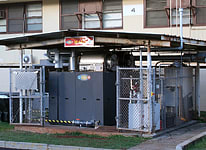
 In partnership with the Office of Naval Research, Marines at Camp Smith, Hawaii are testing a trash disposal system called the Micro Auto Gasification System (MAGS) that can reduce a standard 50-gallon bag of waste to a half-pint jar of ash.
The unit is currently being evaluated by U.S. Marine Corps Forces, Pacific (MARFORPAC) as a possible solution to help Marines defeat the increasing trash at remote forward operating bases (FOB).
“Right now, there are really only two solutions: burn it or bury it,” said Lt. Col. Mike Jernigan, a Marine combat engineer. “Any potential solution must reduce the security and logistics concerns of trash disposal, and help the environment...that’s a good thing for the Marine Corps.”
MAGS has a controlled decomposition process which thermally converts energy from biomass. “The system essentially bakes the trash and recovers a high portion of combustible gas byproduct, which is used to fuel the process,” said Donn Murakami, the MARFORPAC science adviser who leads the Marine Corps’ evaluation team.
Watch a video about MAGS below.
Developed under the Environmental Quality, Discovery, and Invention program at the Office of Naval Research and in collaboration with Canada's Department of National Defense, MAGS was designed to meet the need for a compact, solid-waste disposal system for both ships and shore facilities.
The energy-efficient and clean-burning properties of MAGS make it attractive to expeditionary units. It has a low carbon footprint, and emissions are not visible, which is a tactical plus. Waste heat can also be used for practical purposes, such as heating living quarters or water.
“What we are doing for FOBs can be applied to schools, hospitals, or an office building,” Murakami said. “We are talking about disposing our waste in a different manner, rather than just sending it to the landfill.”
Transcript
00:00:01 Imagine A system that takes 100 lb of trash and turns it into 5 lbs of harmless Ash and creates more energy than it uses well onr's science advisor Don murakami at Camp Smith Marine base in Hawaii has been testing A system that does just that it's called the micro Auto gasification system or mags the mags reduces Solid Waste by as much as
00:00:44 95% it's non-toxic something that you can use for mulching uh plant vegetables or fruits the bottom line is you're reducing that volume of trash down because the waste is not incinerated it dramatically reduces the carbon dioxide produced by the processing additionally gases created by the process can be used to help keep the system running making it very environmentally friendly and
00:01:08 fuel efficient an integral part of the mag's testing process is constantly checking Wastewater to be sure it complies with EPA standards we're doing air testing of the emissions coming out of the Smoke Stack uh because we want to make sure it's safe for the environment and safe for our Marines we're taking technology that was originally uh designed for shipboard use
00:01:30 and applying it for the Ford operating base the department of the Navy will by 2020 produce at least half our shore-based energy requirements on our installations from alternative sources the mags program is just one of many onr programs that is advancing the secretary of the Navy's energy goals the secretary is very very driven and very uh Forward Thinking in terms of moving the
00:01:57 department of the Navy towards uh alternative energy sources in order to gather input on the feasibility of using mags for forward operating bases the Marines evaluated mags during a recent test we had eight Marines on loan and they operated mags for 2 weeks straight and that was really the main test is to put it in front of the Marines and see what they thought and get their
00:02:21 feedback using mags a large bag of garbage can be reduced to an ash-like residual filling less than half a baby food jar as you start combusting the waste it produces what we call a Sy gas which is a carbon monoxide hydrogen mixture and that in itself is a combustible gas and it basically takes that gas and recycles it into the combustion process waste disposal in the
00:02:44 field is a huge problem it has the space requirement it has the health requirements that everybody has additionally we have a security requirement and that anything that we throw away we have to make sure it can't be used back against us or that you know nobody gets hurt Scavenging through it the way the way we work in a Ford operating base in places like Iraq or
00:03:03 Afghanistan something like mags could be hugely beneficial to their day-to-day operations and really in the end increase their combat capability in the field this new process could also benefit many outside of the military a lot of things we do in the military can have huge benefits for things in the commercial world for example what we're looking at at forward operating bases
00:03:24 could easily be applied to a school a hospital an office building disposing of our waste in a different manner than just sending it to the landfill really it is because of onr that we have this project here and we have made progress in this area I think the best thing about mags is that it's brand new technology but widely applicable it hits on things like the environment and
00:03:45 sustainability and it's really opened people's eyes into how we could attack this problem differently really the heart of the technology for mags is gasification and the new thing with mags is that we're able to do it on a much smaller scale than it has occurred in the past so really it's about miniaturizing that technology and making it small enough that we could even think
00:04:05 about deploying it into the field we wanted this to work if it falls off a truck uh it needs to be carried by a helicopter it needs to be uh portable it needs to be effective it needs to be simple uh it needs to be durable one mags unit one day may handle the daily waist stream for 1,000 Marines in an auster expeditionary setting and so if we have a solution that can reduce the
00:04:26 security concerns of trash disposal uh and additionally help the the environmental concerns uh that's a good thing for the Marine Corp well the beauty of mags is that we're using our trash as a source of fuel so even though we use electricity to power mags the energy output of mags is more than what we put into it and so there's an opportunity to use that heat that comes
00:04:47 out of it to do something productive with it's very important to include education in this in fact i' I've recently now programs that we're looking at starting this coming year uh Asia Pacific technology and education program where it's looking at how you can combine the Technologies the educational aspects with the universities but very importantly with the commercial sector
00:05:08 and how all those Partners can come together to help move us forward into alternative energies to meet the secretary's goals but also to address the national needs and in fact transport those eventually to the world in itself