

A unit thermionic power cell (TPC) concept has been developed that converts natural heat found in high-temperature environments (460 to 700 ºC) into electrical power for in situ instruments and electronics. Thermionic emission of electrons occurs when an emitter filament is heated to “white hot” temperatures (>1,000 ºC) allowing electrons to overcome the potential barrier and emit into the vacuum. These electrons are then collected by an anode, and transported to the external circuit for energy storage.
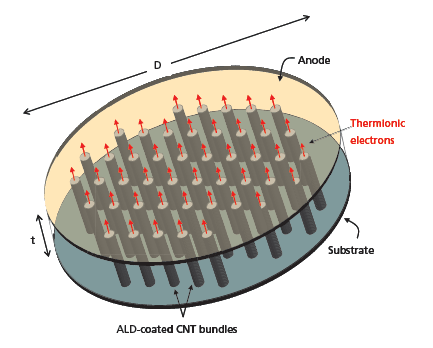
In this proposed approach, the higher emission efficiency of low-work function metal is combined with the enormous surface area achievable using CNT bundles to produce mA to A range current at lower temperatures of 460 to 700 ºC range. This is achievable by conformally coating CNT (see figure)bundle arrays (or simply arrays of CNTs) with alkali metals such as potassium (φ = 2.3 eV) or cesium using an atomic layer deposition process. Projected emission area of such an alkali metal-coated CNT bundle array (2-μm diameter, spaced 2 μm apart) over a 4-in. (≈10-cm) diameter wafer is ≈3.0 × 104 cm2. This leads to an estimated current production of ≈500 μA (> 200 Wh/kg) at 460 ºC to ≈1.3 A at 700 ºC, which is comparable to standard hightemperature batteries (for example, for Na-NiCl2, high-temperature batteries produce ≈90–130 Wh/kg), and sufficient to power communication, computational and control electronics, as well as sensors and miniature motors. Large areas of TPC or multiple TPC plates can be employed to produce much higher electrical energy to power heavier systems.
This highly miniaturized, high-temperature, long-life power source can be supplementary to primary high-temperature battery. The concept applies familiar thermionic emission principle for power generation by harnessing the local heat in the application environments. The approach of power production and design flexibility naturally provides an attractive option to harness in situ heat to produce power enough to operate electronics and miniature instrumentation. TPC can be designed to support geo thermal explorations by harnessing heat energy of the local environment.
This work was done by Harish Manohara, Mohammad Mojarradi, and Harold F. Greer of Caltech for NASA’s Jet Propulsion Laboratory. NPO-46967
This Brief includes a Technical Support Package (TSP).
Thermionic Power Cell to Harness Heat Energies for Geothermal Applications
(reference NPO-46967) is currently available for download from the TSP library.
Don't have an account?
Overview
The document discusses the development of a Thermionic Power Cell (TPC) designed to convert geothermal and other heat energies into electrical power, specifically for in situ instruments and electronics. Conducted at NASA's Jet Propulsion Laboratory (JPL) under a contract with the National Aeronautics and Space Administration, the research focuses on utilizing natural heat sources, with operational temperatures ranging from 460°C to 700°C.
The TPC employs carbon nanotube (CNT) bundles coated with low-work function metals, such as Potassium and Caesium, to enhance thermionic emission. When heated, these metals allow electrons to "boil off" and be collected by an anode, generating current in an external circuit. The document highlights that the efficiency of thermionic emission increases with higher temperatures and lower work functions, making the combination of CNTs and alkali metals particularly effective.
The projected emission area of the TPC is significant, with estimates suggesting a current production of approximately 500 μA at 460°C and up to 1.3 A at 700°C. This performance surpasses that of standard high-temperature batteries, which typically produce 90-130 Wh/kg. The TPC's design allows for scalability, enabling the use of multiple units or larger areas to generate higher electrical energy outputs suitable for powering communication systems, computational devices, sensors, and miniature motors.
The innovation of the TPC lies in its miniaturized, high-temperature, long-life power source, which presents a viable alternative to traditional high-temperature batteries. The document emphasizes the unique combination of techniques used in the TPC's design, particularly the conformal coating of CNT bundles with alkali metals through atomic layer deposition (ALD), which enhances emission efficiency.
The TPC offers flexibility in design, allowing for configurations such as stackable or foldable discs, akin to solar panels, or tubular cells for applications in space-restricted environments like geothermal well-logging. The document concludes by stating that the timing for this technology's development is ideal, with expectations for achieving maturity within the next five years, potentially expanding JPL's strategic technology portfolio and opening new business opportunities in geothermal energy harnessing.











