A proposed system would exploit the ocean thermal gradient for recharging the batteries in a battery-powered unmanned underwater vehicle [UUV (essentially, a small exploratory submarine robot)] of a type that has been deployed in large numbers in research pertaining to global warming. A UUV of this type travels between the ocean surface and depths, measuring temperature and salinity. The proposed system is related to, but not the same as, previously reported ocean thermal energy conversion (OTEC) systems that exploit the ocean thermal gradient but consist of stationary apparatuses that span large depth ranges.
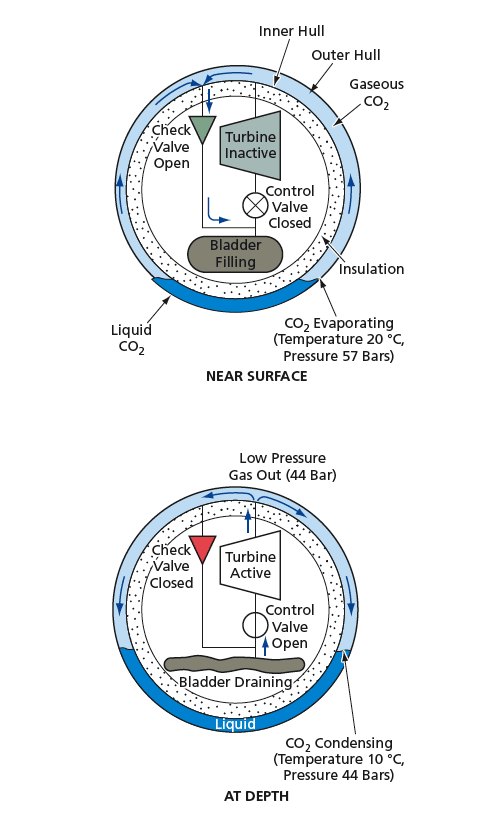
The thermodynamic cycle would begin when the UUV was at maximum depth, where some of the CO2 would condense and be stored, at relatively low temperature and pressure, in the annular volume between the inner and outer hulls. The cycle would resume once the UUV had ascended to near the surface, where the ocean temperature is typically ≥20 °C. At this temperature, the CO2 previously stored at depth in the annular volume between the inner and outer hulls would be pressurized to ≈57 bar (5.7 MPa). The pressurized gaseous CO2 would flow through a check valve into a bladder inside the pressurized compartment, thereby storing energy of the relatively warm, pressurized CO2 for subsequent use after the next descent to maximum depth.
Upon descent, the outer hull would become cooled — possibly to a minimum temperature as low as about 4 °C at a depth of about 300 m. The cooling would reduce the pressure of the CO2 remaining in the annular volume to about 44 bars (4.4 MPa) or less. Then a control valve would be opened, allowing CO2 from the pressurized bladder to expand through a turbine, thus producing electricity for recharging the battery. After flowing through the turbine and the control valve, the CO2 would enter the annular volume, where it would be condensed at low temperature and pressure, completing the thermodynamic cycle.
This work was done by Jack Jones and Yi Chao of Caltech for NASA’s Jet Propulsion Laboratory.
NPO-43304
This Brief includes a Technical Support Package (TSP).
Utilizing Ocean Thermal Energy in a Submarine Robot
(reference NPO-43304) is currently available for download from the TSP library.
Don't have an account?
Overview
The document titled "Utilizing Ocean Thermal Energy in a Submarine Robot" (NPO-43304) from NASA's Jet Propulsion Laboratory discusses an innovative approach to power generation for unmanned underwater vehicles (UUVs) by leveraging the temperature differences in ocean water. The primary challenge addressed is the need for a sustainable energy source that allows UUVs to operate for extended periods underwater, as traditional battery systems limit their operational time to hours or weeks.
The concept revolves around Ocean Thermal Energy Conversion (OTEC), which utilizes the temperature gradient between warm surface water (above 20 °C) and cold deep water (around 4 °C at depths below 300 meters) to generate electricity. The proposed solution involves using a refrigerant, specifically carbon dioxide (CO2), which is heated by the warm upper sea water to create high-pressure gas. This gas is then stored in a pressurized bladder within the UUV.
As the UUV descends into colder waters, the pressure of the CO2 decreases, allowing it to expand and pass through a turbine, generating electricity to recharge the vehicle's batteries. The CO2 gas is subsequently condensed in the outer annular region of the UUV, completing the cycle as the vehicle returns to the surface. This method not only provides a renewable energy source but also enables the UUV to remain submerged for months or even years, significantly enhancing its operational capabilities.
The document emphasizes the novelty of this approach, as current UUVs rely solely on batteries for propulsion and energy, limiting their underwater endurance. By implementing the CO2 turbine energy cycle, the UUV can continuously generate electricity, thus reducing the need for frequent surfacing and maintenance.
In summary, the document outlines a promising technological advancement in underwater vehicle design, focusing on the integration of ocean thermal energy for sustainable power generation. This innovation has the potential to revolutionize underwater exploration and research, allowing for longer missions and more efficient use of resources in marine environments. The research is part of NASA's broader efforts to develop technologies with significant scientific and commercial applications.