

Two reports discuss methods for evaluating the magnitude of electrostatic charging that occurs in spacecraft dielectric materials (in particular, polyimides) during prolonged exposure to radiation in outer space. The reports describe experiments on the electrical resistivities and charge-storage properties of polyimide specimens in a dark, evacuated environment, both before and after 5-megarad exposures to Υ rays from cobalt-60. The experiments were designed to measure these properties not under standard conditions prescribed for testing dielectrics in air but, rather, under conditions approximating those in the intended spacecraft applications. The results of the experiments showed that the electrical resistivities of the insulations as determined under these conditions are greater, by a factor of roughly a thousand, than those determined under the standard conditions and that the g irradiation reduced resistivities marginally.
This work was done by Arthur Frederickson and Charles Benson of NASA's Jet Propulsion Laboratory and James Bockman of Langley Research Center. To obtain copies of the reports, "Processes for Treating Spacecraft Insulators in Order To Prevent Excessive Dielectric Charging" and "Measurement of Charge Storage and Leakage in Polyimides," access the Technical Support Package (TSP) free on-line at www.techbriefs.com/tsp under the Physical Sciences category. NPO-30482.
This Brief includes a Technical Support Package (TSP).
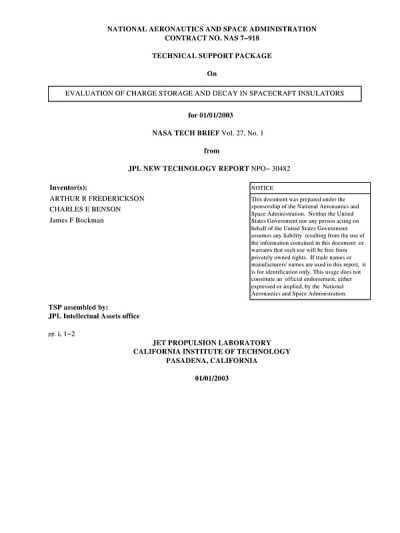
Evaluation of Charge Storage and Decay in Spacecraft Insulators
(reference NPO-30482) is currently available for download from the TSP library.
Don't have an account?
Overview
The document is a technical support package from NASA, specifically focusing on the evaluation of charge storage and decay in spacecraft insulators. It highlights research conducted by Arthur Frederickson, Charles Benson, and James Bockman, aimed at understanding the effects of radiation on dielectric materials, particularly polyimides, used in spacecraft.
The research addresses the issue of radiation-induced electrostatic charging in insulator materials, which can lead to problems such as sudden pulsed discharges or electrical breakdowns. Traditional solutions have involved engineering approaches like adding heavy shielding or applying semiconductive coatings to insulator surfaces. However, the authors propose a novel method to enhance the conductivity of insulation materials, allowing them to dissipate charge more effectively while still functioning as good insulators.
The study demonstrates that materials like Kapton polyimide can be made more conductive through irradiation with high-energy electrons and gamma rays. This process aims to reduce the resistivity of these materials from typical values of around 1E19 ohm-cm to a range of 1E12 to 1E14 ohm-cm. The authors also suggest that ultraviolet (UV) processing could similarly enhance conductivity.
In addition to the primary focus on charge storage and decay, the document discusses the development of a microspacecraft designed to function like a "black box" for larger spacecraft. This microspacecraft would continuously store critical data and, upon detecting serious conditions in the prime spacecraft, would separate and transmit the stored data back to Earth. This system offers functional enhancements over traditional black boxes, including independence from the prime vehicle and wireless data transmission.
The document emphasizes the importance of these innovations for future spacecraft design, particularly in mitigating the risks associated with electrostatic charging and ensuring reliable data retrieval during critical failures. The findings and proposed methods are intended to improve the safety and functionality of spacecraft operating in the harsh conditions of outer space.
For further details, the reports related to this research can be accessed online through NASA's Technical Support Package under the relevant categories.











