

There are two conventional types of hinges for in-space deployment applications. The first type is mechanically deploying hinges. A typical mechanically deploying hinge is usually composed of several tens of components. It is complicated, heavy, and bulky. More components imply higher deployment failure probability. Due to the existence of relatively moving components among a mechanically deploying hinge, it unavoidably has microdynamic problems. The second type of conventional hinge relies on strain energy for deployment. A tape-spring hinge is a typical strain energy hinge. A fundamental problem of a strain energy hinge is that its deployment dynamic is uncontrollable. Usually, its deployment is associated with a large impact, which is unacceptable for many space applications. Some damping technologies have been experimented with to reduce the impact, but they increased the risks of an unsuccessful deployment.
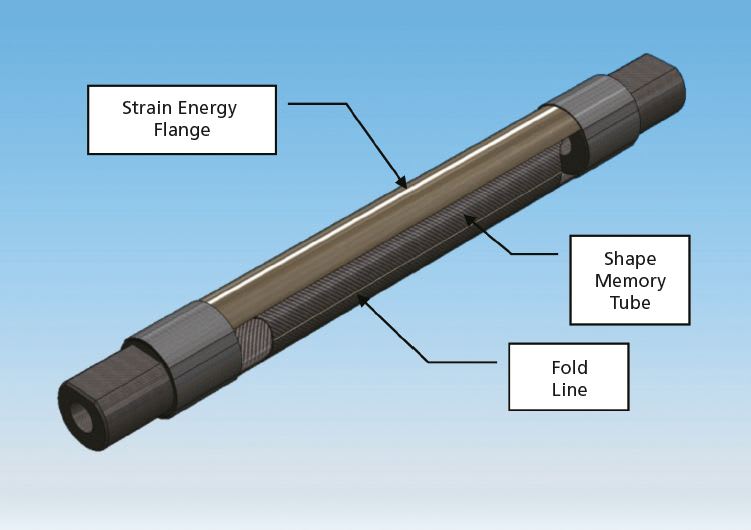
A hybrid hinge is composed of two strain energy flanges (also called tapesprings) and one SMC tube. Two folding lines are placed on the SMC tube to avoid excessive strain on the SMC during folding. Two adapters are used to connect the hybrid hinge to its adjacent structural components. While the SMC tube is heated to above its glass transition temperature, a hybrid hinge can be folded and stays at folded status after the temperature is reduced to below its glass transition temperature. After the deployable structure is launched in space, the SMC tube is reheated and the hinge is unfolded to deploy the structure. Based on test results, the hybrid hinge can achieve higher than 99.999% shape recovery.
The hybrid hinge inherits all of the good characteristics of a tape-spring hinge such as simplicity, light weight, high deployment reliability, and high deployment precision. Conversely, it eliminates the deployment impact that has significantly limited the applications of a tape-spring hinge. The deployment dynamics of a hybrid hinge are in a slow and controllable fashion. The SMC tube of a hybrid hinge is a multifunctional component. It serves as a deployment mechanism during the deployment process, and also serves as a structural component after the hinge is fully deployed, which makes a hybrid hinge much stronger and stiffer than a tapespring hinge. Unlike a mechanically deploying hinge that uses relatively moving components, a hybrid hinge depends on material deformation for its packing and deployment. It naturally eliminates the microdynamic phenomenon.
This work was performed by Houfei Fang and Eastwood Im of Caltech, and John Lin and Stephen Scarborough of ILC Dover LP for NASA’s Jet Propulsion Laboratory. NPO-48370
This Brief includes a Technical Support Package (TSP).
Shape Memory Composite Hybrid Hinge
(reference NPO-48370) is currently available for download from the TSP library.
Don't have an account?
Overview
The document discusses the innovative Shape Memory Composite (SMC) Hybrid Hinge, developed at NASA's Jet Propulsion Laboratory. This hinge technology is designed for space deployable structures, addressing the limitations of conventional hinge types. There are two main types of traditional hinges: mechanically deploying hinges, which are complex, heavy, and prone to failure due to their numerous moving parts, and strain energy hinges, like tape-spring hinges, which suffer from uncontrollable deployment dynamics and associated impacts.
The hybrid hinge combines the advantages of both hinge types while mitigating their drawbacks. It integrates SMC materials with strain energy components, resulting in a simpler, lighter, and more reliable deployment mechanism. The SMC tube serves dual functions: it acts as a deployment mechanism during the unfolding process and as a structural component once fully deployed, enhancing the hinge's strength and stiffness compared to traditional tape-spring hinges.
The document details the production of the SMC, which is made from high-performance fibers and a specially formulated shape memory polymer resin. This resin allows for consistent manufacturing processes and enables the hinge to be folded and packed when heated above its glass transition temperature. Once cooled, the hinge retains its folded state until reheated in space, at which point it returns to its original shape, ensuring reliable deployment.
Test results presented in the document demonstrate the hybrid hinge's exceptional repeatability, achieving over 99.999% shape repeatability in deployment tests. This high level of performance is crucial for space applications, where precision and reliability are paramount.
The document also includes schematics and images illustrating the hybrid hinge's design and deployment process. It emphasizes the advantages of this technology, such as reduced deployment impact, elimination of micro-dynamic issues, and the ability to undergo elastic deformations without permanent damage.
Overall, the Shape Memory Composite Hybrid Hinge represents a significant advancement in hinge technology for aerospace applications, promising improved performance and reliability for future space missions. The research was conducted under NASA's sponsorship, highlighting its potential for broader technological and commercial applications.











