Nearly isotropic matrix/fiber composite materials can be made quickly and at relatively low cost by resin-transfer molding. The fiber components of these materials are fine, loosely woven, three-dimensional preforms; the matrix components are epoxy or polycyanate resins. With proper tooling, these materials can be resin-transfer molded to net shape. Alternatively, they can be machined to net shape. The three-dimensional weaves enable the materials to withstand machining with minimal loss of mechanical properties. These materials are particularly suitable for lightweight, all-composite replacements for aluminum end fittings that have been used on tubular composite-material structural members.
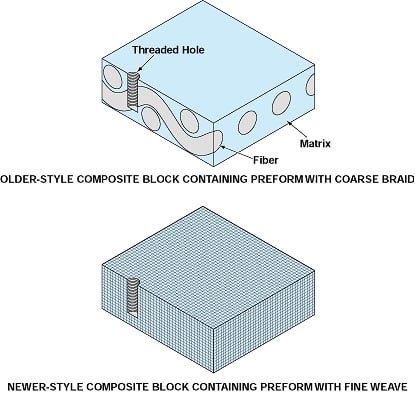
Heretofore, resin-transfer-molded composites have been made with relatively coarse three-dimensional braided or angle-interlock woven preforms (see figure). These composites are so coarse that they cannot be machined and cannot be fabricated with fine details. For example, screw threads in these materials are useless because the threads contain no reinforcement and thus have insufficient strength.
The fine three-dimensional weaves of the present composites were developed previously for carbon/carbon composites, but have not been used heretofore in resin-transfer-molded composites. The method used heretofore to make carbon/carbon composites requires long processing times and expensive capital equipment, and the materials produced by this method are too brittle at room temperature to satisfy the requirements that prompted the development of the present nearly isotropic resin-transfer-molded materials.
The three-dimensional loosely woven preforms used in the present materials cost less than do the coarser three-dimensional preforms made by conventional three-dimensional braiding or weaving. In comparison with the coarser three-dimensional woven preforms, the present finer preforms are weaker on a large scale but stronger on a small scale like that of screw threads, where the fine weaves provide reinforcement that the coarser weaves cannot.
This work was done by D. Kyle Brown of Caltech for NASA's Jet Propulsion Laboratory. For further information, access the Technical Support Package (TSP) free on-line at www.techbriefs.com under the Materials category, or circle no. 103on the TSP Order Card in this issue to receive a copy by mail ($5 charge). NPO-19918
This Brief includes a Technical Support Package (TSP).
Nearly Isotropic Resin-Transfer-Molded Composites
(reference NPO19918) is currently available for download from the TSP library.
Don't have an account?
Overview
The document discusses advancements in nearly isotropic resin-transfer-molded composites, developed by David K. Brown at NASA's Jet Propulsion Laboratory. These composites utilize fine, loosely woven three-dimensional preforms, which are a significant improvement over traditional coarse three-dimensional braided or angle-interlock woven preforms. The older composites lacked the ability to be machined with fine details, such as screw threads, due to insufficient reinforcement in those areas. In contrast, the new fine weaves provide the necessary strength and reinforcement, enabling the machining of intricate features.
The manufacturing process involves resin transfer molding, which allows for quick fabrication with minimal tooling and can produce components to net shape. This method is more efficient than the previous techniques used for carbon/carbon composites, which required long processing times and expensive equipment, resulting in materials that were too brittle for many applications. The new composites, made with epoxy or polycyanate resins, are not only less expensive to produce but also maintain mechanical properties during machining, making them suitable for lightweight applications.
The document highlights the potential applications of these composites, particularly as replacements for aluminum end fittings in composite tubing structures. This shift to composite materials can lead to significant weight savings, which is crucial in aerospace and other high-performance industries. The fine weave architecture, referred to as "Novoltex," was previously used only in carbon/carbon applications, such as brakes and rocket nozzles, but is now being adapted for polymer matrices.
Overall, the development of these nearly isotropic resin-transfer-molded composites represents a significant step forward in composite technology, enabling the use of composites in areas where they were previously impractical. The ability to machine fine details while retaining strength opens up new possibilities for design and application in various fields, particularly in aerospace, where weight reduction and structural integrity are paramount. The document serves as a technical disclosure of this innovative technology, emphasizing its novelty and potential impact on future composite material applications.