

Inside this issue
Supplements
Overview
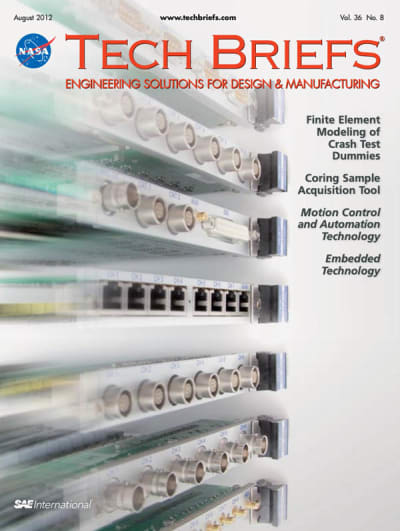
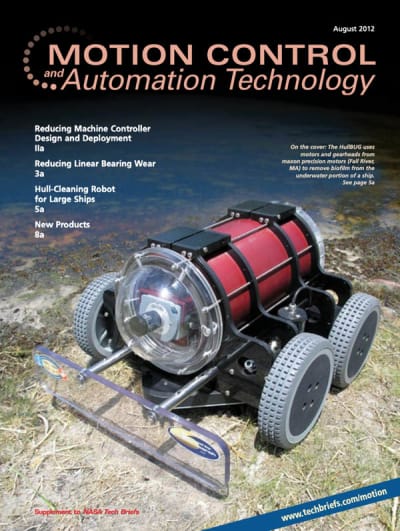
The August 2012 issue of NASA Tech Briefs, Embedded Technology, and Motion Control and Automation Technology presents a comprehensive overview of advancements and trends in various technological fields, particularly focusing on telecommunications, data centers, and automation technologies.
Key Highlights:
-
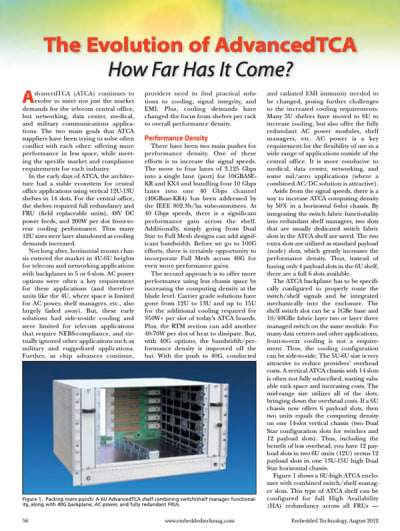
AdvancedTCA (ATCA) Evolution: The issue delves into the evolution of AdvancedTCA (ATCA), which is designed to meet the growing demands of various sectors, including telecommunications, data centers, medical, and military communications. The primary challenge for ATCA suppliers has been to balance the need for increased performance with the constraints of space and compliance requirements across different industries.
-
Historical Context: Initially, ATCA architecture was tailored for central office applications, utilizing vertical 12U-13U shelves with 14 slots. These setups required full redundancy, field-replaceable units (FRUs), and specific power and cooling capabilities. However, as cooling demands escalated, many of these early configurations were phased out.
-
Shift to Horizontal Mount Chassis: The introduction of horizontal mount chassis in 4U-6U heights marked a significant shift, particularly for telecom and networking applications. These systems often required AC power options and were designed to accommodate the increasing cooling demands while ensuring compliance with NEBS (Network Equipment Building System) standards.
-
-
Performance Density: The magazine discusses the ongoing push for performance density in ATCA systems. This involves enhancing signal speeds and overall system performance while addressing challenges related to cooling, signal integrity, and electromagnetic interference (EMI). The focus has shifted from merely fitting more shelves into a rack to optimizing the overall performance density of the systems.
Technological Innovations: The issue highlights various technological innovations that are shaping the future of embedded systems and automation. These include advancements in motion control technologies, which are crucial for improving the efficiency and reliability of automated systems across different applications.
-
Coring Sample Acquisition Tool: Another significant feature in this issue is the introduction of a coring sample acquisition tool. This tool is designed to enhance the efficiency of acquiring samples in various environments, which is essential for research and development in fields such as geology and environmental science.
-
Finite Element Modeling of Crash Test Dummies: The magazine also covers the application of finite element modeling in the design and testing of crash test dummies. This technology plays a critical role in improving vehicle safety by allowing engineers to simulate and analyze the impact of crashes on human bodies, leading to better safety designs in automotive engineering.
-
Motion Control and Automation Technology: The issue emphasizes the importance of motion control and automation technologies in modern manufacturing and industrial processes. It discusses how these technologies are being integrated into various systems to enhance productivity, reduce costs, and improve safety.
-
Industry Applications: The articles in this issue provide insights into how these technologies are being applied across different industries, including telecommunications, automotive, aerospace, and medical fields. The integration of advanced technologies is driving innovation and efficiency, enabling companies to meet the demands of a rapidly changing market.
-
Future Trends: The magazine concludes with a look at future trends in technology, emphasizing the need for continuous innovation and adaptation to meet the evolving needs of various sectors. The importance of collaboration between industry leaders, researchers, and regulatory bodies is highlighted as essential for driving advancements and ensuring compliance with safety and performance standards.
Conclusion:
The August 2012 issue of NASA Tech Briefs, Embedded Technology, and Motion Control and Automation Technology serves as a valuable resource for professionals and enthusiasts in the fields of technology and engineering. It provides a detailed overview of current trends, challenges, and innovations that are shaping the future of various industries. By focusing on the evolution of ATCA, advancements in motion control, and the application of finite element modeling, this issue underscores the critical role of technology in enhancing safety, performance, and efficiency across multiple sectors.
Features
-
Application Briefs
MEMS Deformable Mirrors Enable Imaging of Earth-Sized Extra-Solar Planets
Tech Briefs
-
Bio-Medical
Experimental Modeling of Sterilization Effects for Atmospheric Entry Heating on Microorganisms
-
Physical Sciences
Hemispherical Field-of-View Above-Water Surface Imager for Submarines
Quantum-Well Infrared Photodetector (QWIP) Focal Plane Assembly
-
Manufacturing & Prototyping
Joining and Assembly of Bulk Metallic Glass Composites Through Capacitive Discharge
-
Software
POSTMAN: Point of Sail Tacking for Maritime Autonomous Navigation
Aerosol and Surface Parameter Retrievals for a Multi-Angle, Multiband Spectrometer
-
Materials
Imidazolium-Based Polymeric Materials as Alkaline Anion-Exchange Fuel Cell Membranes
Blocking Filters With Enhanced Throughput for X-Ray Microcalorimetry
High-Thermal-Conductivity Fabrics
Electrospun Nanofiber Coating of Fiber Materials: A Composite Toughening Approach
-
Information Sciences
Social Networking Adapted for Distributed Scientific Collaboration
3D Drop Size Distribution Extrapolation Algorithm Using a Single Disdrometer
Iterative Transform Phase Diversity: An Image-Based Object and Wavefront Recovery
Space Operations Learning Center
Large Eddy Simulation (LES) of Particle-Laden Temporal Mixing Layers
OVERSMART Reporting Tool for Flow Computations Over Large Grid Systems
-
Mechanics & Machinery
Shape Memory Composite Hybrid Hinge
Ultra-Compact Motor Controller
Binding Causes of Printed Wiring Assemblies With Card-Loks
A Reversible Thermally Driven Pump for Use in a Sub-Kelvin Magnetic Refrigerator
-
Electronics & Computers
670-GHz Schottky Diode-Based Subharmonic Mixer With CPW Circuits and 70-GHz IF
Hardware for Accelerating N-Modular Redundant Systems for High-Reliability Computing
Discontinuous Mode Power Supply
Optimal Dynamic Sub-Threshold Technique for Extreme Low Power Consumption for VLSI
Self-Nulling Lock-in Detection Electronics for Capacitance Probe Electrometer











