A complete, tested, and tunable shock and vibration suppression device is composed of statically compressed chains of spherical particles. The device superimposes a combination of dissipative damping and dispersive effects. The dissipative damping resulting from the elastic wave attenuation properties of the bulk material selected for the granular media is independent of particle geometry and periodicity, and can be accordingly designed based on the dissipative (or viscoelastic) properties of the material. For instance, a viscoelastic polymer might be selected where broadband damping is desired. In contrast, the dispersive effects result from the periodic arrangement and geometry of particles composing a linear granular chain. A uniform (monatomic) chain of statically compressed spherical particles will have a low-pass filter effect, with a cutoff frequency tunable as a function of particle mass, elastic modulus, Poisson’s ratio, radius, and static compression. Elastic waves with frequency content above this cutoff frequency will exhibit an exponential decay in amplitude as a function of propagation distance.
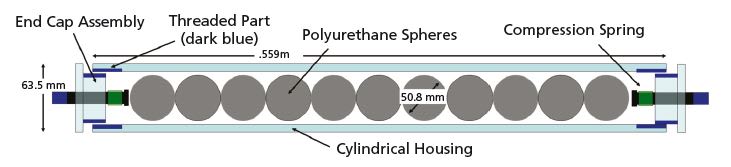
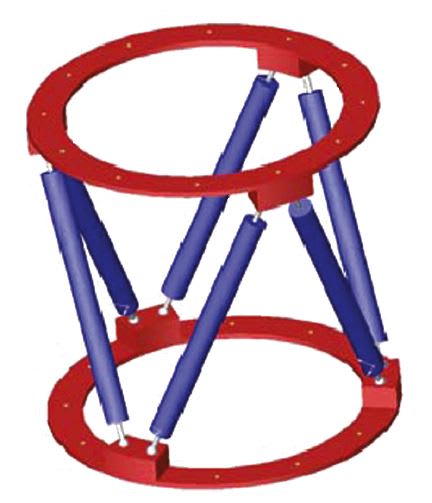
The device is a linear array of spherical particles compressed in a container with a mechanism for attachment to the shock and/or vibration source, and a mechanism for attachment to the article requiring isolation (Figure 1). This configuration is referred to as a single-axis vibration suppressor. This invention also includes further designs for the integration of the single-axis vibration suppressor into a six-degree-of-freedom hexapod “Stewart” mounting configuration (Figure 2). By integrating each single-axis vibration suppressor into a hexapod formation, a payload will be protected in all six degrees of freedom from shock and/or vibration. Additionally, to further enable the application of this device to multiple operational scenarios, particularly in the case of high loads, the vibration suppressor devices can be used in parallel in any array configuration. The parallel application of these devices divides the amplitude of the incident vibrations while preserving the frequency content and thus preserving the designed operation of the invention.
This invention includes the design of a novel, self-contained method for adjustably applying (and simply adjusting or tuning) static compression to the chain of spheres while still transmitting vibration through the dissipative and dispersive media. The dispersive filtering effect for this system only exists as predicted in the presence of static compression, which must be applied in application.
Performance of the invention was demonstrated using a prototype single-axis vibration suppressor constructed and tested under both high-amplitude simulated pyroshock and lowamplitude continuous broadband noise perturbations. The results show high attenuation with frequency response characteristics in accordance with the theoretical and numerical predictions. Two orders of magnitude reduction were observed in the shock response spectra at frequencies over 1 kHz, and over two orders of magnitude reduction in the peak accelerations for high-amplitude transient shocklike impacts. Approximately one order of magnitude reduction in the shock response spectra at frequencies below 1 kHz, which was attributed to the dissipative effects of the bulk polyurethane material, was observed.
This work was done by Robert P. Dillon, Gregory L. Davis, Andrew A. Shapiro, John Paul C. Borgonia, Daniel L. Kahn, Nicholas Boechler, and Chiara Daraio of Caltech for NASA’s Jet Propulsion Laboratory.
In accordance with Public Law 96-517, the contractor has elected to retain title to this invention. Inquiries concerning rights for its commercial use should be addressed to:
Innovative Technology Assets Management NPO-47655
JPL
Mail Stop 321-123
4800 Oak Grove Drive
Pasadena, CA 91109-8099
E-mail:
This Brief includes a Technical Support Package (TSP).
Granular Media-Based Tunable Passive Vibration Suppressor
(reference NPO-47655) is currently available for download from the TSP library.
Don't have an account?
Overview
The document is a Technical Support Package for the Granular Media-Based Tunable Passive Vibration Suppressor, referenced as NPO-47655 by NASA. It aims to disseminate the results of aerospace-related developments that have broader technological, scientific, or commercial applications. The focus of this research is on creating a tunable vibration damper that utilizes granular media to effectively suppress vibrations, particularly in aerospace contexts.
The overall goal of the project is to develop a system that can handle significant shock loads while minimizing mass and volume. Key requirements for the design include a 1 kHz cutoff frequency, the ability to withstand at least a 10 g shock with a 10 kg payload, and a reduction of forces by at least a factor of ten. The design process involves selecting appropriate materials, geometries, and configurations to meet these requirements, as well as estimating realistic values for nonlinear stiffness and attenuation through experimental methods.
The document outlines the importance of dispersion and nonlinearity in the design of the vibration suppressor. By channeling vibrations through dispersive media and statically compressing spheres, the system aims to effectively manage and dissipate vibrational energy. The design process is iterative, involving testing and refinement to ensure that the system performs as intended under various conditions.
Additionally, the document includes references to testing methodologies, including the JPL Tunable Beam Shock Test and Caltech's low amplitude noise testing, which are critical for validating the performance of the vibration suppressor. The research is positioned within the broader context of NASA's Innovative Partnerships Program, emphasizing the potential for commercial applications of the technology developed.
For further inquiries or assistance, the document provides contact information for the Innovative Technology Assets Management at JPL, highlighting NASA's commitment to sharing knowledge and fostering innovation in aerospace technology.
In summary, this Technical Support Package presents a comprehensive overview of the development of a granular media-based vibration suppressor, detailing its design requirements, theoretical foundations, and testing processes, while also emphasizing its potential applications in various fields beyond aerospace.