

Very few industries are as affected by strict test standards as the automotive sector. Nearly every automobile component (engine parts, accelerators, clutches, brakes, tires, seatbelts, etc.) must exhibit adequate tribological properties in accordance with ASTM, DIN, JIS, ISO, and other comprehensive international standards. Universal mechanical testers (UMTs) that are able to perform multiple tests in a single platform with interchangeable modules can help manufacturers meet test specifications quickly and economically. For example, crankshafts and camshafts have critical requirements for proper functioning under diverse service conditions. Tests include evaluation of base materials, heat-treated parts, surface coatings, and lubricants. Tests can be run with diverse loads, velocities, and temperatures that simulate actual service conditions using various lubricants and liquids.
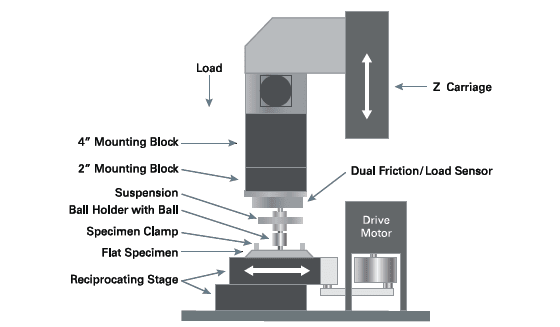
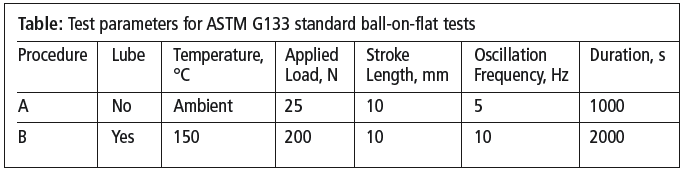
Other tests, such as those for door handles and lock mechanisms, include evaluation of different base materials, heat treatment conditions, surface coatings, and lubricants. One of the most common tests for wear on these kinds of parts is the ballon-flat sliding wear test as defined in ASTM G133. This test is also applicable to addressing tribological concerns for engine valve stems and rollers, including measurement of hardness and modulus of valve material, and wear tests on the valve and cylinder head interface. A UMT can measure Vickers hardness and can be reconfigured to a linear test setup from rotary in minutes. The ASTM G133 test method utilizes a flat lower specimen and a ball-shaped upper counterpart that slides against the flat specimen (Figure 1). These parts move relative to one another in a linear, back-and-forth sliding motion, under a prescribed set of test conditions. In this test method, the load is applied vertically downward through the ball against the horizontally mounted flat specimen. The load, stroke length, frequency of oscillation, temperature, condition of lubrication, and test duration are selected from one of the two procedures (see Table).
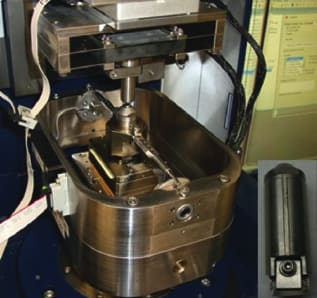
 Another critical automotive test is for friction and wear at the piston ring and cylinder interface. It has been estimated that half or more of the friction losses in internal combustion engines occur at that interface, making friction tests of those areas critical. The ASTM G181 test method uses a reciprocating sliding arrangement to simulate the type of oscillating contact that occurs between a piston ring and its mating cylinder bore surface near the top-dead-center position in the cylinder where the most severe surface contact conditions occur (Figure 2).
In addition to contact testing of the piston ring and cylinder, UMTs can be used to examine their material finishing processes, the effect of normal force, and the use of different lubricants on friction and wear. The flexibility of the UMT test platform to control multiple variables, including normal load, reciprocating speed, and stroke length, as well as to introduce environmental factors such as hot, cold, and humid conditions, enables a user to perform the widest range of possible experimentation.
This work was done by Steve Shaffer, Suresh Kuiry, and James Earle of Bruker Nano Surfaces. For more information, Click Here .











