

Most NASA missions require the use of a launch lock for securing moving components during the launch or securing the payload before release. A launch lock is used to prevent unwanted motion and secure the controlled components. The current launch locks are based on pyrotechnic, electromechanical or NiTi-driven pin pullers that are one-time activation mechanisms. Generally, the use of piezoelectric activation provides high-precision nanometer accuracy, but they rely on friction to generate displacement. During launch, the generated vibrations can release the normal force between the actuator components, allowing the shaft’s free motion, which could result in damage to the actuated structures or instruments. This problem is common to other linear actuators that consist of a ball screw mechanism. There are many mechanisms that require the capability of being activated multiple times, and the disclosed concept addresses this need.
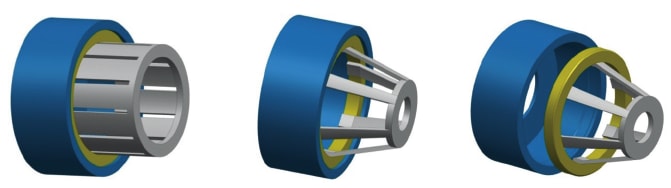
The lock consists of an SMA ring and a cylindrical target element. The target element can be mounted on one structure and the SMA element to the other structure through an adapter that allows a diameter change of the SMA ring. The target element has a large stiffness, while the adapter has a large axial stiffness but a low radial stiffness. The use of pretrained NiTi SMA material as an actuator allows generating 5% or more deformation by heating, using phase transition from martensite phase to austenite phase. Phase transition can be positive or negative. The phase transition temperature can be controlled by the composition of the selected alloy. The NiTi alloy has a martensite-to-austenite transition that starts at a temperature higher than 650 °C. A launch lock mechanism using SMA material is not expected to change the locking status by self-activation below this temperature.
This work was done by Mircea Badescu, Xiaoqi Bao, and Yoseph Bar-Cohen of Caltech for NASA’s Jet Propulsion Laboratory. NPO-49294
This Brief includes a Technical Support Package (TSP).
Shape-Memory-Alloy-Based Launch Lock
(reference NPO-49294) is currently available for download from the TSP library.
Don't have an account?
Overview
The document presents a novel launch lock mechanism developed by NASA's Jet Propulsion Laboratory (JPL) that utilizes shape memory alloy (SMA) technology, specifically NiTi (Nickel-Titanium) SMA rings, to enable controlled and repeatable activation for aerospace applications. Traditional launch locks typically rely on pyro activation devices, which can only be activated once, limiting their utility in mechanisms that require multiple activations. The new SMA-based launch lock addresses this limitation by allowing for reusability and reducing the risk of additional shocks or vibrations during operation.
The launch lock consists of an SMA ring and a cylindrical target element, which can be mounted on different structures. The SMA ring is designed to undergo a phase transition from the Martensite phase to the Austenite phase when heated, resulting in a diameter change that allows it to lock and unlock from the target element. This mechanism is activated by heating the SMA ring above a specific temperature (greater than 65°C), which causes it to shrink and release from the locked position. The design is versatile, allowing for various configurations, including two-way shape memory effects, where the SMA can remember two distinct shapes, enabling it to re-lock after being unlocked.
The document emphasizes the novelty of this technology, highlighting its potential to revolutionize launch locks by replacing one-time activation systems with a mechanism that can be activated multiple times. This advancement is particularly beneficial for space applications, where reliability and repeatability are crucial. The SMA launch lock can also be activated naturally by ambient temperature changes in space, further enhancing its functionality.
Overall, the SMA-based launch lock represents a significant advancement in aerospace technology, providing a reliable, low-mass, and low-power solution for mechanisms requiring multiple activations. The research was conducted under NASA's sponsorship, and the findings are intended to have broader technological, scientific, and commercial applications beyond aerospace. The document serves as a technical support package, summarizing the innovative aspects of the launch lock and its potential impact on future aerospace missions.











