

An advanced communication system has been proposed for transmitting and receiving coded digital data conveyed as a form of quadrature amplitude modulation (QAM) on orthogonal frequency-division multiplexing (OFDM) signals in the presence of such adverse propagation channel effects as large dynamic Doppler shifts and frequency-selective multipath fading. Such adverse channel effects are typical of data communications between mobile units or between mobile and stationary units (e.g., telemetric transmissions from aircraft to ground stations). The proposed system incorporates novel signal processing techniques intended to reduce the losses associated with adverse channel effects while maintaining compatibility with the high-speed physical layer specifications defined for wireless localarea networks (LANs) as the standard 802.11a of the Institute of Electrical and Electronics Engineers (IEEE 802.11a).
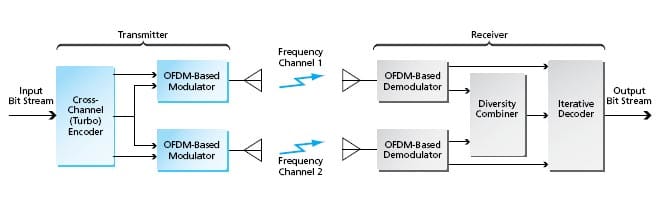
OFDM is a multi-carrier modulation technique that is widely used for wireless transmission of data in LANs and in metropolitan area networks (MANs). OFDM has been adopted in IEEE 802.11a and some other industry standards because it affords robust performance under frequency- selective fading. However, its intrinsic frequency-diversity feature is highly sensitive to synchronization errors; this sensitivity poses a challenge to preserve coherence between the component subcarriers of an OFDM system in order to avoid intercarrier interference in the presence of large dynamic Doppler shifts as well as frequency-selective fading. As a result, heretofore, the use of OFDM has been limited primarily to applications involving small or zero Doppler shifts. The proposed system includes a digital coherent OFDM communication system that would utilize enhanced 802.1la-compatible signal-processing algorithms to overcome effects of frequency-selective fading and large dynamic Doppler shifts. The overall transceiver design would implement a two-frequency-channel architecture (see figure) that would afford frequency diversity for reducing the adverse effects of multipath fading. By using parallel concatenated convolutional codes (also known as Turbo codes) across the dualchannel and advanced OFDM signal processing within each channel, the proposed system is intended to achieve at least an order of magnitude improvement in received signal-to-noise ratio under adverse channel effects while preserving spectral efficiency.
One of the novel techniques adopted for the proposed system would be multipass processing of packet preamble for acquisition of frequencies and timing of carrier and data symbols. The multipass approach is intended to eliminate as much synchronization error as possible at an early stage of packet preamble processing in order to reduce the inter-carrier interference, which can contribute significantly to the bit-error rate under adverse channel conditions.
Another novel signal-processing technique would be joint pilot- and data-aided channel estimation, tracking, and equalization in each of the two frequency channels. This technique would not only increase the accuracy in the estimate of the channel effects, but also would support tracking of dynamic Doppler shifts, resulting in a much improved channel equalization under adverse channel conditions.
Another novel aspect of the design would be the use of (1) turbo cross-channel coding in the transmitter in conjunction with (2) diversity combining of signals in the receiver. The gain afforded by this combination of coding and frequency and time diversity would help to counteract severe fading, especially for the case when both channels are simultaneously affected by deep fades.
This work was done by Haiping Tsou, Scott Darden, Dennis Lee, and Tsun-Yee Yan of Caltech for NASA’s Jet Propulsion Laboratory. For further information, access the Technical Support Package (TSP) free online at www.techbriefs.com/tsp under the Electronics/Computers category.
The software used in this innovation is available for commercial licensing. Please contact Karina Edmonds of the California Institute of Technology at (818) 393-2827. Refer to NPO-40205.
This Brief includes a Technical Support Package (TSP).
System for Processing Coded OFDM Under Doppler and Fading
(reference NPO-40205) is currently available for download from the TSP library.
Don't have an account?
Overview
The document presents a technical overview of a novel signal processing design for coded Orthogonal Frequency Division Multiplexing (OFDM) systems, specifically tailored to operate effectively under high dynamic mobile conditions and frequency selective fading. This research, conducted by a team at NASA's Jet Propulsion Laboratory, aims to enhance the performance of wireless communication systems, particularly those adhering to the IEEE 802.11a standard.
The key innovations introduced in this paper include multi-pass carrier and symbol/sample timing acquisition, joint pilot- and data-aided channel estimation, tracking, and equalization, as well as adaptive turbo cross-channel coding and diversity combining. These advancements are crucial for maintaining reliable communication in environments characterized by significant Doppler shifts and multipath fading, which can severely degrade signal quality.
The results of the study demonstrate that the proposed Adaptive OFDM (AOFDM) receiver design significantly outperforms a generic 802.11a receiver. The AOFDM system can achieve a bit-error rate (BER) of 10^-5 with an energy per bit to noise power spectral density ratio (E_b/N_0) as low as 6 dB, except under the most adverse fading conditions. Even in scenarios where both channels experience severe fading, the turbo-coded AOFDM system can still reach a BER of 10^-5 at an E_b/N_0 of 27 dB.
The document also discusses the importance of multi-pass preamble processing, which mitigates inter-carrier interference (ICI) that can significantly impact BER performance. Simulations indicate that the AOFDM receiver can successfully acquire an 802.11a-compliant packet with a carrier frequency offset exceeding 400 KHz, nearly double the offset expected at speeds of Mach 40. This capability is critical for high-speed platforms, where maintaining signal integrity is challenging.
In summary, the research highlights the potential of advanced signal processing techniques to improve the robustness of OFDM systems in dynamic environments, making them suitable for various applications, including military communications and broadband wireless networks. The findings underscore the significance of these innovations in enhancing communication reliability and performance in the face of challenging operational conditions.











