Spectrum would be utilized more efficiently than in CDMA and FDMA.
Frequency-hopped and partitioned frequency-division multiplex (FH/PFDM) is a proposed modulation technique for transmission of digital signals. In FH/PFDM, a serial stream of data (possibly generated by multiple users) coming into a transmitter would be distributed into frequency-hopped, frequency-partitioned subchannels, in such a way as to reduce (in comparison with other modulation techniques) the overall carrier deviation and sidelobe excursion.
Figure 1 presents block diagrams of the bandwidth-compression and -decompression portions of an FH/PFDM transmitter and receiver, respectively. In the transmitter, the incoming data stream to be transmitted would first be converted from serial to parallel format and grouped into data blocks of n slots, each slot corresponding to one of n subcarrier frequencies generated by a digital frequency synthesizer. Next, a serial transfer switch would transfer the data bits into a buffer. Under sequential strobing by clock pulses, data bits would be strobed from the buffer into modulo-2 adders, the outputs of which would be modulated onto the subcarriers by phase-shift keying (PSK). The data bits would be interleaved in the sense that each successive data bit would be phase-modulated onto one of the subcarriers in a sequence of increasing subcarrier frequencies.
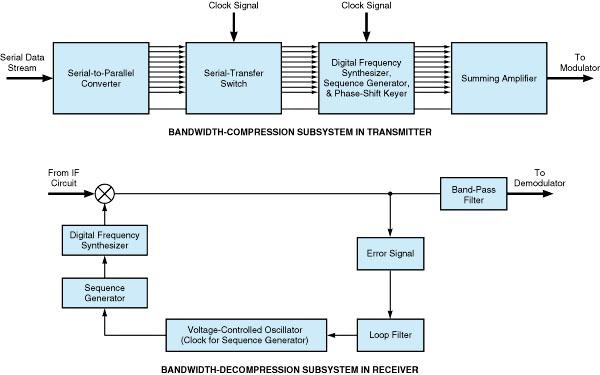
Figure 1. The FH/PFDM Portions of a Transmitter and Receiver would increase the efficiency of utilization of the radio spectrum for transmitting a data stream of a given rate.
Meanwhile, under synchronization by clock pulses from a sequence generator, the frequencies of the n subcarriers would periodically be made to hop; during each clock cycle of the sequence generator, each subcarrier would hop through a total of m different frequencies (see Figure 2). The purpose of the hopping is to achieve spectral isolation between subchannels and thereby reduce self-interference. Finally, the PSK subcarriers would be combined in a summing amplifier, which, in turn, would be used to modulate a carrier signal by frequency-shift keying (FSK).
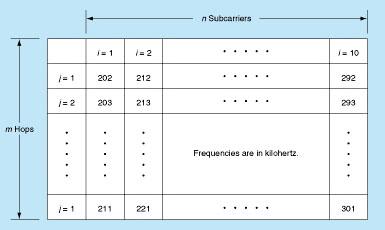
Figure 2. This Table Lists Subcarrier Frequencies for an example of an array of n = 10 subcarriers and m = 10 hops. Each cell (i,j) in the table gives the frequency of the ith subcarrier during the jth interval between frequency hops.
In the receiver, a digital frequency synthesizer driven by a sequence generator would produce the same array of n frequencies and sequence of m frequency hops as that of the transmitter. This array of hopped frequencies would serve as a local-oscillator signal for use in asynchronously demodulating the received modulated subcarriers. The local-oscillator signal would be multiplied by the incoming intermediate-frequency (IF) signal in a mixer. An error signal derived from the mixer output would be used to control the sequence-generator clock frequency. The mixer output would also be band-pass filtered to remove unwanted mixer products, then passed on to a demodulator.
Theoretical calculations have shown that FH/PFDM would make it possible to utilize the available spectrum more efficiently than is possible in the established techniques of code-division multiple access (CDMA) and frequency-division multiple access (FDMA). In other words, for a given equivalent communication-link power, and performance, FH/PFDM would accommodate a greater number of users or a greater overall data rate in a given bandwidth or, equivalently, require less bandwidth for a given overall data rate or number of users. The cost of this spectrum compression would be an increase in the complexity of transmitters and receivers. One potential additional advantage FH/PFDM is that by interleaving the data and ordering the frequency hops in pseudorandom sequences, one could help to prevent unauthorized interception of data. The most practical route to realization of the potential of FH/PFDM would likely be to develop application-specific integrated circuits to implement the FH/PFDM transmitting and receiving functions.
This work was done by Charles Ruggier of Caltech for NASA's Jet Propulsion Laboratory.
This Brief includes a Technical Support Package (TSP).
Partitioned frequency-division multiplex for bandwidth compression
(reference NPO20364) is currently available for download from the TSP library.
Don't have an account?
Overview
The document is a technical support package detailing advancements in Frequency-Division Multiplexing (FDM) with a focus on Frequency Hopping (FH) techniques, authored by Charles J. Ruggier at NASA's Jet Propulsion Laboratory. It presents a novel modulation technique known as Frequency-Hopped and Partitioned Frequency Division Multiplex (FH/PFDM), which aims to enhance the efficiency of spectrum usage in communication systems, particularly for satellite applications requiring high data rates.
The FH/PFDM technique integrates the principles of FDM with frequency hopping, allowing for more robust data transmission. This method addresses the inherent vulnerabilities of traditional FDM systems to radio interference by interleaving data and employing subcarrier frequency hopping. The document emphasizes that while this approach adds complexity to the system, it significantly improves resilience against interference and enhances adaptability for encrypted data transmissions. The use of pseudo-random codes for data interleaving and frequency hopping is highlighted as a means to prevent unauthorized interception.
The theoretical analysis presented suggests that the implementation of this bandwidth compression technique could lead to narrower transmission bandwidths, especially if transmitters and receivers are designed using a single CMOS Integrated Circuit or Application-Specific Integrated Circuit (ASIC). This could streamline the hardware requirements and reduce costs, making the technology more accessible for various applications.
The document also discusses the operational limitations and performance impacts of the proposed microdevices, indicating that further investigation is necessary to fully understand the implications of electronic switching and processing delays on link performance. The conclusions drawn suggest that while the FH/PFDM technique shows promise for improving communication systems, particularly in satellite technology, practical implementation will depend on balancing size, mass, cost, and performance requirements.
Overall, the document serves as a comprehensive exploration of innovative modulation techniques that could significantly advance the field of mobile satellite communication, providing a foundation for future research and development in this area.