Suits cooled by evaporation of water have been proposed as improved means of temporary protection against high temperatures near fires. When air temperature exceeds 600 °F (316 °C) or in the presence of radiative heating from nearby sources at temperatures of 1,200 °F (649 °C) or more, outer suits now used by firefighters afford protection for only a few seconds. The proposed suits would exploit the high latent heat of vaporization of water to satisfy a need to protect against higher air temperatures and against radiant heating for significantly longer times. These suits would be fabricated and operated in conjunction with breathing and cooling systems like those with which firefighting suits are now equipped.
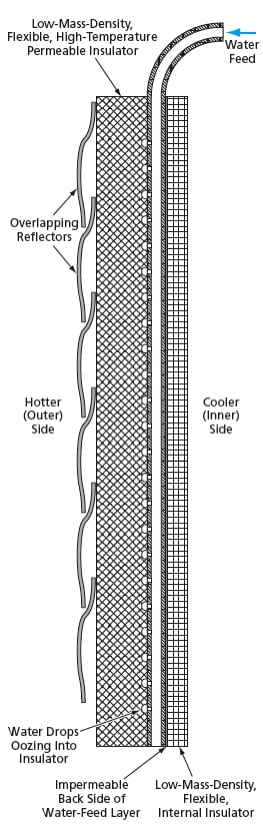
For even better protection against both conductive and radiative heating, a suit according to the present proposal could include both a highly reflective outer layer as well as an evaporative-cooling sublayer system. Whereas the outer layers of some protective suits now in use have reflectivities of about 0.90, the proposal calls for a reflectivity of about 0.97. In one version, shown in the figure, the outer layer would consist of overlapping shinglelike reflectors (see figure), possibly made of thin copper plates coated with gold. The shingles would be individually attached to the suit so that they could slide over each other and motion would not be restricted. The water would be injected into, and would evaporate from the inner surface of a thick, permeable insulating layer, which is shielded by the reflective shingles. The shingles would be allowed to get very hot, but the wet sub-layer would remain much cooler, and water would be used up at a lower rate than would be the case if no reflective shingles were used and water were allowed to evaporate directly from a hot outer surface.
This work was done by Leonard Murray Weinstein of Langley Research Center. For further information, contact the Langley Innovative Partnerships Office at (757) 864-8881. LAR-16245-1