

Tech Briefs: What got you started on this project?
Ashif Iquebal: My background is in manufacturing, and it's kind of evolved since I started my Ph.D. in 2014. I was a pure manufacturing engineer, doing polishing and machining and cutting, and then I stumbled upon additive manufacturing. Not the process itself — I was more interested in looking at the parts that were made with the process. For many of them, their surfaces were not good — they were very rough. They would usually have to go through post-processing to finish the surfaces and remove the defects so they could be used without fearing that they could fail.
Over time, I realized there's a lot of data we collect from additive manufactured samples. It includes data from sensors, microscopic images, atomic force microscopes, scanning electron microscope images — a ton of imaging data. So, that was what got me interested in data science and machine learning. My question was, how do I make additive manufacturing more predictable? That to me is the key question. If you look at any traditional manufacturing method, if you know what the process is, you know what the end product will look like. But in additive manufacturing, it is extremely hard because of the variability of the process. That was my original motivation for doing this research.
Tech Briefs: As you were talking about this, I was picturing how with traditional manufacturing processes, using lathes and milling machines, you could control surfaces down to one-thousandth of an inch. Could you get that with additive manufacturing?

Iquebal: That's why we are putting a lot of effort into post-processing. We're getting there, but not to a point where we can say, print it and it's done — we’re far from that. We have to go through machining, and if it's for complex surfaces like medical implants, we have to go through a manual finishing process of grinding and lapping, which takes a lot of time.
We say that we want to save time by doing 3D printing, but the post-processing takes so much time it has always been a barrier.
Tech Briefs: It's hard for me to imagine how you could do additive manufacturing with stainless steel. Could you tell me how that’s done?
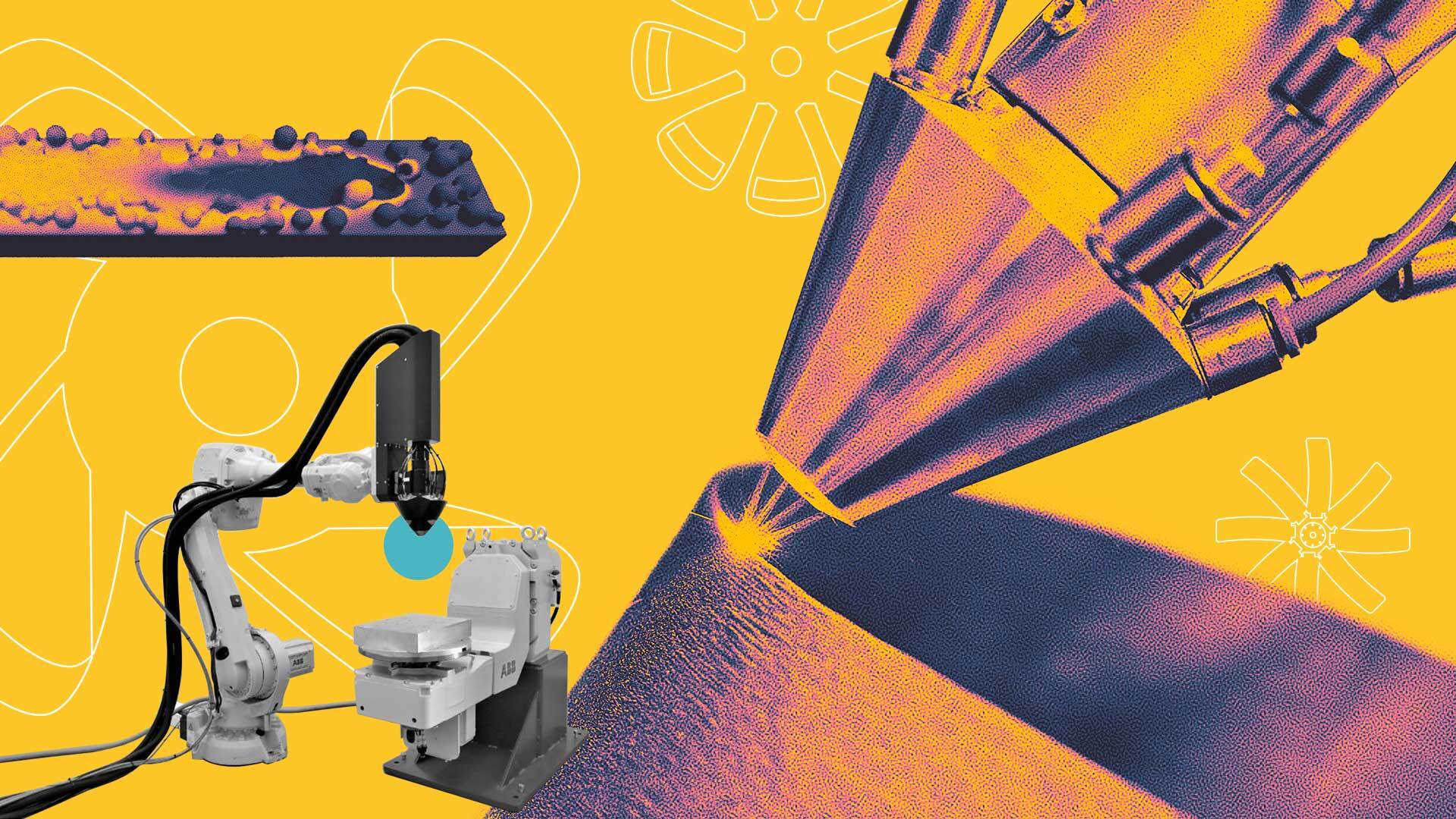
Iquebal: Everything starts off with the feedstock, which could be a wire, or a pellet, or a powder. It turns out that there are two lines of thought that have evolved in the last 20 years. The first is powder-based printing and the second is wire-based printing. In powder-based printing, you create microscopic, powdered particles of stainless steel through a process called gas atomization. This process gives you particles in the range of somewhere between 50 and 500 micrometers.
A nozzle, or a gun, fires these particles at a very high speed. The particles then encounter a localized laser — two lasers, four lasers, or just a single laser beam. Since the lasers are focused between the deposition surface and the nozzle, the powder particles meet the localized laser source at a point right before they are deposited. Laser power of 500 Watts instantly melts the powders. The temperature goes up to 2,000 F, or sometimes more, which melts the powder, deposits it and then moves to the next location. It's a continuous process. Things are so fast that it just keeps on moving, melting, depositing, cooling — everything happens almost in microseconds.
Tech Briefs: Can you tell me more about how the powder is created?
Iquebal: For example, if you blow water, it creates tiny particles. It's exactly the same with molten stainless steel — you blow it with high-pressure gas, it creates small spherical particles, and because of the surface tension effect, the particles are spherical. Once you have these spherical shapes you will have a wide range of particle sizes. The powder then goes through a sieving process where different sizes are separated out. Depending on your application, you can purchase different sizes of powder particles. This atomization process has been perfected for many years now. At present, more focus has been on the uniformity of the particles because that will eventually guide how the printing happens. There are manufacturers who specialize in producing powders of different types of metals like titanium and stainless steel.
Tech Briefs: You’ve described your process as physics-informed. What do you mean by that?
Iquebal: The laser melts the powder particles almost instantly, right before they are deposited. That’s where the magic happens. As it starts to cool down, there's a solidification process in which, depending on how you're cooling it, grains form. When stainless steel is in a molten state, you can think of its atoms as dispersed. As the metal cools and solidifies, the atoms become locked in a specific state.
That’s true for all solids. For example, when water cools down and freezes into ice, it locks into specific structures and orientations. Depending on how it locks into those states, you get clear ice or foggy ice or snow or dendritic structures. It's all about how the water flows into ice.
So, if I have molten stainless steel and I pour really cold liquid or water on it, it will solidify instantly. The atoms then get locked wherever they are — they don’t have time to move. Atoms that are close to each other are in a specific configuration. And as you move further away, they are in a different configuration — different clusters of atoms are formed.
As a material goes from liquid state to solid state, it tries to minimize the energy, a process that’s determined by how the atoms are configured. If all the atoms are in the same orientation, you get one giant block of grain, a homogeneous structure. But for that to happen, you have to cool it so slowly that every single atom gets an opportunity to move into this low energy structure. But if I cool it instantly, all the atoms will be in different orientations, and that will lead to multiple grains, each of which would be really tiny because they're not aligned in the same direction. If I cool it slowly, the atoms get an opportunity to align themselves, and as they align themselves, they form clusters that are slightly bigger — the slower the cool, the larger the clusters. These clusters eventually determine the properties of the material.
If I try to bend a metal object, the only reason it will bend is because it has what we call defects. They are crucial for us to be able to bend or fold something without melting it or making it really soft. But what happens when I try to bend the object, is that the defects start to move.
Imagine if there is just a single grain — every single atom is oriented in the same direction. In that case, the defects move very quickly to the boundaries. The boundaries are where the defects face an obstruction, which they cannot cross, so the defect stays inside the grain. If you have just one single grain, like in a homogeneous material, the defects can propagate very easily to the edges and the material will crack. But if you have lots and lots of boundaries because you have lots and lots of grains, these defects would not propagate, they would not have the opportunity to move. If they cannot move, the defects would be localized in a small region. So even if there are defects, the part might not fail or fracture.
So, the whole idea is I don't want it to cool too slowly because that will give the atoms too much of an opportunity to move around and come to a lower energy state and form larger grains. I want smaller grains, but I don't want too small a grain because it might become difficult for me to machine it. It would become super hard, something like a ceramic. You want to find a nice balance between making it either too hard or too malleable — finding the right balance is the key.
Think about doing 3D printing by depositing materials layer by layer on top of each other. When I deposit one layer, I can ask the printer to stop printing and let this layer cool down a little bit before I print the next layer. The question is: How long should I wait? But there's no good answer because every time I print something, I'm printing a different structure, a different part. So, each time the heat in the part will diffuse differently; for example, if it’s a solid block, the heat will diffuse differently than if I print something hollow.
Physics can tell us how the heat will diffuse in the part and also how the atoms will orient in different directions. I can then solve the physics to know exactly what the microstructures are going to look like. But every time I do these physics simulations, it takes hours and hours at least. Even if I had a 1,000-core supercomputer, it might still take me a year to finish the simulation.
Controlling the material property is the key here, and physics is a way of doing that. The whole idea of this project revolves around finding a way to run these simulations fast enough so I can have real-time information. For example, if I'm printing a teacup, I might need to wait a slightly different time for the handle because of the geometry. So, if I can have this inference in real time, I can control what the part is going to look like.
Tech Briefs: How do you get the simulations to run quickly?
Iquebal: Simulation is really a bunch of equations. What we're doing is solving these equations over a large amount of time and for every single point in the 3D space. So, we decided to try and train our AI models to see how simulations actually work — that's really what we're doing here. When we change the AI models, we do something called a loss minimization. A loss function is essentially the difference between what the reality is and what the AI model has learned so far. We use the physics to minimize that difference.
Every time AI makes a prediction, if it deviates from the physics predictions, it is penalized. So, if you train these models for a long period of time, they learn how the simulations work. We’re training the AI models on data, but the good part about this research is we are not looking for real data — all we're looking for is simulations, which we can run offline. The idea is, we run many simulations offline, we take the physics, we put that into the loss function, and then we train the AI model. Essentially, instead of training on real data, we are training it on physical laws.
Tech Briefs: Isn’t the physics different for different shapes even within the same object, for example, the handle of the coffee cup? As you're making the same thing, the shape is changing all the time.
Iquebal: There are two components to the design of the physics model: there's heat diffusion and then there's the phase field modelling. The diffusion equation tells us how heat will diffuse through the entire body. We simulate the diffusion equation using our CAD model. However, it's difficult for the AI model to generalize the diffusion across all kinds of shapes — I feel like that's a much larger problem. But I think over time, AI can start to figure out, for example, that “if these are narrow walls, heat will diffuse much more slowly than if it's a block.” So, it's all about finding the patterns. If we know the exact design, we can use the physics model to figure out how quickly or how slowly it will diffuse. It's a much harder problem, which we are for the time being not looking into, but we will definitely focus in on it. We will train these diffusion models depending on the design.
Once the diffusion model is trained, we come to the phase field model. The phase field model determines how the atoms will configure once the part starts to cool down and solidify. So, these two models have to run side by side — the heating and the solidification models.
There is one more complexity that our project is specifically handling, and that is what makes it even more interesting. If I print one layer in additive manufacturing and I let it cool down, then I print the next layer, even if I have controlled everything so far, as soon as I deposit the next layer, the entire part will heat up. And if it heats up, atoms will again have the opportunity to move and change things.
This is where it becomes really hard, because even if I do everything right up until now, the next layer will come and mess everything up. So, the idea we're proposing is to use another heat source to heat up the structure after printing. Remove the powder flow and just use the heat source to heat it up in such a way that I'm able to get the microstructure I want.
Or we can do it another way. I can heat the part up a little before I deposit the next layer, so I know that when it cools down, it leads to the microstructure that I'm interested in.
Tech Briefs: Can you bring this around to how it solves the problem of the rough surface of additive manufactured products.
Iquebal: Yes, absolutely. This is something that we have not previously talked about in this project, but it's part of what we're doing right now. As soon as I deposit a layer, I can either machine the top surface or heat it up so it just smooths itself.
If I don't control the surface roughness, there are defects. Cracks might start to originate on the surface. If you imagine two particles next to each other, there would be a hole, or a valley, between them. As you begin to polish the surface, the valley just gets filled up. So, the problem is, if we don't control the surface roughness, we are just filling up the holes. If I machine one layer out, these holes might reveal themselves again — we're not really getting rid of them completely — we are just patching them up.
This becomes a real problem, because I don't want a part where defects might appear after 10 years of use. This is why there is now a slow transition from powder-based systems to wire-based systems. With wire-based systems, you have a very thin wire, and the process is the same as with the powder. The wire and the laser meet right before the deposition and the laser melts the wire. Then we wouldn’t have the problems caused by powders. It leads to much better surfaces and fewer defects.
The research that we are doing now is based on the process called wire directed-energy deposition (Wire DD). It will lead to fewer defects and less wastage because powders are not flying everywhere.
Tech Briefs: So, the next step in your project is the wire?
Iquebal: Wire is a natural progression in this space. If you look at the current industry adoption, I see both. I see powder-based systems and I see wire-based systems as well. In the last 15 to 20 years, powder-based systems have become quite mature in the sense that by controlling the size of the powders, we can minimize the number of defects that are formed.
Tech Briefs: Where does your technology stand in terms of being utilized in the field?
Iquebal: When I started doing my research, 10 years ago, GE made a revolutionary breakthrough in additive manufacturing. They had been using an engine nozzle, which was initially made from 20 different components assembled together. Then they switched to an additive manufacturing process and created it as a single unified part. It was the exact same thing, but without any assembling. GE has so far made about 30,000 of these nozzles for use in their aircraft.
So, 3D printing has already been adopted in industry. But it's still very narrow in terms of its usage, because every single time I print something new, I have to reconfigure and requalify the process. In fact, one of the major research areas right now is how to accelerate the qualification of parts made with additive manufacturing.
But once we perfect the process, then we can scale it up, as GE has done. For example, there's a startup company called Relativity Space, which has produced a rocket with 85 percent of it made from 3D-printed parts. Its entire rocket body was built using something called robotic additive manufacturing. A rocket is essentially a cylinder, so the robot starts making circles and then keeps going in the Z direction until it finishes. They have already made and launched their first rocket, which is a huge leap because it demonstrated that it’s possible to create complex 3D-printed parts.
Another example is biomedical applications — for complex joint implants. There are special requirements for implants. If the surgery is successful, muscle cells will bond to the bone. So, some areas of the implant should be textured so that muscles can connect to it. But some areas, for example, where bearing action happens, have to be really smooth so the joint can move effectively. You need surfaces with different functionalities, which is a perfect application for additive manufacturing. You can create porosities and also make as complicated a shape as you want, depending on the personal needs of the patient.
The areas of application for 3D printing depend on economies of scale. For example, Stryker, a major manufacturer of medical devices, has been successfully making implants using additive manufacturing for more than 10 years.
Tech Briefs: Is additive manufacturing best suited for large-scale manufacturing, rather than one-offs?
Iquebal: I think both. Because of the variability in the additive manufacturing process, we need to qualify it for every part, so that might be suitable for mass production — qualify a part once, then manufacture it in large quantities. However, the true potential of additive manufacturing lies in personalized and customized production, because all you need is a 3D CAD design and the corresponding G-code to print it.
Tech Briefs: Can you summarize what your process adds to what's already existing?
Iquebal: Additive manufacturing has been perfected quite a bit in terms of how the deposition happens. Where we are at right now is, as I go from one shape to the next shape to the third shape, our work is to control the process, so that I can know that whatever I'm making is what I expected to make. It's not just about creating the shape. In terms of creating the shapes, additive manufacturing has a clear advantage. Our work is all about minimizing defects, it's about the microstructures that I'm able to achieve. Making sure it’s going to perform as well as I expect when it is deployed in the field. So, the real question is how do I control the structures? How do I control the defects? Once we accomplish that there will be a huge advance in adopting additive manufacturing.











