

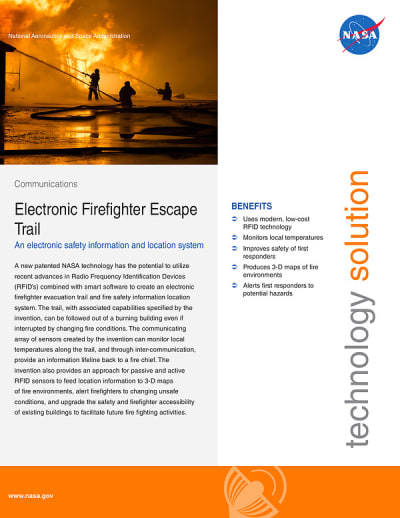
Electronic Firefighter Escape Trail
 This technology uses recent advances in Radio Frequency Identification Devices, combined with smart software, to create an electronic firefighter evacuation trail and fire safety information location system. The trail can be followed out of a burning building even if interrupted by changing fire conditions.
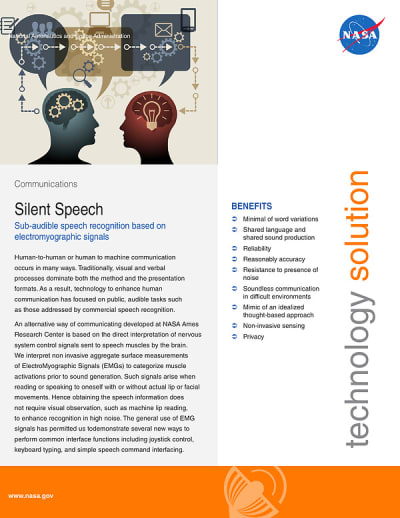
Silent Speech
An alternative way of communicating is based on the direct interpretation of nervous system control signals sent to speech muscles by the brain. New ways have been developed using ElectroMyographic Signals (EMGs) to perform common interface functions such as joystick control, keyboard typing, and simple speech command interfacing when reading or speaking to oneself with or without actual lip or facial movements.
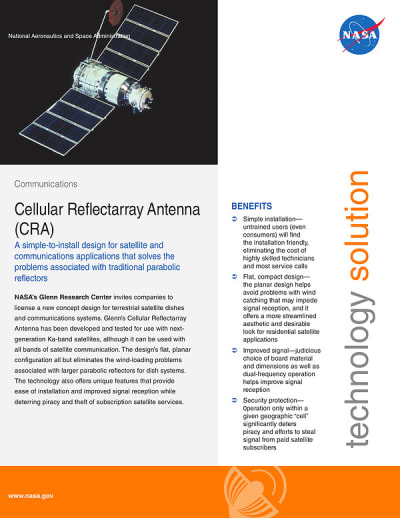
Cellular Reflectarray Antenna (CRA)
 This antenna is used with next-generation Ka-band satellites to eliminate the windloading problems associated with larger parabolic reflectors for dish systems. The CRA receives satellite signals for satellite television and communications services within a specified geographic area that comprises approximately 1,500 square miles.
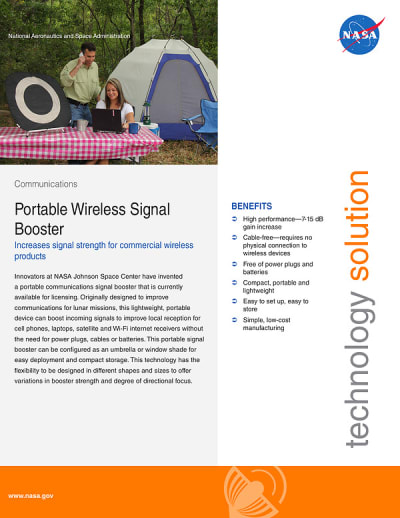
Portable Wireless Signal Booster
 A portable communications signal booster, originally designed to improve communications for lunar missions, is lightweight, portable, and can boost incoming signals to improve local reception for cellphones, laptops, satellite, and Wi-Fi Internet receivers without the need for power plugs, cables, or batteries. It can be configured as an umbrella or window shade for easy deployment and compact storage.
Extended Range RFID and Sensor Tag
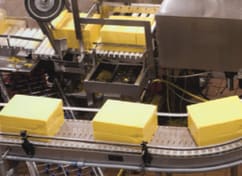 This technology enhances the performance of surface acoustic wave radio frequency tags for passive radio frequency identification and sensor applications without the need for additional transmit power. It also can reduce transmit power requirements for shorter-range passive RFID systems. Applications include first responder personnel and assets, hospital patient tracking, and vehicle and container tracking.
Real-Time Tracking System Uses Ultra-Wideband RF Signals
 A real-time locating system uses ultra-wideband RF signals for tracking and reporting the position of transmitter-equipped people and objects in a variety of environments. Originally designed for use in tracking lunar and Mars rovers, robots, and astronauts, it has applications such as long-range tracking of emergency, military, and mining personnel where GPS is not reliable.
Ad Hoc Selection for Voice Over Internet Streams
This technology features the ability to select specific audio streams from one or more sources and convert them into a multicast to the user’s audio player. This ability allows a range of information and/or data to be monitored from a remote location using existing network technologies in near-real time.
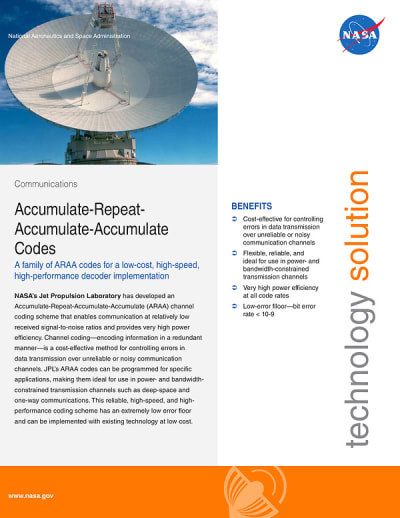
Accumulate-Repeat-Accumulate-Accumulate (ARAA) Codes
 The ARAA channel coding scheme enables communication at relatively low received signal-to-noise ratios and provides very high power efficiency. This coding scheme has an extremely low error floor and can be implemented with existing technology at low cost. Applications include fixed and mobile wireless channels and mass storage.
Overview
The document outlines the development and applications of the Accumulate-Repeat-Accumulate-Accumulate (ARAA) coding scheme by NASA's Jet Propulsion Laboratory (JPL). This innovative technology is a type of forward error correcting code that achieves near-Shannon limit performance, making it highly effective for data transmission over unreliable or noisy communication channels.
The ARAA coding scheme combines an accumulator as the inner code with an Accumulate-Repeat-Accumulate (ARA) code with a repetition factor of 2 as the outer code. This design enhances the minimum distance between codewords, which is crucial for maintaining data integrity, especially in low error floor applications. The minimum distance of these codes increases with block length, providing superior performance at high signal-to-noise ratios (SNRs) compared to standalone ARA codes.
One of the key advantages of JPL's ARAA codes is their protograph representation, which facilitates high-speed iterative decoder implementation using belief propagation. Prototypes of these codes have been successfully constructed using field-programmable gate arrays (FPGAs), demonstrating encoding, noise addition, and decoding capabilities with a throughput exceeding 10 Mbits/second. The threshold SNR for reliable communication with these protographs is within 0.28 dB of channel capacity, indicating performance comparable to the best-known low-density parity-check codes, but with a significantly lower error floor, even at moderate block lengths.
The potential applications of ARAA codes are extensive. They are particularly suited for aerospace communications, enabling reliable deep space communication. Additionally, they can be applied in bandwidth-constrained transmission channels, such as fixed and mobile wireless systems, cable modems, and digital subscriber line systems. They also have implications for hard disk drive systems, enhancing mass storage and data compression capabilities.
The document emphasizes NASA's Technology Transfer Program, which aims to extend the benefits of its research to the broader economy, creating jobs and improving quality of life through partnerships and licensing agreements with industry. Overall, the ARAA coding scheme represents a significant advancement in error correction technology, promising to enhance communication reliability in various fields while ensuring cost-effectiveness and high performance.







