

Variable Power Handheld Laser Torch
 A handheld laser torch was designed for welding and brazing metals to repair hard-to-reach space shuttle engine nozzles. It incorporates various manual controls and changing lenses to allow the operator to adjust the laser’s power output in real time. Applications are likely to be in-field welding and brazing of damaged equipment where traditional welding systems cannot easily access the welding area.

Compact Long-Reach Robotic Arm
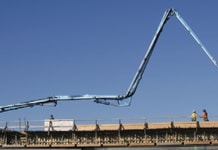 A robotic arm features lightweight joints that provide a wide range of motion and numerous degrees of freedom. The arm, ideal for use in aquatic environments or for manipulation of light terrestrial loads, consists of articulating booms connected by cable tension elements. The tendon articulation allows the use of small, efficient motor systems.
NASA-427: A New Aluminum Alloy
 NASA-427 is a strong aluminum alloy, ideal for cast aluminum products that have powder or paint-baked thermal coatings. The alloy improves the thermal coating process by decreasing the time required for heat treatment. With improvements in both strength and processing time, use of the alloy provides reduced materials and production costs, lower product weight, and better product performance.
Ultrasonic Stir Welding
 Ultrasonic Stir Welding joins large pieces of very high-strength metals such as titanium and Inconel. Because of the independent control of process elements, closed-loop temperature control can be integrated into the system so that a constant weld nugget temperature can be maintained during welding. Applications include hardware for severe environments, launch vehicles, aircraft, automobiles, bridges, and trains.
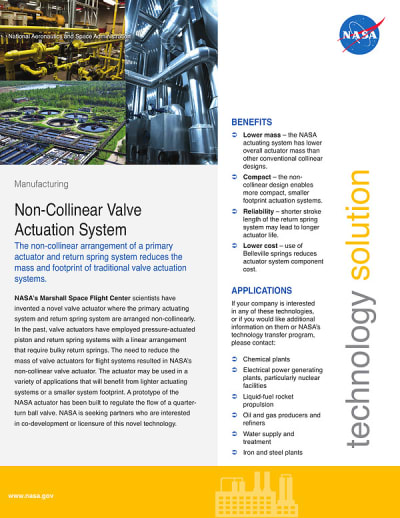
Non-Collinear Valve Actuation System
The need to reduce the mass of valve actuators for flight systems resulted in NASA’s non-collinear valve actuator. The actuator may be used in a variety of applications that will benefit from lighter actuating systems or a smaller system footprint such as chemical plants, electrical power generating plants, oil and gas refiners, and water supply and treatment.
Thermal Stir Welding
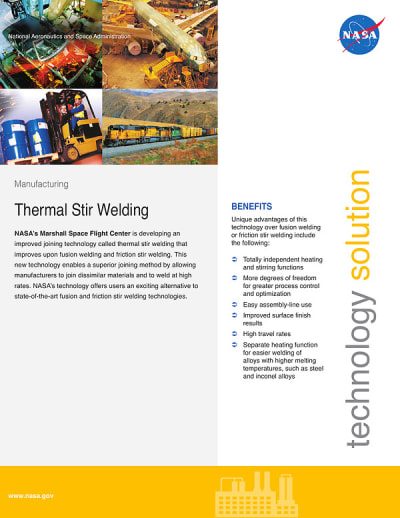
 Thermal stir welding improves upon fusion welding and friction stir welding. This technology enables a superior joining method by allowing manufacturers to join dissimilar materials and to weld at high rates. It offers users an alternative to fusion and friction stir welding technologies. Applications include aerospace, automotive, shipbuilding, storage tanks and cylinders, construction, and railway cars.
Overview
The document discusses NASA's innovative Thermal Stir Welding technology, developed at the Marshall Space Flight Center, which addresses the limitations of traditional welding methods such as fusion welding and friction stir welding. This new joining technology allows for improved welding processes, particularly for dissimilar materials, by separating the heating and matrix transformation functions.
Key Features of Thermal Stir Welding:
-
Independent Heating and Stirring: Unlike traditional methods, Thermal Stir Welding utilizes separate heat sources that can independently control the melting of different materials. This feature is particularly advantageous for joining dissimilar metals, such as copper and aluminum or stainless steel and titanium, as it creates a more favorable thermal environment for welding.
-
Enhanced Process Control: The technology provides greater degrees of freedom for process optimization, allowing for higher travel rates during welding. This is achieved without the need for a backing anvil, which is typically required in friction stir welding, thus simplifying the apparatus design.
-
Improved Surface Finish and Quality: The process results in better surface finishes and maintains the physical properties of the materials being welded, addressing the microstructural compromises often seen in fusion welding.
-
Applications Across Industries: Thermal Stir Welding has potential applications in various sectors, including aerospace, automotive, shipbuilding, construction, and railway manufacturing. Its ability to weld at high rates and join complex materials makes it a valuable technology for industries that rely on advanced manufacturing techniques.
-
NASA's Technology Transfer Program: The document highlights NASA's commitment to transferring its technological advancements to benefit the economy and improve quality of life. Through partnerships and licensing agreements, NASA aims to ensure that its research finds practical applications in the industry, creating jobs and fostering innovation.
In summary, Thermal Stir Welding represents a significant advancement in welding technology, offering unique advantages over existing methods. By enabling the joining of dissimilar materials with improved efficiency and quality, this technology has the potential to transform manufacturing processes across multiple industries, showcasing NASA's dedication to innovation and technology transfer for the benefit of society.







