

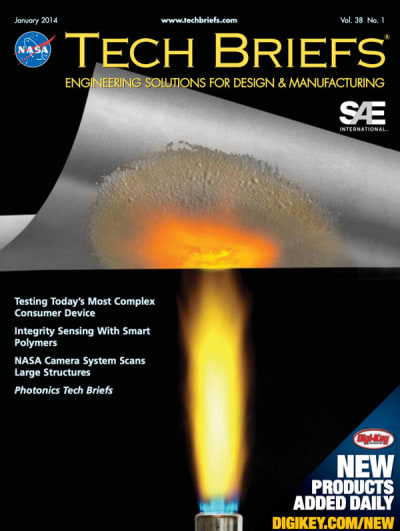
Inside this issue
Supplements

Overview
The January 2014 issue of Photonics Tech Briefs, a supplement to NASA Tech Briefs, presents a collection of innovative technologies and advancements in the field of photonics. This edition highlights various applications and developments that are shaping the future of engineering and technology, particularly in aerospace and consumer electronics.
Key Highlights:
-
Photonic Laser Thrusters for Spacecraft Maneuvering: This article discusses the development of photonic laser thrusters, which utilize light for propulsion. These thrusters offer a promising alternative to traditional chemical propulsion systems, potentially allowing for more efficient spacecraft maneuvering and longer missions in space.
-
Silicon vs. Gallium Arsenide in Photovoltaics: A comparative analysis of silicon and gallium arsenide as photovoltaic materials is presented. The article examines the efficiency, cost, and performance of both materials in solar energy applications, providing insights into which material may be more suitable for specific applications in the renewable energy sector.
-
V-Assembly Dual-Head Efficiency Resonator (VADER) Laser Transmitter: The VADER laser transmitter is introduced as a cutting-edge technology designed to enhance laser communication systems. This dual-head resonator aims to improve efficiency and performance in various applications, including telecommunications and remote sensing.
-
Twin Head Efficient Oscillator Development for ACE Multi-Beam Lidar and 3D-Winds: This feature covers the development of a twin-head efficient oscillator for the Atmospheric Science and Climate Experiment (ACE). The oscillator is designed to enhance the capabilities of multi-beam lidar systems, which are essential for studying atmospheric conditions and wind patterns.
Planetary Polarization Nephelometer: The article discusses a new instrument called the planetary polarization nephelometer, which is designed for remote sensing of atmospheric particles. This device can provide valuable data on the composition and behavior of aerosols, contributing to our understanding of climate change and air quality.
-
GaSb-Based Diode Lasers for Remote Detection of Carbon Dioxide: This section highlights the development of gallium antimonide (GaSb)-based diode lasers that are capable of detecting carbon dioxide levels from a distance. These lasers have significant implications for environmental monitoring and climate research, enabling more accurate assessments of greenhouse gas emissions.
-
Optical Tunable-Based Transmitter for Multiple High-Frequency Bands: The optical tunable transmitter is introduced as a versatile solution for communication systems that require operation across multiple high-frequency bands. This technology is crucial for enhancing data transmission rates and improving overall communication efficiency.
-
High-Repetition-Rate Seeded Optical Fiber Amplifier (SOFiA) for the LIST Mission: The SOFiA project is discussed, focusing on a high-repetition-rate seeded optical fiber amplifier designed for the Laser Interferometer Space Antenna (LISA) mission. This technology aims to improve the sensitivity and performance of gravitational wave detection in space.
-
Product of the Month: Miniature Motorized Zoom Lens for Underwater Welding: A notable innovation featured in this issue is a miniature motorized zoom lens designed to enhance the capabilities of remotely operated vehicles (ROVs) used in underwater welding. This technology addresses challenges such as poor visibility and variable joint quality, making underwater repairs more efficient and reliable.
Additional Features:
- New Products: The magazine includes a section dedicated to new products in the photonics industry, showcasing the latest advancements and tools available to engineers and researchers.
- Industry Insights: Throughout the issue, there are insights into current trends and future directions in photonics, emphasizing the importance of this field in various applications, from aerospace to renewable energy.
Conclusion:
The January 2014 issue of Photonics Tech Briefs serves as a valuable resource for engineers, researchers, and industry professionals interested in the latest developments in photonics technology. With a focus on innovative solutions and practical applications, this edition highlights the critical role of photonics in advancing technology and addressing global challenges. From space exploration to environmental monitoring, the advancements presented in this issue underscore the transformative potential of photonics in shaping the future of various industries.
Features
-
Application Briefs
Prototype Recovers Lost-At-Sea Images
-
Articles
Speed2Design: A Chance of a Lifetime
Testing Today’s Most Complex Consumer Device: The Ubiquitous Smartphone
Tech Briefs
-
Bio-Medical
Visual Image Sensor Organ Replacement
A Novel Protocol for Decoating and Permeabilizing Bacterial Spores for Epifluorescent Microscopy
Method and Apparatus for Automated Isolation of Nucleic Acids from Small Cell Samples
Enabling Microliquid Chromatography by Microbead Packing of Microchannels
On-Command Force and Torque Impeding Devices (OC-FTID) Using ERF
-
Physical Sciences
Integrity Sensing With Smart Polymers and Rubber Components on Vehicles
Blade Tip Clearance Sensors for Engine Health Monitoring
Multi-Source Autonomous Response for Targeting and Monitoring of Volcanic Activity
Array Design Considerations for the Solar Probe Plus
Transition-Edge Hot-Electron Microbolometers for Millimeter and Submillimeter Astrophysics
-
Manufacturing & Prototyping
Additive Manufacturing of Ti-6Al-4V Alloy Components for Spacecraft Applications
-
Software
Software Suite to Support In-Flight Characterization of Remote Sensing Systems
Spacecraft Trajectory Analysis and Mission Planning Simulation (STAMPS) Software
Cross Support Transfer Service (CSTS) Framework Library
Mars Science Laboratory Second-Chance Flight Software
-
Information Sciences
GPU Lossless Hyperspectral Data Compression System
Calculation of Operations Efficiency Factors for Mars Surface Missions
Fuzzy Neuron: Method and Hardware Realization
Frequency-Modulated, Continuous-Wave Laser Ranging Using Photon-Counting Detectors
Robust, Optimal Subsonic Airfoil Shapes
Temperature Dependences of Mechanisms Responsible for the Water-Vapor Continuum Absorption
Kalman Filter Input Processor for Boresight Calibration
Organizing Compression of Hyperspectral Imagery to Allow Efficient Parallel Decompression
-
Mechanics & Machinery
Habitat Demonstration Unit (HDU) Vertical Cylinder Habitat
-
Electronics & Computers
Ultra-Wideband, Dual-Polarized, Beam- Steering P-Band Array Antenna
Centering a DDR Strobe in the Middle of a Data Packet
Submerged AUV Charging Station
Using a Commercial Ethernet PHY Device in a Radiation Environment
Products
-
Briefs
V-Assembly Dual-Head Efficiency Resonator (VADER) Laser Transmitter
Twin Head Efficient Oscillator Development for the ACE Multi- Beam Lidar and 3D-Winds
Planetary Polarization Nephelometer
GaSb-Based Diode Lasers for Remote Detection of Carbon Dioxide
Optical Tunable-Based Transmitter for Multiple High-Frequency Bands











