

Inside this issue
Supplements
Overview
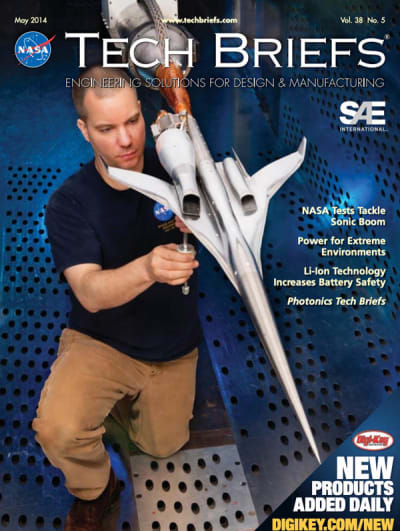
The May 2014 issue of NASA Tech Briefs presents a wealth of information on cutting-edge technologies and innovations across various fields, particularly focusing on aerospace and engineering advancements. This edition highlights several key topics, including NASA's research on sonic booms, improvements in battery safety, and the potential applications of carbon nanotubes.
One of the standout features of this issue is an in-depth exploration of NASA's efforts to mitigate the impact of sonic booms, which are a significant concern for supersonic flight. The article discusses the agency's testing of new technologies aimed at reducing the noise produced when an aircraft breaks the sound barrier. This research is crucial for the future of commercial supersonic travel, as it addresses regulatory challenges and public acceptance of such flights.
Another significant topic covered is the advancements in lithium-ion battery technology, particularly concerning safety. The issue delves into the latest research aimed at preventing thermal runaway, a dangerous condition that can lead to battery fires. Innovations in battery design and materials are discussed, showcasing how these improvements can enhance the safety and reliability of batteries used in various applications, from consumer electronics to electric vehicles.
The magazine also features an article on carbon nanotubes, which are gaining attention for their remarkable properties, including strength, conductivity, and flexibility. The potential applications of carbon nanotubes in various industries, such as electronics, materials science, and medicine, are explored. The article highlights ongoing research and development efforts to harness these materials for practical use, emphasizing their transformative potential.
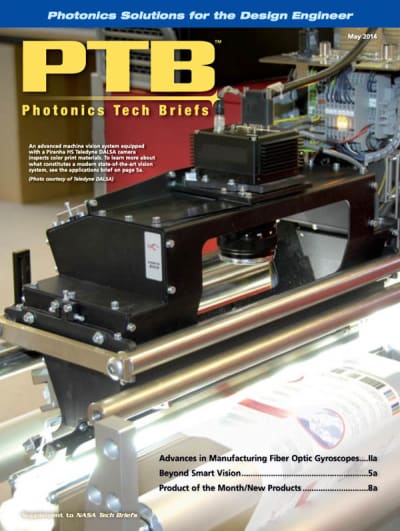
In addition to these main features, the issue includes a variety of shorter articles and briefs that cover a range of topics, from advancements in robotics and automation to new materials and manufacturing techniques. These articles provide readers with a snapshot of the latest trends and innovations in technology, making the issue a valuable resource for engineers, researchers, and tech enthusiasts.
The magazine also includes an advertisers' index, directing readers to additional resources and product literature related to the technologies discussed. This feature enhances the issue's utility, allowing readers to easily access further information on specific products and innovations.
Overall, the May 2014 issue of NASA Tech Briefs serves as a comprehensive overview of the latest advancements in technology, particularly in the aerospace sector. It highlights the importance of ongoing research and development in addressing challenges and improving safety and efficiency in various applications. The issue is a testament to the innovative spirit of the engineering community and the continuous pursuit of knowledge and improvement in technology.
Features
-
Technologies
-
Application Briefs
Flexible Wing Flap Reduces Noise and Drag
Tech Briefs
-
Test & Measurement
Processing COSMIC/FORMOSAT-3 Data for Slant Total Electron Content Measurements
Durability Analysis of a Vehicle by Virtual Test Model (VTM)
Model-Based Prognostics for Batteries
Application of a Physics-Based Stabilization Criterion to Flight System Thermal Testing
-
Physical Sciences
Optical Phased Array with Digitally Enhanced Interferometry
Mass Spectrometry of Spacecraft Contamination Using the Direct Analysis in Real-Time Ion Source
Lithium-Ion Battery Technologies with High Energy Density
Low-Cost Communications Concept for Smallsats: Opportunistic MSPA
Use of Selective Oxidation Catalyst for Amperometric Sensing Electrode
-
Manufacturing & Prototyping
Tailored 3D Fiber Architecture to Improve CVI Processing
-
Software
Goddard Mission Services Evolution Center Compliance Test Suite
NASA Experiment Designer: A Tool for Running Scientific Workflows
SensorWeb Campaign Manager API Client
Software for Lossless Data Compression
Asynchronous Message Service (AMS) Software Libraries
Software for Executing International Standard CCSDS 123B
TASAR and TAP: Airborne Trajectory Management Enabled by Traffic-Aware Software
-
Materials
The Flexibility of ITO Films in Electronic Coating Applications
Electride Mediated Surface Enhanced Raman Spectroscopy
-
Information Sciences
Safety Analysis of Conflict Prevention Algorithms
CT-CURS: Unwrapping/Re-slicing Software for Cylindrical Objects Inspected Using Computed Tomography
Trajectory Specification for High-Capacity Air Traffic Control
Whole Symbol Moments SNR Estimator Analysis and Implementation
Quick Thrust Profile Design Analysis for Verifying Spacecraft Operational Capabilities
-
Mechanics & Machinery
Pneumatic Sample Acquisition and Transfer System
Hybrid Mechanical Electrostatic Actuator for Deformable Mirrors
-
Electronics & Computers
Battery Fault Detection with Saturating Transformers
Digitally Controlled, 12-V Precision Current Source for Extreme-Temperature Operation
Scandate Cathode for High-Power, Long-Life Electric Space Propulsion
Hybrid Force/Stress Amplified Piezoelectric Energy Harvesting Transducer System
Improved Battery Health Monitoring
Barrel Distortion Correction Image Processing Algorithm for Fish-Eye Lenses
Products
-
Applications
-
Briefs
First Single-Molecule LED Developed
Two-Dimensional Material Shows Promise for Optoelectronics
Improving the Efficiency of Green-Blue-Ultraviolet Light-Emitting Diodes
-
Applications
LED Street Lights Reduce Energy Consumption by 72% at Power Station
Production Company Uses LED Street Lights To Illuminate Dark Parking Lot
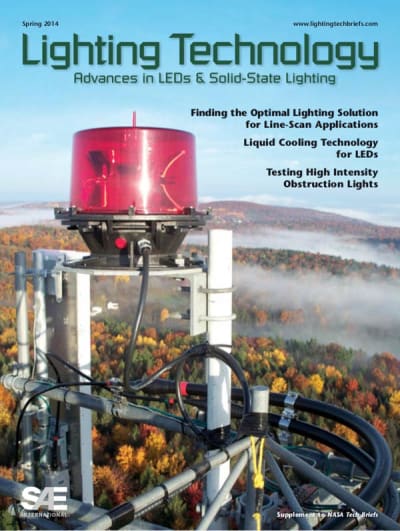
Customized Goniophotometer System Tests High Intensity Obstruction Lights
-
Articles
Liquid Cooling Technology for LEDs
Finding the Optimal Lighting Solution for Line-Scan Applications











