

Sampling, sample handling, and sample transfer to lander platforms of in situ exploration missions involve great technical challenges. These challenges are even harder to address when the planetary bodies have extreme environments. For example, Venus has an ambient temperature of around 460 °C, and atmospheric pressure that is over 90 times the atmosphere of Earth.
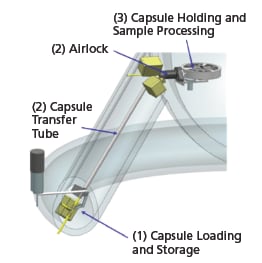
In order to address these challenges, a pneumatic sample acquisition and handling system has been developed that is able to load powder samples into a capsule, transport that capsule into the vicinity of the lander, and then transfer the capsule inside the lander through an airlock to deliver the sample to science instruments for analysis. A series of vacuum reservoirs (reservoirs with pressure lower than the ambient pressure) and control valves is used to create pressure differentials across various components of the system in order to load the sample into the capsule and transport the capsule to the testing instruments. The premise of the system is to take advantage of the pressure difference between Venus’ atmosphere and the inside of the lander or vacuum reservoirs.
The pneumatic sample transfer system consists of three subsystems: capsule loading and storage, capsule transfer and airlock, and capsule holding and sample processing. Grates in the wall of the capsule allow airflow to convey the powdered sample to enter the capsule. When pressure is applied to the outside of the front half of the capsule, the radial one-way valve opens inward and allows air to flow through the capsule from left to right. However, if the high pressure is applied in reverse, on the back of the capsule, the radial valve closes and air cannot flow back through the grates. This seals the sample inside the capsule.
After the sample is loaded into the capsule and placed along the transfer tube, valves open one side to the atmosphere and the other side to the inside of the lander or vacuum reservoir to create pressure difference across the capsule. This difference results in a force that pushes the capsule through the tube into the airlock. A similar procedure takes the sample loaded capsule from the airlock inside the spacecraft for sample processing.
This work was done by Mircea Badescu, Stewart Sherrit, Yoseph Bar-Cohen, and Wayne F. Zimmerman of Caltech; and Louisa A. Avellar for NASA’s Jet Propulsion Laboratory. NPO-49167
This Brief includes a Technical Support Package (TSP).
Pneumatic Sample Acquisition and Transfer System
(reference NPO-49167) is currently available for download from the TSP library.
Don't have an account?
Overview
The document outlines the development of a Pneumatic Sample Acquisition and Transfer System designed for in-situ exploration missions, particularly targeting the extreme conditions of Venus, where temperatures reach approximately 460ºC and atmospheric pressure exceeds 90 times that of Earth. The Jet Propulsion Laboratory (JPL) identified significant challenges in sampling, handling, and transferring samples to lander platforms in such harsh environments, emphasizing the need for advanced technology in sample containment and mechanical transfer devices.
The pneumatic system is engineered to load powder samples into capsules, transport them to the lander, and deliver them to scientific instruments for analysis. It operates by utilizing a pressure differential created between Venus's atmosphere and the lander's internal environment, which is maintained at approximately Earth pressure. This pressure difference is achieved through a series of vacuum reservoirs and control valves, allowing the system to effectively load samples into capsules and facilitate their movement through a transfer tube.
The system comprises three main subsystems: (1) capsule loading and storage, (2) capsule transfer and airlock, and (3) capsule holding and sample processing. The design includes a capsule that can be constructed from materials such as beryllium, with variations including a window for observation. The entire system is expected to weigh around 1.9 kg, excluding additional components like valves and actuators.
Figures included in the document illustrate the configuration of the pneumatic system, the capsule design, and the components of the airlock, which consists of an outer barrel and an inner drum. The document serves as a technical disclosure under NASA's Commercial Technology Program, aiming to disseminate aerospace-related developments with potential wider applications.
Overall, this innovative pneumatic sample acquisition and transfer system represents a significant advancement in technology for planetary exploration, addressing the unique challenges posed by extreme environments and enhancing the capability to conduct scientific analysis on other planetary bodies. The research was conducted at JPL under NASA's auspices, highlighting the collaborative efforts in advancing space exploration technologies.











