

Inside this issue
Supplements
Overview
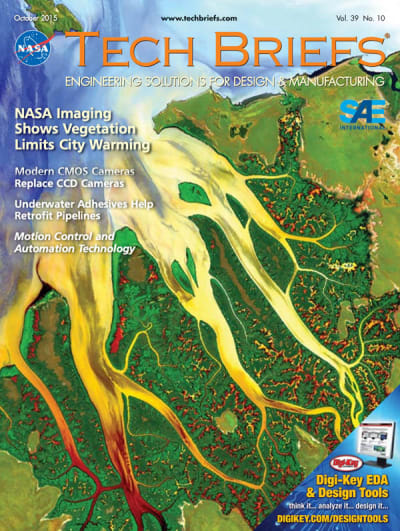
The October 2015 issue of NASA Tech Briefs presents a variety of innovative technologies and advancements in engineering, particularly focusing on motion control, automation, and imaging technologies. This edition highlights several key topics and breakthroughs that are shaping the future of these fields.
One of the prominent features of this issue is the discussion on modern CMOS (Complementary Metal-Oxide-Semiconductor) cameras, which are increasingly replacing traditional CCD (Charge-Coupled Device) cameras. CMOS technology offers several advantages, including lower power consumption, faster processing speeds, and the ability to integrate additional functionalities on the same chip. This transition is significant for various applications, including space exploration, where efficient imaging systems are crucial.
The issue also covers advancements in underwater adhesives, which are essential for retrofitting pipelines. These adhesives are designed to bond effectively in wet conditions, making them ideal for repairing and maintaining underwater infrastructure. The development of such materials is critical for ensuring the longevity and reliability of pipelines, which are vital for transporting resources.
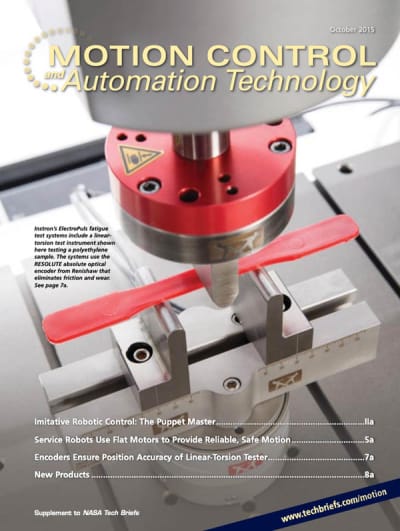
Another highlight is the exploration of motion control and automation technology. The magazine discusses the latest systems and components that enhance precision and efficiency in automated processes. This includes advancements in robotics, which are increasingly being integrated into manufacturing and other industries to improve productivity and reduce human error.
In addition to these technological advancements, the issue features NASA's imaging studies that focus on vegetation and its impact on urban heat islands. The research demonstrates how vegetation can help mitigate city warming, emphasizing the importance of green spaces in urban planning. This study not only contributes to environmental science but also provides insights for city planners looking to create more sustainable urban environments.
The magazine also includes a section dedicated to advertisers, showcasing various companies and their products relevant to the fields of motion control and automation. This serves as a resource for readers interested in exploring new technologies and solutions available in the market.
Overall, the October 2015 issue of NASA Tech Briefs is a comprehensive resource for professionals and enthusiasts in the fields of engineering, automation, and environmental science. It provides valuable insights into current trends, innovative technologies, and practical applications that are shaping the future of these industries. The combination of technical articles, product literature, and research findings makes this issue a must-read for anyone interested in the latest developments in technology and engineering.
Features
-
Application Briefs
Tech Briefs
-
Test & Measurement
Live-Cell Microscopy and Traction Force Measurements with Simulated Microgravity “Clinochip”
Comparison of Three Methods for Measuring Distortion in Optical Windows
Measurement of O-phthalaldehyde (OPA)
Improved Combustion Products Monitor for the ISS
Decomposition Technique for Remaining Useful Life Prediction
-
Bio-Medical
Polymerase Chain Reaction Preparation Kit and Self-Enclosed, Pipette-Free DNA/RNA Isolation Device
Hydrostatic Hyperbaric Oxygen Treatment Chamber
Reagent and Method of Using a Microfluidic Cytometer for Leukocyte Differential Count
Intravehicular Tissue Equivalent Proportional Counter (TEPC) Flight Software
Combinatorial Multidomain Mesoporous Chips for Fractionation of Biomolecules
-
Manufacturing & Prototyping
Method for Decreasing Additive Manufacturing Build Times Using Arrays of Multiple Deposition Heads
-
Information Sciences
Software Framework for Control and Observation in Distributed Environments (CODE)
Simple RunTime eXecutive (SRTX)
v-Anomica: A Fast Support Vector-Based Novelty Detection Technique
Self-Stabilizing Distributed Clock Synchronization Protocol for Arbitrary Digraphs
Precision Navigation Strategies for Primitive Solar-System-Body Sample Return Missions
Orbit Determination Toolbox 2012a (v5.0)
Design and Construction of Protograph-Based LDPC Codes
Spitzer Integrated Resource Planning and Scheduling System (SIRPASS)
Tracking a Scene on Earth from Space Using the Adaptive Cross-Correlation Algorithm
Automated Scheduling of Personnel to Staff Operations for the Mars Science Laboratory
Area Coverage Path Planning Using Divided Grid-Graphs
Shape Sensing Using Multicore Fiber Optic Cable and Parametric Curve Solutions
Encoders and Decoders for the AR4JA LDPC Codes
Explicitly Filtered Large Eddy Simulation for Prediction of a Conserved Scalar
-
Mechanics & Machinery
Habitat Water Wall for Water, Solids, and Atmosphere Recycle and Reuse
Novel Feedthrough for Instrumentation Lead Wires
Pneumatic Conveying of Lunar Regolith Simulant
Low-Cost, Portable Platform for Mounting Multiple Antennas for Automatic UAV Tracking
-
Electronics & Computers
Reusable Integrated Instrument Control and Computing Platform
Compact, Two-Stage, 120-W GaN High-Power Amplifier for SweepSAR Radar Systems
Eliminating Wires in Making Electrical Connections to a Stack of Electron and Ion Optical Components
Graphene Composite Materials for Supercapacitor Electrodes
Integrated, Radiation-Hardened Radio Frequency Digitizer and Signal Processing Electronics











