

Making electrical connections inside a vacuum chamber to a stack of electron and ion optical components using the conventional approach of discrete wires is not efficient because: (1) the separate wires must be insulated from each other and the interior structures; (2) the wires must be spot welded or mechanically secured at their end points to the electrical feedthroughs and optical components, both of which are typically bulky and prone to failure in vibration; and (3) the wires are a major source of failure in high-G applications.
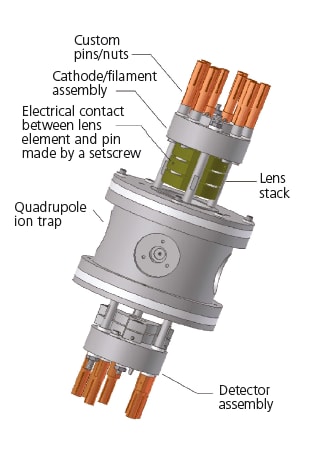
The mechanical structures that mount and constrain the electron and ion optics are also used to make electrical connectivity. The mechanical supports are patterned in such a way to plug directly into the vacuum feedthrough contacts, so that during assembly, the entire system is held tightly in compression. This robust arrangement is highly beneficial for instruments that must withstand high- G loads.
This work was done by Stojan Madzunkov, Murray R. Darrach, and Jurij Simcic of Caltech for NASA’s Jet Propulsion Laboratory. For more information, contact







