All-solid-state, room-temperature, multipixel, sub milli meter-wave re ceiv ers are in demand for efficient spatial mapping of a planet’s atmosphere composition and wind velocities for future NASA missions to Venus, Jupiter, and its moons. Roomtemperature operation based on Schottky diode technology is a must in order to avoid cryogenic cooling and enable long-term missions. This technology is also being successfully applied for very-high-resolution imaging radars for standoff detection of concealed weapons. For submillimeter-wave radar imaging, the main issue is that, in order to reach video frame rates with high image pixel density, multi-pixel focal plane transceiver arrays are needed to illuminate targets with many radar beams simultaneously.
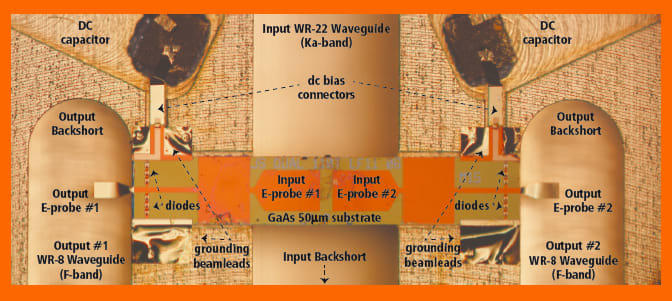
The epi-structure and anode size of the devices have been, for the first time, optimized to reach the limits of the GaAs Schottky diode technology in terms of power handling and efficiency at these frequency bands. The improvement with regard to the state-of-the-art is a factor of four to five in both power and efficiency. These devices can operate up to 120 GHz (commercially available high-power amplifiers do not operate beyond 105 GHz), and can be pumped with low-cost, high-power amplifiers at Ka-band. Hence, this solution considerably reduces the cost of high-power sources.
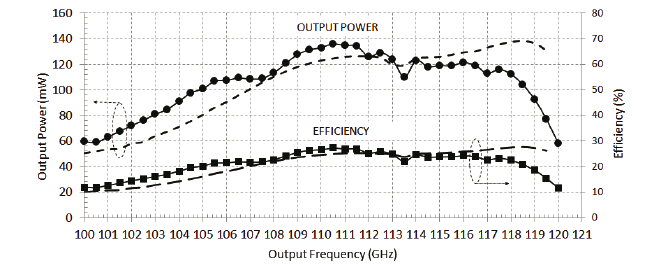
Reaching the highest possible powers is critical to operate radars at the longest standoff range, or for building radars using multiple transmitters and receivers. Sources above 110 GHz can also be used in emerging high-throughput communications systems and emerging space-based applications such as high-resolution altimetry. Finally, high millimeter-wave sources can be used in academic research work, such as molecular spectroscopy.
This work was done by Jose V. Siles, Choonsup Lee, Goutam Chattopadhyay, Ken B. Cooper, Imran Mehdi, Robert H. Lin, and Alejandro Peralta of Caltech for NASA’s Jet Propulsion Laboratory. For more information, contact