Inside this issue
Supplements
Overview
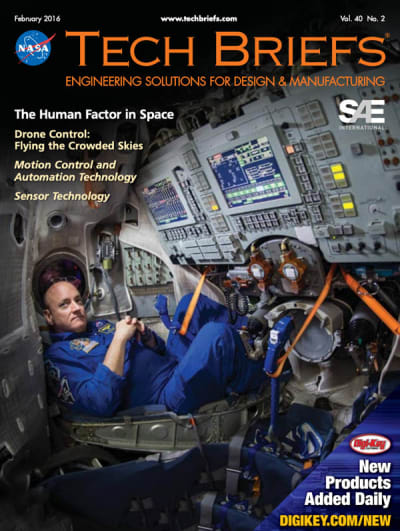
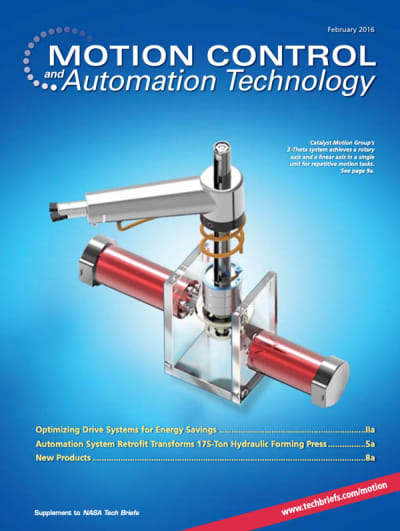
The February 2016 issue of NASA Tech Briefs and Motion Control and Automation Technology presents a wealth of information on advancements in technology, particularly in the fields of automation, manufacturing, and aerospace. This edition highlights innovative solutions, industry insights, and the ongoing evolution of technology that aims to enhance efficiency and productivity.
Key Highlights:
-
Innovative Drive Systems: The issue features articles on new drive systems designed to improve energy efficiency in various applications. These systems leverage advanced technologies to reduce energy consumption while maintaining high performance, showcasing the importance of sustainability in modern engineering.
-
Automation System Retrofit: A significant focus is placed on retrofitting existing automation systems. The magazine discusses how companies can upgrade their current systems to incorporate the latest technologies without the need for complete overhauls. This approach not only saves costs but also minimizes downtime, allowing businesses to remain competitive in a rapidly evolving market.
-
Industry 4.0: The concept of Industry 4.0 is explored in depth, emphasizing the integration of cyber-physical systems, the Internet of Things (IoT), and digital technologies in manufacturing. This fourth industrial revolution aims to create smart factories where machines communicate and collaborate, leading to more efficient and flexible production processes. The magazine discusses the implications of this shift for manufacturers and the potential for increased productivity and innovation.
NASA's Role in Technology Advancement: The issue includes a special message from NASA Administrator Charles Bolden, reflecting on the agency's contributions to technology and innovation over the past 40 years. It highlights how NASA's research and development efforts have led to significant advancements not only in aerospace but also in various industries through technology transfer and spinoffs.
-
Top 40 NASA Spinoffs: In celebration of its 40th anniversary, the magazine features a list of the Top 40 NASA spinoffs that have made a substantial impact on everyday life. These spinoffs demonstrate the practical applications of NASA's research, showcasing how space technology has led to advancements in healthcare, transportation, and consumer products.
-
Executive Perspectives: The issue includes insights from industry leaders who have experienced growth and innovation over the past four decades. These executives share their perspectives on the future of technology and manufacturing, discussing trends and challenges that lie ahead. Their insights provide valuable context for understanding the direction of the industry and the role of emerging technologies.
-
Product Innovations: The magazine also highlights the latest products and technologies in motion control and automation. Readers can find information on cutting-edge components, systems, and solutions that are shaping the future of these fields. This section serves as a resource for engineers and decision-makers looking to stay informed about the latest advancements.
-
Case Studies and Success Stories: Throughout the issue, various case studies illustrate how companies have successfully implemented new technologies and strategies to improve their operations. These stories provide practical examples of the benefits of innovation and the importance of adapting to changing market demands.
-
Networking and Community Engagement: The magazine encourages readers to connect with NASA Tech Briefs through social media platforms like Facebook, LinkedIn, and Twitter. This engagement fosters a community of professionals interested in technology and innovation, providing a platform for sharing ideas and best practices.
In summary, the February 2016 issue of NASA Tech Briefs and Motion Control and Automation Technology serves as a comprehensive resource for professionals in engineering, manufacturing, and technology. It highlights the importance of innovation, sustainability, and collaboration in driving progress across industries. With a focus on practical applications and real-world success stories, this edition inspires readers to embrace new technologies and strategies that can enhance their productivity and competitiveness in an ever-evolving landscape.
Features
-
Application Briefs
CAD-Based Process Analyzes Lidar Interferometer Instrument
Plasma Etching System Expands Device Processing Capability at JPL
Researchers Prepare RoboSimian for Tasks Beyond Disaster Response
Energy Harvester Uses RF Waves to Power Air Pollution Sensors
-
Who's Who
-
Articles
Drone Control: Flying the Crowded Skies
CO2 Recovery System Puts Bubbles into Beer
Graphene Supports NASA-Developed Nanosensors
Tech Briefs
-
Bio-Medical
Technique for Reversible Permeabilization of Live Cells for Intracellular Delivery of Quantum Dots
Introduction of Structural Affinity Handles as a Tool in Selective Nucleic Separations
Functionalized Patterning of Tissue Engineering Substrates
Hearing Test System Suitable for Self-Administered Hearing Assessment
-
Manufacturing & Prototyping
Method for Fabricating Metallic Panels with Deep Stiffener Sections
Robust, High-Temperature Containment Cartridges for Microgravity
Method for Insertion of Carbon Fiber Through the Thickness of Dense Dry Fiber Preform
-
Materials
Advanced Supported Liquid Membranes for CO2 Control in EVA Applications
Low-Density Titanium-Based Bulk Metallic Glasses with High Glass-Forming Ability
-
Information Sciences
The Advanced Data Analytics Platform (ADAPT): Concept, Design, Architecture, and Operation
Orion Heat Shield Thermal Mapping Tool
Distributed User Interface Management System for Interactive Collaborative Environments
Design Reference Mission Tool for Exoplanet Starshade Mission Study
Data Parallel Line Relaxation Code (DPLR) Version 3.05
Front End Data System (FEDS) Version 10.0
Link Complexity Scheduling Algorithm
BUMPER-CEV Micrometeoroid and Orbital Debris Risk Assessment Code Rev. A
Advanced Numerical Integration Techniques for High-Fidelity SDE Spacecraft Simulation
Launch Environment Water Flow Simulations Using Smoothed Particle Hydrodynamics
Seismometer Simulation Software
The Space Station Modulator: A Configurable Surface Mesh Geometry Model for Aeroscience Analyses
Submersible Phase Change Float Sizing
Method for Evaluating the Pneumatic Hammer Stability of a Fluid-Film Bearing Using CFD
DAWN: a Simulation Model for Evaluating Costs and Tradeoffs of Big Data Science Architectures
-
Mechanics & Machinery
NEO Hunter Seeker Micro-Spacecraft and Mission Concept
Multipath, Multistage, Erosion-Resistive Valve for Downhole Flow Control
Passive Close-Off Feature for Sample Acquisition and Retention
-
Electronics & Computers
Development of a Multi-User Modem for Space Telecommunications
Wire Bonding to Pads in Tilted Planes
-
Sensors/Data Acquisition
Advanced Spacecraft Navigation and Timing Using Celestial Gamma-Ray Sources
Generating a Laser Linear Frequency Modulation Waveform for Application in Coherent Doppler Lidar
Outlier Detection Via Estimating Clusters
Wideband Single-Crystal Transducer for Bone Characterization
Wireless Multi-Walled Carbon Nanotube Microwave Heater System Using RFID-Based Temperature Feedback
Sub-Audible Speech Recognition Based on Electromyographic (EMG) Signals
Precision Detector Conductance Definition via Ballistic Thermal Transport