

Inside this issue
Supplements


Overview
The September 2016 issue of NASA Tech Briefs presents a wealth of information on cutting-edge technologies and innovations developed by NASA and its partners. This edition highlights advancements in various fields, including motion control, automation technology, and photonics and imaging technology, showcasing how these developments are influencing both space exploration and terrestrial applications.
One of the key features of this issue is the exploration of how satellite data is being utilized to enhance agricultural practices. By leveraging advanced satellite imagery and data analytics, researchers are able to provide more accurate crop projections. This not only aids farmers in making informed decisions about planting and harvesting but also contributes to food security by optimizing resource use and minimizing waste.
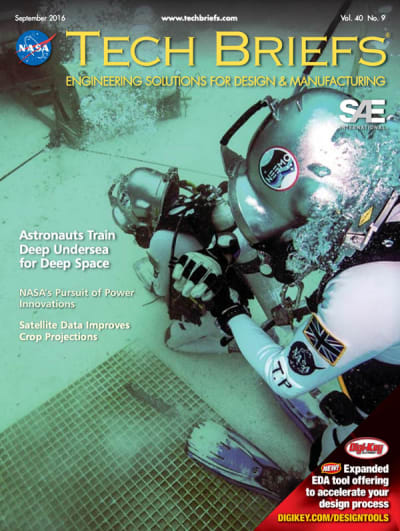
Another significant topic covered in this issue is the training of astronauts in deep undersea environments. This innovative approach simulates the conditions of deep space missions, allowing astronauts to gain valuable experience in a controlled setting. The training focuses on teamwork, problem-solving, and the use of advanced technologies, preparing astronauts for the challenges they will face during long-duration missions beyond Earth.
The magazine also delves into the realm of motion control and automation technology. It discusses the latest advancements in robotics and automation systems that are being developed for various applications, from manufacturing to space exploration. These technologies are designed to improve efficiency, precision, and safety in operations, making them invaluable in both industrial and extraterrestrial environments.
In the field of photonics and imaging technology, the issue highlights new developments in imaging systems that enhance our ability to capture and analyze data. These advancements are crucial for a variety of applications, including remote sensing, medical imaging, and scientific research. The integration of photonics into various technologies is paving the way for more sophisticated and efficient systems that can operate in challenging environments.
The issue also features profiles of key individuals involved in these technological advancements, including Joseph T. Pramberger, the publisher, and Linda L. Bell, the editorial director. Their leadership and vision play a significant role in guiding the publication and ensuring that it remains a vital resource for engineers, researchers, and technology enthusiasts.
Additionally, the magazine provides insights into the marketing and audience development strategies employed to reach a broader audience. This includes efforts to engage with readers through digital marketing initiatives and audience development programs, ensuring that the latest innovations are accessible to those who can benefit from them.
Throughout the issue, readers will find links to additional resources and information, allowing them to delve deeper into specific topics of interest. The magazine encourages readers to explore these resources to gain a more comprehensive understanding of the technologies discussed.
In summary, the September 2016 issue of NASA Tech Briefs serves as a comprehensive overview of the latest advancements in technology and innovation. It highlights the intersection of space exploration and practical applications, showcasing how NASA's research and development efforts are making a significant impact on various industries. From enhancing agricultural practices through satellite data to preparing astronauts for future missions, this issue underscores the importance of technology in addressing global challenges and advancing human knowledge.
Features
Tech Briefs
-
Bio-Medical
A Simplified Production of Organic Compounds Containing High Enantiomer Excesses
Generation of High-Pressure Oxygen Via Electrochemical Pumping in a Multi-Stage Electrolysis Stack
-
Machinery & Automation
Probabilistic Surface Characterization for Safe Landing Hazard Detection and Avoidance (HDA)
Robot for Controlled Deposition of Multilayer Thin Film Structures
Human Grasp Assist Device with Exoskeleton
Electromagnetic Monitoring and Control of a Plurality of Nanosatellites
Elimination of Yaw Component of Gyroscope Propagation Error During Arm Activity in MSL
-
Software
Adaptive Refinement Tools for Tetrahedral Unstructured Grids
Self-Stabilizing, Byzantine-Fault-Tolerant Clock Synchronization System and Method
Method of Performing Computational Aeroelastic Analyses
Fourier Transform Spectrometer Performance Modeling
Mesh Adaptation Module for Cartesian Meshes with Embedded Boundaries
-
Materials
Thermomechanical Methodology for Stabilizing Shape Memory Alloy (SMA) Response
Flexible Ablator for Thermal Protection
Resistive Heating Method for TPS Property Measurements
Toughened Uni-piece Fibrous Reinforced Oxidation-Resistant Composite (TUFROC)
Effects of Postcure and Associated Design Allowables for M55J/RS-3C Polycyanate Composite
-
Mechanics & Machinery
Conduit Purging Device and Method
Nanotube-Based Device Cooling System
A Method for Accurate Load/Position Control of Rigidly Coupled Electromechanical Actuators
Ultralight Self-Deployable Solar Sails
Ultra-Compact Heat Rejection System
Transformable and Reconfigurable Entry, Descent, and Landing Systems and Methods
-
Electronics & Computers
Stackable Form-Factor Peripheral Component Interconnect Device and Assembly
-
Sensors/Data Acquisition
Integrated Temperature and Capacitive Ablation Recession Rate Sensors
Cryogenic Liquid Level Sensor Apparatus and Method
Flexible Thin Metal Film Thermal Sensing System
Short-Range Communication System
Real-Time Radiation Monitoring Using Nanotechnology
-
Aerospace
Airfoil System for Cruising Flight
Conditionally Active Min-Max Limit Regulators
Design of the Next-Generation Aircraft Noise Prediction Program (ANOPP2)
-
Communications
Heterogeneous Spacecraft Networks
Space Optical Communications Using Laser Beams
Hybrid Loop Element Design for Enhanced High-Frequency Reflector/Reflectarray Performance
Using a Power Grid as an Extremely Large Antenna for Geophysical Imaging
Products
-
Products
Sensor Technology
-
Articles
Advantages of Servo Motor and Direct Drive Technology
An Inside Look at Electromechanical Power-Off Braking Options











