

Efforts are under way to develop a special class of thin-shell curved mirrors for high-resolution imaging in visible and infrared light in a variety of terrestrial or extraterrestrial applications. These mirrors can have diameters of the order of a meter and include metallic film reflectors on nanolaminate substrates supported by multiple distributed piezoceramic "piston"-type actuators for micron-level figure control. Whereas conventional glass mirrors of equivalent size and precision have areal mass densities between 50 and 150 kg/m2, the nanolaminate mirrors, including not only the reflector/shell portions but also the actuators and the backing structures needed to react the actuation forces, would have areal mass densities that may approach ~5 kg/m2. Moreover, whereas fabrication of a conventional glass mirror of equivalent precision takes several years, the reflector/shell portion of a nanolaminate mirror can be fabricated in less than a week, and its actuation system can be fabricated in 1 to 2 months.
The engineering of these mirrors involves a fusion of the technological heritage of multi-segmented adaptive optics and deformable mirrors with more recent advances in metallic nanolaminates and in mathematical modeling of the deflections of thin, curved shells in response to displacements by multiple, distributed actuators. Because a nanolaminate shell is of the order of 10 times as strong as an otherwise identical shell made of a single, high-strength, non-nanolaminate metal suitable for mirror use, a nanolaminate mirror can be made very thin (typically between 100 and 150 μm from the back of the nanolaminate substrate to the front reflecting surface). The thinness and strength of the nanolaminate are what make it possible to use distributed "piston"-type actuators for surface figure control with minimal local concentrated distortion (called print-through in the art) at the actuation points.
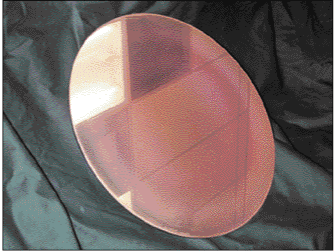
Nanolaminate mirror substrates are fabricated in a direct replication process that consists of magnetron sputtering on precise, optical-quality master tools. As a result, the mirror substrates as manufactured (see figure) have nearly optical quality. Because nanolaminates are metals, their coefficients of thermal expansion are greater than those of the low-thermal-expansion glasses ordinarily used to make precise curved mirrors. Hence, backing structures should be made of materials with coefficients of thermal expansion matching those of the nanolaminate mirror shells. The actuators could be used to compensate for any residual thermally induced surface-figure distortions up to a few microns.
This work was done by Andrew Lowman, David Redding, Gregory Hickey, Jennifer Knight, Philip Moynihan, and Shyh-Shiuh Lih of Caltech and Troy Barbee of Lawrence Livermore National Laboratory for NASA's Jet Propulsion Laboratory. For further information, access the Technical Support Package (TSP) free on-line at www.nasatech.com/tsp under the Materials category.
NPO-30222
This Brief includes a Technical Support Package (TSP).
Nanolaminate Mirrors With "Piston" Figure-Control Actuators
(reference NPO-30222) is currently available for download from the TSP library.
Don't have an account?
Overview
The document discusses the development of innovative thin-shell nanolaminate mirrors designed for high-resolution imaging in both visible and infrared light. These mirrors, with diameters around one meter, utilize metallic film reflectors on nanolaminate substrates supported by multiple distributed piezo-ceramic "piston" type actuators. This design allows for micron-level control of the mirror's surface figure, addressing the challenges associated with traditional mirror fabrication.
The motivation behind this development stems from the need for low areal density optical quality mirrors, particularly in the 1-meter class. Previous attempts at creating lightweight mirrors involved using light-weighted optical glass or graphite polymeric composites, which either required extensive fabrication time or were limited to specific wavelengths. The new approach introduces metallic nanolaminate substrates that are significantly stronger and can support thinner reflecting surfaces (100 to 150 microns thick). This reduction in thickness enables the use of distributed actuators, which provide precise surface control with minimal print-through effects.
The document highlights the advantages of this technology, including a substantial reduction in areal density to approximately 5 kg/m², which is a significant improvement over traditional glass mirrors that can weigh 50 kg/m² or more. Additionally, the processing time for these mirrors is expected to be reduced by an order of magnitude, making them more feasible for various applications.
The actuation mechanism is designed to counteract thermal distortions, which can affect mirror performance. The distributed actuators, combined with a reactive back surface, provide a lower-risk solution compared to precision in-plane actuation methods. This approach benefits from existing heritage and software development from current NASA and Department of Defense programs in adaptive optics.
Overall, the document outlines a promising advancement in mirror technology that could enhance imaging capabilities for both terrestrial and extraterrestrial applications. The combination of lightweight materials, efficient fabrication processes, and precise actuation mechanisms positions these nanolaminate mirrors as a significant step forward in optical engineering.











