A class of lightweight, deployable, thin-shell, curved mirrors with built-in precise-shape-control actuators is being developed for high-resolution scientific imaging. This technology incorporates a combination of advanced design concepts in actuation and membrane optics that, heretofore, have been considered as separate innovations. These mirrors are conceived to be stowed compactly in a launch shroud and transported aboard spacecraft, then deployed in outer space to required precise shapes at much larger dimensions (diameters of the order of meters or tens of meters).
A typical shell rollable mirror structure would include (1) a flexible single- or multiple-layer face sheet that would include an integrated reflective surface layer that would constitute the mirror; (2) structural supports in the form of stiffeners made of a shape-memory alloy (SMA); and (3) piezoelectric actuators. The actuators, together with an electronic control subsystem, would implement a concept of hierarchical distributed control, in which (1) the SMA actuators would be used for global shape control and would generate the large deformations needed for the deployment process and (2) the piezoelectric actuators would generate smaller deformations and would be used primarily to effect fine local control of the shape of the mirror.
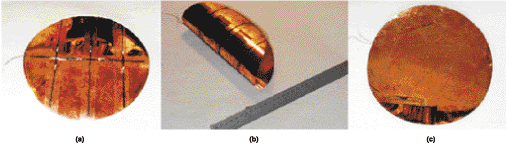
Another advanced design concept is that of nanolaminate mirror shells. This design concept builds upon technology reported previously in "Nanolaminate Mirrors With Integral Figure-Control Actuators" (NPO-30221), NASA Tech Briefs, Vol. 26, No. 5 (May 2002), page 80. Nanolaminates constitute a relatively new class of materials that can approach theoretical limits of stiffness and strength. For making the proposed mirrors, nanolaminates are synthesized by magnetron sputter deposition of metallic alloys and/or compounds on optically precise master surfaces to obtain an optical-quality reflector. Ideally, the crystallographic textures of the deposited layers would be controlled to optimize mechanical performance. The present development efforts are directed toward incorporating the nanolaminate concept into the first-mentioned concept of the deployable shell structure with built-in SMA and piezoelectric shape-control actuators. In a typical intended application, a thin-shell paraboloidal mirror would be stowed by rolling it into a taco or cigar shape. Subsequently, it would be deployed by use of its SMA, which would "remember" the unrolled shape. As shown in the figure, the feasibility of this stowage/deployment concept was verified in an experiment.
This work was done by Gregory Hickey and Shyh-Shiuh Lih of Caltech and Troy Barbee, Jr., of Lawrence Livermore National Laboratory for NASA's Jet Propulsion Laboratory.
NPO-30214
This Brief includes a Technical Support Package (TSP).
Rollable Thin-Shell Nanolaminate Mirrors
(reference NPO30214) is currently available for download from the TSP library.
Don't have an account?
Overview
The document outlines a progress report on the development of a deformable thin-shell nano-laminate mirror, initiated under the Director’s Innovative Initiative Program at the Jet Propulsion Laboratory (JPL) and Lawrence Livermore National Laboratory. The program began on October 1, 1999, and aims to address the space science community's need for ultra-lightweight, large aperture optical systems capable of producing high-resolution images in visible wavelengths.
Current mirror technologies face limitations due to high areal densities of optical substrates and supporting structures, as well as challenges in surface finish and dimensional stability in space environments. The report highlights that the maximum diameter of large mirrors is constrained by the launch vehicle payload fairing, with medium-class launch vehicles typically accommodating mirrors of about 3-4 meters in diameter. To overcome this limitation, the report proposes the development of mirrors that can be mechanically deformed into compact shapes (like a taco or cigar) for launch, allowing for larger optics (up to 10 meters) to be deployed in space.
The innovative solution combines two emerging technologies: nano-layer composite materials and electroactive shape memory materials. This combination aims to create an ultra-lightweight, optical quality, doubly curved mirror that can be deformed for launch and then reformed to its original shape in space while maintaining surface quality. The technology also has the potential to reduce costs associated with space-based optics by enabling the replication of lightweight primary mirrors from a master precision tool.
The report emphasizes the novelty of this work, detailing how it improves upon prior art by addressing the scalability and mass limitations of existing mirror technologies. The deformable mirrors are designed to be cost-effective and capable of being launched on medium-class vehicles, thus expanding the possibilities for large aperture space imaging systems.
Additionally, the document includes a disclaimer stating that references to specific commercial products or services do not imply endorsement by the U.S. Government or JPL. Overall, the report presents a significant advancement in optical technology for space exploration, with the potential to enhance scientific imaging capabilities in future missions.