The laboratory apparatus shown in the figure is a chamber for aerosol deposition of bioparticles on surfaces of test coupons. It is designed for primary use in inoculating both flat and three-dimensional objects with approximately reproducible, uniform dispersions of bacterial spores of the genus Bacillus so that the objects could be used as standards for removal of the spores by quantitative surface sampling and/or cleaning processes. The apparatus is also designed for deposition of particles other than bacterial spores, including fungal spores, viruses, bacteriophages, and standard micron-sized beads. The novelty of the apparatus lies in the combination of a controllable nebulization system with a settling chamber large enough to contain a significant number of test coupons. Several companies market other nebulizer systems, but none are known to include chambers for deposition of bioparticles to mimic the natural fallout of bioparticles.
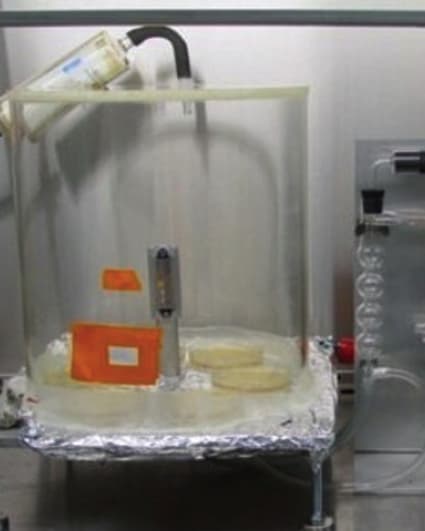
The nebulization system is an expanded and improved version of commercially available aerosol generators that include nebulizers and drying columns. In comparison with a typical commercial aerosol generator, this system includes additional, higher-resolution flowmeters and an additional pressure regulator. Also, unlike a typical commercial aerosol generator, it includes stopcocks for separately controlling flows of gases to the nebulizer and drying column.
To maximize the degree of uniformity of dispersion of bioaerosol, the chamber is shaped as an axisymmetrical cylinder and the aerosol generator is positioned centrally within the chamber and aimed upward like a fountain. In order to minimize electric charge associated with the aerosol particles, the drying column is made of aluminum, the drying column is in direct contact with an aluminum base plate, and three equally spaced 210Po antistatic strips are located at the exit end of the drying column. The sides and top of the chamber are made of an acrylic polymer; to prevent accumulation of electric charge on them, they are spray-coated with an anti-static material. During use, the base plate and the sides and top of the chamber are grounded as a further measure to minimize the buildup of electric charge.
This work was done by Roger Kern and Larry Kirschner of Caltech for NASA’s Jet Propulsion Laboratory.
In accordance with Public Law 96-517, the contractor has elected to retain title to this invention. Inquiries concerning rights for its commercial use should be addressed to:
Innovative Technology Assets Management
JPL
Mail Stop 202-233
4800 Oak Grove Drive
Pasadena, CA 91109-8099
(818) 354-2240
E-mail: This email address is being protected from spambots. You need JavaScript enabled to view it.
Refer to NPO-42191, volume and number of this NASA Tech Briefs issue, and the page number.
This Brief includes a Technical Support Package (TSP).
Chamber for Aerosol Deposition of Bioparticles
(reference NPO-42191) is currently available for download from the TSP library.
Don't have an account?
Overview
The document outlines NASA's development of a specialized Chamber for Aerosol Deposition of Bioparticles, designated as NPO-42191, created at the Jet Propulsion Laboratory (JPL) in Pasadena, California. The primary motivation for this project was the need for standardized test coupons and three-dimensional objects that could be inoculated with a reproducible number of bacterial spores. This was essential for evaluating cleaning methods aimed at achieving sterility, particularly in industrial hygiene contexts.
The project was initiated because existing commercial deposition systems were found inadequate for the specific requirements of the research. After extensive discussions with vendors and experts, including Dr. Paul A. Baron from the National Institute for Occupational Safety and Health, it became clear that a custom solution was necessary. Consequently, JPL developed a novel nebulizer-settling chamber apparatus designed to deposit spores uniformly on test articles.
The system consists of two main components: an aerosol generator and a deposition chamber. The aerosol generator is an enhanced version of commercially available devices, modified with higher resolution flowmeters, additional pressure control regulators, and stopcocks for individual gas control. The deposition chamber features a cylindrical design with a centrally located dispersion unit, which maximizes the uniform distribution of bioaerosols. To mitigate static charge accumulation on the particles, the chamber is constructed from aluminum and includes Polonium-210 antistatic strips, while the sides and top are made of acrylic treated with an anti-static coating.
This apparatus is designed primarily for inoculating coupons with a uniform dispersion of Bacillus spores, but it is also expected to be suitable for other biological materials, including fungal spores, viruses, and synthetic micron-sized beads. The chamber is compact enough to fit within a standard Class II Biological Safety Cabinet, ensuring safe handling during experiments.
The document emphasizes the novelty of this device, highlighting that while other nebulizer systems exist, none provide a dedicated chamber for housing test specimens to mimic natural fallout of particles. The only known similar device is a larger chamber constructed by the U.S. Army at Dugway Proving Grounds. Overall, this innovative system represents a significant advancement in the field of aerosol deposition for biological research and cleaning validation.