

A miniature optoelectronic instrument has been invented as a nonintrusive means of measuring a velocity gradient proportional to a shear stress in a flow near a wall. The instrument, which can be mounted flush with the wall, is a variant of a basic laser Doppler velocimeter. The laser Doppler probe volume can be located close enough to the wall (as little as 100 µm from the surface) to lie within the viscosity-dominated sublayer of a turbulent boundary layer.
Like other laser Doppler velocimeters, this instrument includes optics that split a laser beam into two parts that impinge on the probe volume from two different directions to form interference fringes in the probe volume. Also like other laser Doppler velocimeters, this instrument measures the frequency of variation of light reflected by particles entrained in the flow as they pass through the fringes (the velocity component that one seeks to measure is simply the product of this frequency and the fringe spacing). What distinguishes this instrument from other laser Doppler velocimeters is its highly miniaturized design and its unique fringe geometry.
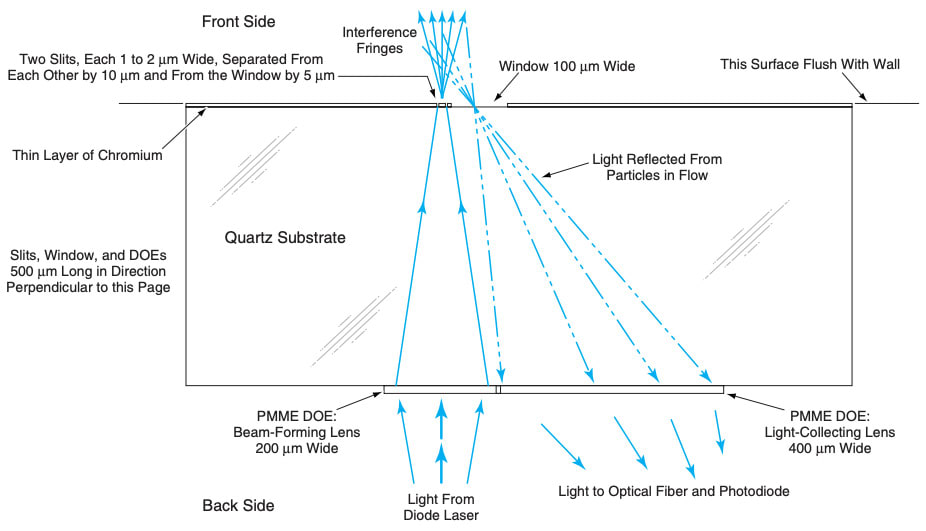
The instrument (see figure) includes a diode laser, the output of which is shaped by a diffractive optical element (DOE) into two beams that have elliptical cross sections with very high aspect ratios. The DOE focuses these beams through two slits a few microns apart on a surface that, in use, is mounted flush with the wall that bounds the flow. Light reflected from flow particles that pass through the fringes is collected through a window (essentially, a third, wider slit). Another DOE acts as focusing lens that couples the collected light into an optical fiber that, in turn, couples the light to an avalanche photodiode. The output of the photodiode is processed to measure the frequency of variation in the intensity of the reflected light
The interference between the laser beams forms fringes that diverge by an amount proportional to the distance from the wall: the fringes appear as radial spokes in the plane that contains a parallel-to-the-wall velocity component to be measured. Because the magnitude of this velocity component also increases linearly with distance from the wall in the viscosity-dominated flow regime and because the corresponding component of shear stress is proportional to the perpendicular-to-the-wall gradient of this velocity component, it follows that the frequency of variation of light reflected by particles entrained in the flow is proportional to the shear stress component that one seeks to measure.
The critical optical components for manipulating the laser light are fabricated on a 0.5-mm-thick quartz substrate in a sequence of microfabrication steps. The front surface (the top surface in the figure) is coated with a thin film of chromium, then further coated with poly(methyl methacrylate) [PMMA]. The slits and window are formed in the chromium film by electron-beam lithography followed by wet etching. The back surface is coated with PMMA, in which the DOEs are formed by electron-beam lithography. The unitary assembly of optical components thus formed is mounted in a compact housing that also holds the diode laser and the fiber-optic coupled photodiode.
This work was done by Morteza Gharib, Darius Modarress, Siamak Forouhar, Dominique Fourguette, Federic Taugwalder, and Daniel Wilson of Caltech for NASA’s Jet Propulsion Laboratory. For further information, access the Technical Support Package (TSP) free on-line at www.techbriefs.com/tsp under the Physical Sciences category.
In accordance with Public Law 96-517, the contractor has elected to retain title to this invention. Inquiries concerning rights for its commercial use should be addressed to:
Innovative Technology Assets Management
JPL
Mail Stop 202-233
4800 Oak Grove Drive
Pasadena, CA 91109-8099
(818) 354-2240
E-mail: This email address is being protected from spambots. You need JavaScript enabled to view it.
Refer to NPO-20851, volume and number of this NASA Tech Briefs issue, and the page number.
This Brief includes a Technical Support Package (TSP).
Miniature Laser Doppler Velocimeter for Measuring Wall Shear
(reference NPO-20851) is currently available for download from the TSP library.
Don't have an account?
Overview
The document is a Technical Support Package for the Miniature Laser Doppler Velocimeter (MLDV) designed for measuring wall shear, as referenced in NASA Tech Briefs NPO-20851. It is produced under the Commercial Technology Program of NASA, which aims to disseminate the results of aerospace-related developments that have potential applications beyond the aerospace sector.
The MLDV is a sophisticated instrument that utilizes laser Doppler technology to measure the velocity of fluid flow near surfaces, which is critical for understanding wall shear stress in various engineering and scientific applications. Wall shear stress is an important parameter in fluid dynamics, influencing the design and analysis of various systems, including aircraft, spacecraft, and other vehicles where fluid interaction with surfaces is significant.
The document emphasizes the broader implications of the MLDV technology, suggesting that it can be applied in various fields, including automotive, civil engineering, and environmental studies, where accurate measurements of fluid dynamics are essential. The MLDV's miniature design allows for easier integration into existing systems and facilitates measurements in confined spaces where traditional measurement techniques may be impractical.
Additionally, the document provides contact information for further assistance and resources available through the NASA Scientific and Technical Information (STI) Program Office. This includes access to a variety of publications and technical support related to research and technology in the field of fluid dynamics and measurement technologies.
It is important to note that the document includes a disclaimer stating that neither the United States Government nor any individuals acting on its behalf assume liability for the use of the information contained within. The mention of trade names or manufacturers is for identification purposes only and does not imply official endorsement by NASA.
In summary, the Technical Support Package for the Miniature Laser Doppler Velocimeter outlines the capabilities and potential applications of this innovative measurement technology, highlighting its significance in both aerospace and other industries. It serves as a resource for those interested in utilizing advanced measurement techniques to enhance their understanding of fluid dynamics and wall shear stress.











