

A method for correcting the aim of a beam-waveguide microwave antenna compensates for the beam aberration that occurs during radio tracking of a target that has a component of velocity transverse to the line of sight from the tracking station. The method was devised primarily for use in tracking of distant target spacecraft by large terrestrial beam-waveguide antennas of NASA's Deep Space Network (DSN). The method should also be adaptable to tracking, by other beam-waveguide antennas, of targets that move with large transverse velocities at large distances from the antennas.
The aberration effect arises whenever a spacecraft is not moving along the line of sight as seen from an antenna on Earth. In such a case, the spacecraft has a cross-velocity component, which is normal to the line-of-sight direction. In order to obtain optimum two-way communication, the uplink and downlink beams must be pointed differently for simultaneous uplink and downlink communications. At any instant of time, the downlink (or receive, Rx) beam must be pointed at a position where the spacecraft was 1/2-round-trip light time (RTLT) ago, and the uplink (or transmit, Tx) beam must be pointed where the spacecraft will be in 1/2 RTLT (see figure). In the case of a high-gain, narrow-beam antenna such as is used in the DSN, aiming the antenna in other than the correct transmitting or receiving direction, or aiming at a compromise direction between the correct transmitting and receiving directions, can give rise to several dB of pointing loss.
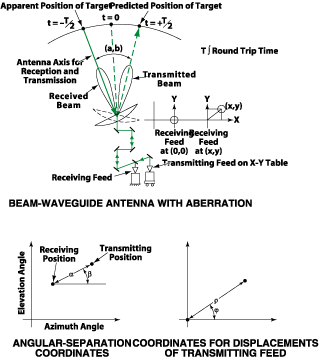
In the present method, the antenna is aimed directly at the apparent position of the target, so that no directional correction is necessary for reception of the signal from the target. Hence, the effort at correction is concentrated entirely on the transmitted beam. In physical terms, the correction is implemented by moving the transmitting feed along a small displacement vector chosen so that the direction of the transmitted beam is altered by the small amount needed to make the beam point to the anticipated position of the target at the anticipated time of arrival of the transmitted signal at the target.
The angular and linear coordinates mentioned in the following sentences are defined in the figure. The angular separation between the transmitting and receiving beams is described in terms of the separation angle a and the clock angle b. The transmitting feed is mounted on an X-Y translation table. The problem is to compute the polar coordinates r and f of the amount by which the transmitting feed must be displaced in the X-Y plane to move the direction transmitting beam, away from the direction of the receiving beam, by the amounts of the required angular separation. The problem becomes one of computing the r and f needed to obtain the required a and b. (Then the required X and Y are calculated from r and f by simple trigonometry.)
The algorithm used to control the X-Y table implements a closed-form representation of the coordinates r and f as functions of the coordinates a and b. This representation can be obtained by experimentation and/or physical-optics-based, computational-simulation studies of electromagnetic scattering by the pertinent antenna optics configuration for various combinations of r and f. The representation is of the general form
r = c1a + c2a2 and
f = fF - b + qEL - qAZ- nΠ/2 radians,
where c1 and c2 are coefficients determined by the computational study; fF is related to the feed position on the floor; qEL and qAZ are the elevation and azimuth angles, respectively; and nis one of the integers between -1 and +2, determined through measurements of beam offsets obtained at known feed offsets.
This work was done by Manuel Franco, Stephen Slobin, and Watt Veruttipong of Caltech for NASA's Jet Propulsion Laboratory. For further information, access the Technical Support Package (TSP) free on-line at www.techbriefs.com/tsp under the Computers/Electronics category.
NPO-30534
This Brief includes a Technical Support Package (TSP).
Correcting for Beam Aberrations in a Beam-Waveguide Antenna
(reference NPO-30534) is currently available for download from the TSP library.
Don't have an account?
Overview
The document presents a technical support package detailing a novel beam aberration correction technique for beam-waveguide (BWG) antennas, developed by researchers at NASA's Jet Propulsion Laboratory (JPL). The primary focus of this work is to enhance real-time communication capabilities for deep space missions, particularly when tracking spacecraft that do not move directly along the line of sight from Earth.
The technique addresses the issue of beam aberration, which occurs when a spacecraft has a cross-velocity component relative to the antenna, leading to a separation between the uplink (transmit) and downlink (receive) beams. This separation can significantly impact communication quality, especially for missions involving distant targets like Saturn, where the maximum beam separation can reach about 20 millidegrees. Without proper correction, communication losses can exceed 5 dB for over 30% of the time, and losses can be more than 20 dB near maximum separation, jeopardizing mission success.
The proposed solution involves a closed-form relationship between beam aberration angles and the corresponding feed displacement for reflector antennas equipped with BWG systems. This algorithm allows for accurate real-time predictions of feed movement based on known beam deviations while the antenna tracks a spacecraft. Specifically, the technique enables the uplink feed to move while keeping the downlink feed fixed, effectively managing the separation between the two beams.
The document includes numerical results and discussions based on measurements taken from the DSS-25 34m BWG antenna, which validate the proposed method. The results demonstrate excellent agreement between predicted and actual beam movements, showcasing the effectiveness of the technique in practical applications. Additionally, the document outlines the motivation behind the research, emphasizing the need for improved communication strategies in deep space missions.
Overall, this technical support package highlights a significant advancement in antenna technology, providing a robust solution to the challenges posed by beam aberration in deep space communications. The work is a collaborative effort by inventors Manuel M. Franco, Stephen D. Slobin, and Watt Veruttipong, and it underscores JPL's commitment to enhancing the capabilities of space exploration through innovative engineering solutions.











