The figure shows a tension/compression structure that provides rigid suspension and a high degree of thermal isolation for a small instrument assembly used in low-temperature experiments. The structure is designed primarily for use in a microgravitational environment; specifically, to support a sensor package in the Critical Dynamics in Microgravity Experiment (DYNAMX), which is scheduled to fly on the space shuttle as part of the Microgravity Science Payload in early 2002. The structure also is adaptable to scientific experimentation in normal Earth gravity in cases in which there are requirements for lightweight, rigid, thermally isolating structures in confining geometries.
High structural rigidity is necessary for low-temperature scientific experimentation in the microgravitational environment of a spacecraft in a low orbit around the Earth. The rigidity is needed not only to withstand loads encountered during launch but also to prevent amplification of low-frequency vibrations from the spacecraft (typically, the space shuttle), which vibrations can generate heat in an instrument and thereby bias the results of an experiment. High levels of thermal isolation are needed, not only between the instrument and the spacecraft, but also between components within the instrument, to prevent thermal "crosstalk"and the biases that such crosstalk could engender. In the case of a highly sensitive low-temperature instrument, the need for thermal isolation dictates minimization of instrument-component masses to minimize the bias attributable to heat deposited by cosmic rays.
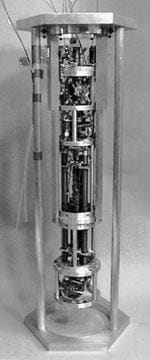
In this Tension/Compression Structure polymeric cords under tensile preload provide rigid suspension and thermal isolation of the suspended mass.
Heretofore, tension/compression structures have seldom been used in cryogenic applications, even though they offer enormous advantages in thermal isolation and rigidity. The present tension/compression structure includes a cylindrical exoskeleton, within which instrument components are held in position by tensioned Kevlar (or equivalent) aromatic polyamid cords. The combination of strength of the exoskeleton and preload in the cords provides rigid mounting for the instrument components. Because the cross-sectional area of the cords is small and the thermal conductivity of the cord material is low, the cords provide a high level of thermal isolation. The narrowness and low density of the cords also limits the deposition of heat from cosmic rays.
A computational simulation was performed to compare the performance of this structure with the performances of mounting structures of conventional designs. The results of the simulation showed that this structure could provide a higher level of thermal isolation from surrounding structures and a lower level of thermal crosstalk between instrument components.
This work was done by Alfred Nash and Linda Robeck of Caltech for NASA's Jet Propulsion Laboratory. For further information, access the Technical Support Package (TSP) free on-line at www.techbriefs.com under the category, or circle no. 21 on the TSP Order Card in this issue to receive a copy by mail ($5 charge).
This Brief includes a Technical Support Package (TSP).
Thermal-Isolation Structure for LowTemperature Experiments
(reference NPO20338) is currently available for download from the TSP library.
Don't have an account?
Overview
The document outlines a technical support package related to the development of a thermal-isolation structure for low-temperature experiments, specifically designed for use in microgravity environments. This work was conducted at the Jet Propulsion Laboratory (JPL) under a contract with NASA, and it is associated with the Critical Dynamics in Microgravity Experiment (DYNAMX), which is scheduled to be conducted aboard the space shuttle in early 2002.
The primary focus of the document is on the design, fabrication, and ground testing of a prototype flight sample subsystem that allows for precise measurements of the heat transport properties of liquid helium at the superfluid/normal fluid transition. The subsystem is engineered to achieve remarkable levels of resolution, including 10^-10 K thermal resolution, 10^5 m spatial resolution, and 10^-10 W heat flow resolution. These performance metrics are unprecedented for flight-qualified cryogenic apparatuses, presenting significant challenges in meeting the design requirements within the constraints of the experiment's configuration.
The document also discusses the novelty of the invention, highlighting that tension/suspension structures are rarely utilized in cryogenic applications, yet they offer substantial advantages in thermal and rigidity isolation. The design employs Kevlar cords to connect components to a robust external structure made of 6061 T6 aluminum, which enhances the overall performance of the system.
Despite the promising capabilities of the invention, the document notes that it is not yet ready for commercialization in its current form. Further development is necessary to refine the prototype and ensure it meets all operational requirements. The intended applications of this technology are primarily within the realm of low-temperature science, with no immediate commercial applications identified.
Additionally, the document mentions potential competitors in the field, such as Oxford Instruments and Janis Research, which are involved in developing cryogenic apparatuses. However, the unique performance levels of this invention differentiate it from existing technologies.
In summary, this document provides a comprehensive overview of a significant advancement in cryogenic technology, emphasizing its potential impact on scientific research in microgravity and the ongoing efforts to bring this innovative solution to fruition.