

The figure illustrates aspects of a proposed switching protocol for optical packet data communication that would serve as an alternative to the older store-and-forward and header-first protocols. In both older protocols, it is necessary to store a single header from each packet of data during the relatively long optical-switching time (typically tens of milliseconds) needed to set up optical input and output paths within each node. In the store-and-forward protocol, there is also a need for electronic storage of the data proper at each node during the setup time. Furthermore, typical implementations of both older protocols have depended on electronic control circuitry between nodes to set up the optical paths between nodes.
The proposed protocol would eliminate the need for both (1) electronic storage of headers and data proper and (2) internode electronic control circuitry. Depending on the specific implementation, local electronic control and switching circuitry might still be needed within each node, but the destination node address needed to set up the optical paths between nodes would be transmitted optically. Each data packet would begin with m identical copies of a header, where m= the number of optical switches along the intended data path. Each copy of the header would contain the address of the destination node. The data proper would follow the headers and would be followed by a trailer.
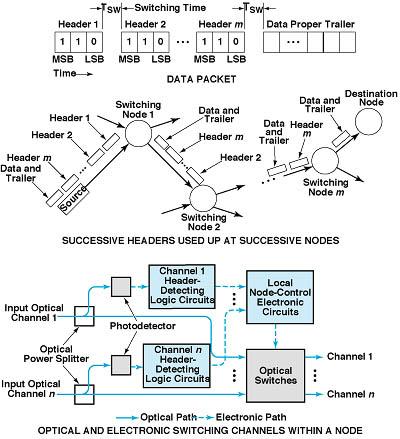
Starting with the first copy of the header in a packet and working back along the packet, successive copies of the header would be consumed in setting up the optical switches within successive nodes along the path. The interval between successive copies of the header would be made long enough to allow sufficient time for optical switching to occur, in the foremost node along the path, in response to the first copy of the header to arrive there. By the time the second copy of the header had arrived at the foremost node along the path, the foremost node would be configured to transmit the header, along with the rest of the packet, to the next node. Thus, the second copy of the header to arrive at a node would be passed on to the next node, becoming the first copy to arrive there. This process would be repeated, each successive node along the path momentarily becoming the foremost node, until all mcopies of the header were used up and the optical path through all mswitching nodes was established. The data proper would then follow along the path, followed by the trailer. As it passed through each node along the path, the trailer would signal each node to break the optical path and await the arrival of the next header, if any.
Because of the long optical-switching times, the data in the headers could be transmitted at relatively low rates, enabling the use of correspondingly slow logic circuits within the nodes to detect headers and control the optical-switching functions. However, the data proper could still be transmitted at high rates (gigabits per second) because the data path would be all-optical.
This work was done by Steve P. Monacos of Caltech for NASA's Jet Propulsion Laboratory.
This invention is owned by NASA, and a patent application has been filed. Inquiries concerning nonexclusive or exclusive license for its commercial development should be addressed to
the Patent Counsel
NASA Resident Office -JPL; (818) 354-5179
Refer to NPO-19522.
This Brief includes a Technical Support Package (TSP).
Switching protocol for optical packet data communication
(reference NPO19522) is currently available for download from the TSP library.
Don't have an account?
Overview
The document presents a technical support package detailing a novel switching protocol for optical packet data communication, developed by Steve P. Monacos at NASA's Jet Propulsion Laboratory (JPL). This protocol aims to improve data transmission efficiency by utilizing multiple identical copies of headers within data packets, thereby eliminating the need for electronic storage of packets and inter-node electronic control circuitry.
In traditional packet-switching methods, such as store-and-forward and header-first protocols, nodes must store headers and data during the lengthy optical-switching times, which can take tens of milliseconds. This new protocol circumvents these limitations by allowing each packet to begin with 'm' identical copies of a header, where 'm' corresponds to the number of optical switches along the intended data path. As the first header reaches a node, it enables the setup of the optical path, allowing subsequent headers to be processed without delay.
The document outlines the structure of the data packet, which consists of multiple headers followed by the data and a trailer. The headers contain the global ID of the destination device, facilitating the establishment of an all-optical pathway. The protocol is designed to ensure that by the time the second header arrives at a node, the first switch has already configured the necessary connections, allowing for seamless data transmission.
One of the key advantages of this protocol is that it permits the use of slower logic circuits within nodes to detect headers and control optical switching, as the data proper can be transmitted at high rates (in the gigabits per second range) through an all-optical path. This capability is particularly beneficial in high-speed networks, such as the proposed Supernet, which employs wavelength division multiplexing (WDM) to optimize routing and minimize the number of nodes required for data paths.
The document concludes by noting that a patent application has been filed for this invention, and inquiries regarding licensing for commercial development should be directed to NASA's Patent Counsel. Overall, this innovative switching protocol represents a significant advancement in optical communication technology, promising to enhance the efficiency and speed of data transmission in future networks.











