In a free-space optical communication system, the mitigation of transient out-ages through the incorporation of error-control methods is of particular concern, the outages being caused by scintillation fades and obscurants. The focus of this innovative technology is the development of a data relay system for a reliable high-data-rate free-space-based optical- transport network. The data relay boards will establish the link, maintain synchronous connection, group the data into frames, and provide for automatic re-transmission (ARQ) of lost or erred frames. A certain Quality of Service (QoS) can then be ensured, compatible with the required data rate. The protocol to be used by the data relay system is based on the draft CCSDS standard data-link protocol "Proximity-1," selected by orbiters to multiple lander assets in the Mars network, for example. In addition to providing data-link protocol capabilities for the free-space optical link and buffering the data, the data relay system will interface directly with user applications over Gigabit Ethernet and/or with high-speed storage resources via Fibre Channel. The hardware implementation is built on a network-processor-based architecture. This technology combines the power of a hardware switch capable of data switching and packet routing at Gbps rates, with the flexibility of a software-driven processor that can host highly adaptive and reconfigurable protocols used, for example, in wireless local-area networks (LANs).
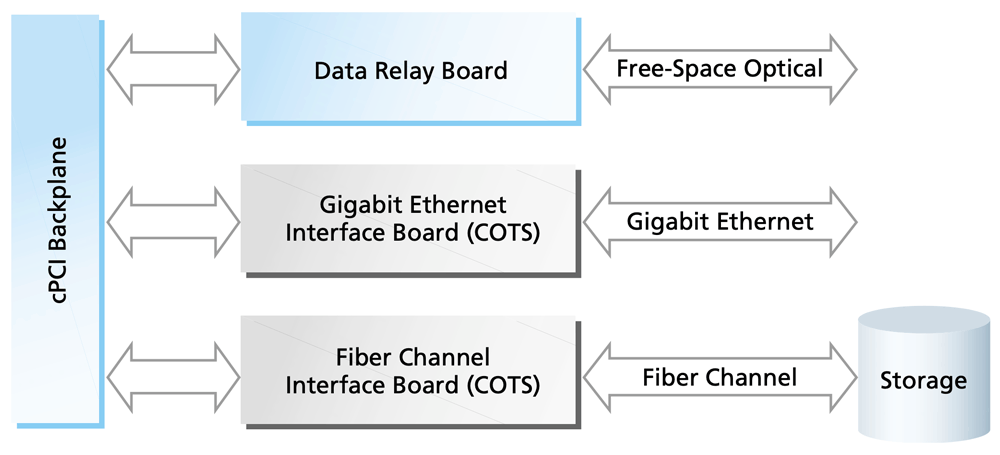
The system will be implemented in a modular multi-board fashion. The main hardware elements of the data relay system are the new data relay board developed by Rockwell Scientific, a COTS Gigabit Ethernet board for user interface, and a COTS Fibre Channel board that connects to local storage. The boards reside in a cPCI back plane, and can be housed in a VME-type enclosure. A block diagram of the data relay system is shown in Figure 1. The data relay board, shown in Figure 2, controls the data flow between the cPCI bus on the one hand and the transmitter and receiver on the other hand once the free-space optical link has been established.
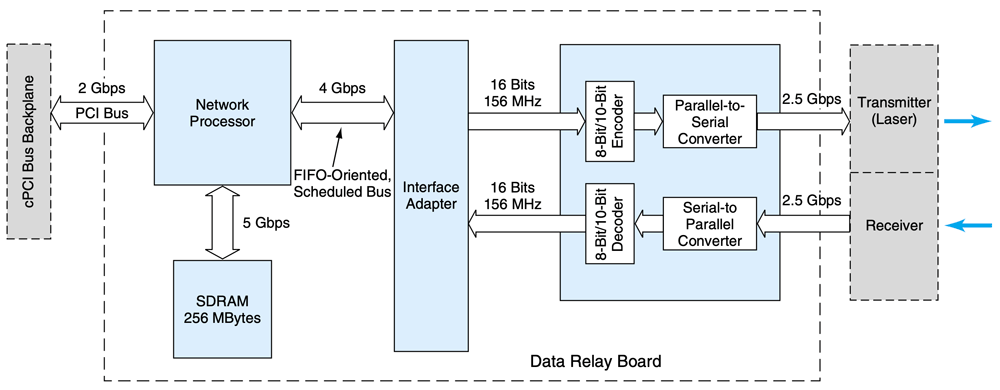
The data rates in transmission and reception need not be equal and could even differ by as much as several orders of magnitude. The data relay board would contain a commercially available network processor programmed to perform the primitive data handling function required by the protocol. Using a memory buffer, the network processor would accept, from the user application or storage through the cPCI bus, a stream of data to be transmitted to the laser. The network processor would form the data into appropriately sized frames with headers and frame sequence information to identify frames for the ARQ process. The frames would then be sent to an interface adaptor for frame acquisition and synchronization. The interface adaptor would then format the data into 16-bit words, add error check bits, and send the data to the serializer and encoder for transmission to the laser. As successful receipt of frames is acknowledged using the free-space optical link in the reverse direction, the corresponding data are cleared from the local memory so that capacity for new streaming data is made available. In the event of missed or corrupted data frames, the network processor will reconstruct and retransmit the data frames over the free-space optical link.
On the receiving side, the interface adapter will check for errors, while the network processor will check for frames out of sequence. For each received frame, the network processor will generate the appropriate ARQ control frame and pass it to the reverse channel free-space optical-link interface for transmission.
This work was done by Malcolm Wright and Loren Clare of Caltech and Gary Gould and Maxim Pedyash of Rockwell Scientific Center for NASA's Jet Propulsion Laboratory. For further information, access the Technical Support Package (TSP) free on-line at www.techbriefs.com/tsp under the Electronics/Computers category.
In accordance with Public Law 96-517, the contractor has elected to retain title to this invention. Inquiries concerning rights for its commercial use should be addressed to
Innovative Technology Assets Management
JPL Mail Stop 202-233
4800 Oak Grove Drive
Pasadena, CA 91109-8099
(818)354-2240
E-mail: This email address is being protected from spambots. You need JavaScript enabled to view it.
Refer to NPO-30610, volume and number of this NASA Tech Briefs issue, and the page number.
This Brief includes a Technical Support Package (TSP).
Data Relay Board With Protocol for High-Speed, Free-Space Optical Communications
(reference NPO-30610) is currently available for download from the TSP library.
Don't have an account?
Overview
The document is a technical support package from NASA detailing the Data Relay Board with Protocol for High-Speed, Free-Space Optical Communications, identified as NPO-30610. It outlines the development of a data relay system designed to facilitate high-speed optical communication in free space, addressing challenges such as transient outages caused by scintillation fades and obscurants.
The core of the system is the data relay board, which integrates essential functions for link establishment, maintenance of synchronous connections, framing, and automatic retransmission (ARQ) of lost or erroneous frames. This system is designed to ensure Quality of Service (QoS) and is compatible with high data rate requirements. The protocol utilized is based on the draft CCSDS standard data link protocol “Proximity-1,” which is particularly relevant for communication between orbiters and landers in the Mars network.
The hardware architecture includes a modular multi-board design, featuring components such as the Intel IXP1200 Network Processor, which manages data flow and error correction. The data relay board interfaces with user applications via Gigabit Ethernet and connects to high-speed storage resources through Fibre Channel. The system also employs a Xilinx FPGA for data link layer protocol processing and frame synchronization.
The document emphasizes the importance of error control methods due to the high data rates involved, highlighting the need for effective buffer management and implementation complexity. The Gigabit Transceiver within the system supports laser data rates up to 2.5 Gbps and includes built-in functions for error generation and checking.
Overall, the data relay board serves as a critical component in the free space optical communication system, enabling efficient data transfer between various subsystems and external users or storage assets. The technology aims to enhance communication capabilities in aerospace applications, with potential implications for broader technological and commercial uses. The document serves as a resource for understanding the advancements in optical communication technology and its applications in high-speed data relay systems.