

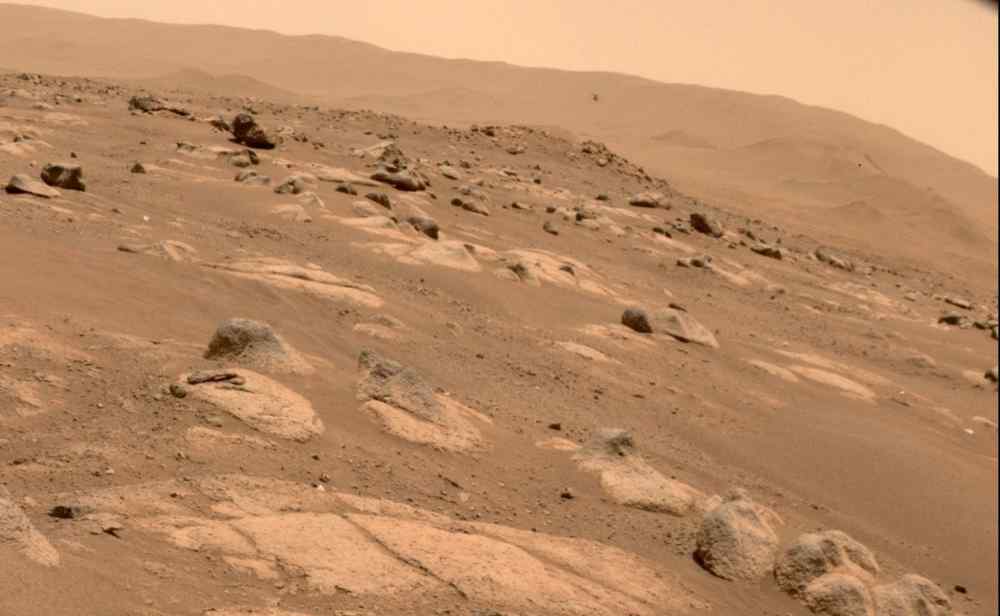
NASA wants to send humans to Mars as early as the 2030s , but astronauts will face particle radiation from the Sun, distant stars, and galaxies, as they travel on their nine-month-long journey to the Red Planet.
In a new article published in the peer-reviewed journal Space Weather, an international team of space scientists, including researchers from UCLA, determined two important conclusions about the risks of radiation: A human-led Mars mission is viable depending on spacecraft shielding and flight timing.
Astronauts on their way to Mars will face two types of dangerous radiation. Radiation originating from the Sun, known as solar energetic particles (SEP), could be very damaging if the travelers are not protected by the spacecraft. Even one solar eruption can create a critical radiation dose.
The second type of radiation, galactic cosmic rays (GCR), originates outside of our solar system. The intensity of this radiation is in general not as high as that of SEP, but the radiation can accumulate to harmful levels over time.
The scientists’ calculations demonstrate that it would be possible to shield a Mars-bound spacecraft from energetic particles during a period known as the "solar maximum," when the Sun is at its highest level of activity. The most dangerous and energetic particles from distant galaxies are deflected by the enhanced solar behavior in this period of time.
Additionally, the researchers recommend a mission not longer than four years because a longer journey would expose astronauts to a dangerously high amount of radiation during the round trip.
A launch to Mars and back is possible within half that time, according to Yuri Shprits, a UCLA research geophysicist, a co-author of the paper, and also a professor in Germany. The average flight to Mars takes about nine months.
“This study shows that while space radiation imposes strict limitations on how heavy the spacecraft can be and the time of launch, and it presents technological difficulties for human missions to Mars, such a mission is viable,” said Shprits, who also is head of space physics and space weather at GFZ German Research Centre for Geosciences in Potsdam, Germany, in a recent news release .
Shprits and colleagues from UCLA, MIT, Moscow’s Skolkovo Institute of Science and Technology and GFZ Potsdam (University of Potsdam) combined geophysical models of particle radiation for a solar cycle with models for how radiation would affect both human passengers — including its varying effects on different bodily organs — and a spacecraft. The modeling determined that having a spacecraft’s shell built out of a relatively thick material — aluminum measuring 30 g/cm2 — could help protect astronauts from radiation.
In a short Q&A with Tech Briefs below, Shprits explains more about the spacecraft material, and other ways to protect Mars-bound astronauts from radiation.
Tech Briefs: What has been the assumption (before your study) about the radiation on Mars, specifically in its impact on astronauts, and did your study change any of these assumptions?
Yuri Shprits: Often past studies looked separately at the effects of galactic cosmic rays and the effects of solar energetic particles.
Three were separate studies focusing on modeling the evolution of radiation, biological effects, and models of how radiation propagates through spacecraft but the combination of all these studies that would answer whether such mission is possible, how long should be such mission, and what should be the optimal shielding was missing.
We combined a realistic model of GCRs with actual observations of SEPs and performed calculations for a human phantom in a simplified spacecraft for different launch times, different durations of the mission, and different thickness of spacecraft. That all allowed us to combine all this knowledge and make realistic predictions for the duration of the mission.
Tech Briefs: What data sources are you pulling from to achieve a kind of simulation of the Mars environment, so that you can draw these conclusions?
Yuri Shprits: We use models of the GCRs based on long term historical and ground observations, and also historical observations of SEP from space.
Tech Briefs: What did you want to use this model to figure out exactly?
Yuri Shprits: Our goal was to make an estimate of how long approximately such a trip may be. There are still lots of uncertainties.
The biological effects of different types of radiation are not fully understood. The limit of 1Sv [units of sievert] may be revised in the future. At the same time the use of hydrogen-rich composite materials may provide a bit better shielding. While our calculations should not be interpreted as exact evaluation, they give a ballpark estimate and show that the mission would be difficult but viable.
Tech Briefs: What is the solar maximum, and why is it so important to launch a trip during that time window? Also, do we know exactly when this solar maximum will be?
Yuri Shprits: Usually, solar maximum is determined as a time when the highest number of sunspots is observed on the Sun during the 11-year solar cycle. During that time there is the highest number of coronal mass injections, and also the solar magnetic field is most distorted. It is difficult to know when the solar maximum would occur or if we are now at the maximum or not. However, it roughly repeats every 11 years, which could give a somewhat reasonable estimate.
Tech Briefs: Given the conclusions of your study, what should a spacecraft shell be made out of?
Yuri Shprits: We made estimates for aluminum. There are suggestions to use hydrogen compound materials. That would help to decrease the radiation and allow for a slight increase in the duration of the mission. To save on mass it's also possible to keep the fuel in the shielding of the spacecraft. It remains to be seen if such suggestions can be technologically possible.
In this initial study we considered only aluminum shielding which is the most commonly used material for the spacecraft. The estimate of the maximum mission duration should be approximately correct no matter what other materials one can use. Some adjustments can be made by using innovative solutions and that should be a subject of future research.
The main conclusion is that there is an optimal shielding, which for aluminum is 30 g/cm2. Thicker shielding would not help and would make things worse, as secondary radiation — particles produced from the interaction of the primary radiation with a spacecraft — would significantly increase. So, hydrogen-containing materials would help but would not dramatically change our conclusions.
At the end we gave an accurate ballpark estimate of maximum mission duration of 4 years. To reach this limit one would need to provide sufficient shielding to the spacecraft that would be comparable to the shielding on the International Space Station. If that's difficult, one would need to reduce the flight duration or fly faster, which requires more fuel.
Tech Briefs: Why 4 years? What starts to happen to human explorers after 4 years of exposure to the elements on Mars?
Yuri Shprits: At least currently the most accepted limit for the lifetime dose of radiation is 1 Sv. This limit will be reached in approximately 4 years no matter how well you shield the spacecraft.
Tech Briefs: Do the rewards of Mars exploration outweigh the potential risks from radiation?
Yuri Shprits: Well, that's more of a philosophical question. What we can say is that with using the state-of-the-art models and current knowledge of the radiation effects, it looks like a safe mission to Mars would be extremely difficult but still possible. Humans have always explored new places and pushed the frontiers of our reach further. I am sure we will do that in the future; that’s in our human nature.
What do you think? Share your questions and comments below.
Transcript
00:00:01 it's August 1972 and in Richardson a future NASA scientist is watching TV when the BBC announces the interference is caused by solar activity he didn't know it then but the Sun had just erupted in one of the most powerful solar events ever recorded there's no threat to humans because Earth's magnetic field deflects much of the sun's radiation but the explosions were
00:00:26 so powerful that intense radiation disrupted TV signals and caused radio blackouts so what if you were outside Earth's magnetic field on the moon and beyond astronauts face the risk of extreme radiation exposure luckily the intense radiation in 1972 occurred right between the Apollo 16 and 17 missions when no astronauts were in their path as NASA plans missions to go
00:00:51 back to the moon and then on to Mars predicting the sun's activity to protect astronauts from space radiation is one of our biggest priorities when the biggest unknown factors about going to space is the radiation hazard from the Sun this is in today studying the effects of the Sun also known as the field of Helio physics the Sun is always emitting radiation like the light we see
00:01:13 but certain energetic particles like from the August 1972 events can be far more harmful to be able to forecast cellular energetic particles we need to know how the Sun energizes them the Sun is made up of electrically charged particles called plasma as this plasma moves it builds up energy inside its massive magnetic field this energy is usually released in two types of
00:01:37 explosions flares are intense flashes of Lights coronal mass ejections are giant eruptions of solar material these solar eruptions sends shockwaves across the solar system accelerating particles as they go these are solar energetic particles or s EPS it consists mainly of protons and possess a lot of energy that can affect satellite measurements and humans SCPs can bombard you with a
00:02:02 lot of radiation in the short period of time they can penetrate your skin damage your DNA and increase your chances of getting cancer and radiation signals but they don't occur with every solar eruption only a small number of flares and coronal mass ejections create SCPs so we're trying to predict when SCPs form and how they travel through space at NASA's Goddard Space Flight Center
00:02:25 the community coordinated modeling Center or C CMC is dedicated to testing prediction models working with global partners they use data from NASA satellites at different vantage points and models to figure out how solar explosions behave including how shockwaves energize s EPS and as we get better at predicting we get more time to prepare preparation for an SCP event of
00:02:51 which you may know that is already coming in perhaps a magnitude as well the technique that you would want to use is to put as much mass between you and the source on the surface of the Moon or Mars astronauts can go underground for build shelter with local materials but in transits astronauts can only be protected with what's on the spacecraft which means that you might have elements
00:03:15 on a spacecraft that have multiple purposes NASA's space radiation specialists are testing different ways to do this one strategy they tested on the Orion spacecraft involves crew members barricading themselves with as much mass as possible in the center of the spacecraft other possible techniques in development include VESA add mass and electrically charged surfaces that
00:03:38 deflect particles in terms of radiation protection and radiation mitigation the factor of time is extraordinarily important the Sun has a natural 11-year cycle that transitions through low and high activity which is indicated by the number of sunspots on the surface more sunspots mean more up shion's resulting in a higher risk for scps but during this increased solar activity
00:04:05 the sun's magnetic field strengthens enhancing its shield against another important source of radiation galactic cosmic rains these are charged particles traveling at nearly the speed of light that are thought to come from supernova explosions from within our galaxy and possibly further out in the universe if solar energetic particles are intense sporadic storms then galactic cosmic
00:04:30 rays are a constant drizzle galactic cosmic rays are more sparse but also much more energetic they include heavier elements that can penetrate through vast amounts of materials understanding the rate of galactic cosmic rays helps us determine how much time astronauts can spend in space safely the date humans have only been on the lunar surface for a cumulative total of about 12 days a
00:04:54 trip to Mars will take six or ten months each way that means even more radiation exposure and so NASA is doing work to prepare for that the moon is going to be a test bed for us in order to be able to prepare for Mars the more that we understand the impact in the duration of radiation on the moon the more we can extrapolate that to the length of time that we will be spending in transit and
00:05:19 on the surface of Mars you











