

This column presents technologies that have applications in commercial areas, possibly creating the products of tomorrow. To learn more about each technology, see the contact information provided for that innovation.
Coil-on-Plug Igniter

Innovators at NASA Johnson Space Center have developed a coil-on-plug ignition system for integrated liquid oxygen (LOX)/liquid methane (LCH4) thermal-vacuum environment propulsion systems operating in a thermal-vacuum environment. The technology will help quell corona discharge issues and reduce overall mass. Corona discharge represents a local region surrounding a high-voltage conductor where air has undergone an electrical breakdown and become conductive due to ionization, allowing a charge to leak off the conductor and cause a possible malfunction. The coil-on-plug configuration eliminates the bulky standalone coil-pack and conventional high-voltage spark-plug cable by combining the coil and the spark plug into a single component. The technology can enable integrated LOX/methane propulsion systems in future spacecraft.
Contact: NASA’s Licensing Concierge
202-358-7432
This email address is being protected from spambots. You need JavaScript enabled to view it.
Wireless Underwater Camera
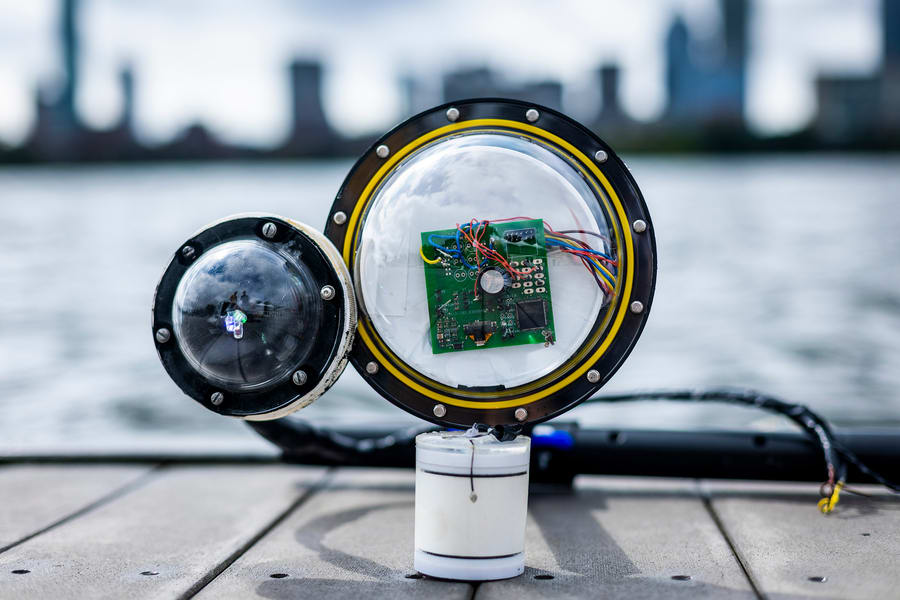
MIT engineers are addressing the challenge powering an underwater camera for a long time by developing a battery-free, wireless underwater camera that is about 100,000 times more energy-efficient than other undersea cameras. The device takes color photos, even in dark underwater environments, and transmits image data wirelessly through the water. The autonomous camera is powered by sound. It converts mechanical energy from sound waves traveling through water into electrical energy that powers its imaging and communications equipment. After capturing and encoding image data, the camera also uses sound waves to transmit data to a receiver that reconstructs the image. Because it doesn’t need a power source, the camera could run for weeks on end before retrieval, opening up opportunities for underwater monitoring and research.
Contact: Abby Abazorius
617-253-2709
This email address is being protected from spambots. You need JavaScript enabled to view it.
Nano-Copper Antibacterial Coating

A team of UBC researchers has designed a nano-copper coating that includes bacteria-killing nanoscale features and zinc. The nanoscale features are tiny bumps that can kill bacteria by rupturing their cell wall. Zinc, which is also antibacterial, selectively oxidizes in the presence of copper and helps kill bacteria more quickly compared to pure copper alone. According to the team, the use of their coating could significantly reduce the incidence of contracting bacterial infections from high-touch surfaces in healthcare facilities, such as doorknobs and elevator buttons. They found that the material took just one hour to kill 99.7 percent of Staphylococcus aureus — a Gram-positive pathogen commonly responsible for hospital-acquired infections — compared with two hours for pure copper. The research is currently targeted for hospitals and healthcare settings because these locations are where the antibiotic-resistant pathogens are an issue.
Contact: Lou Corpuz-Bosshart
604-822-2048
This email address is being protected from spambots. You need JavaScript enabled to view it.
Related Links:
5 Ws of Gel Film for Water Harvesting
Energy-Harvesting Device Turns Wi-Fi Signals into Usable Power











