Aerospace Manufacturing - February 2023
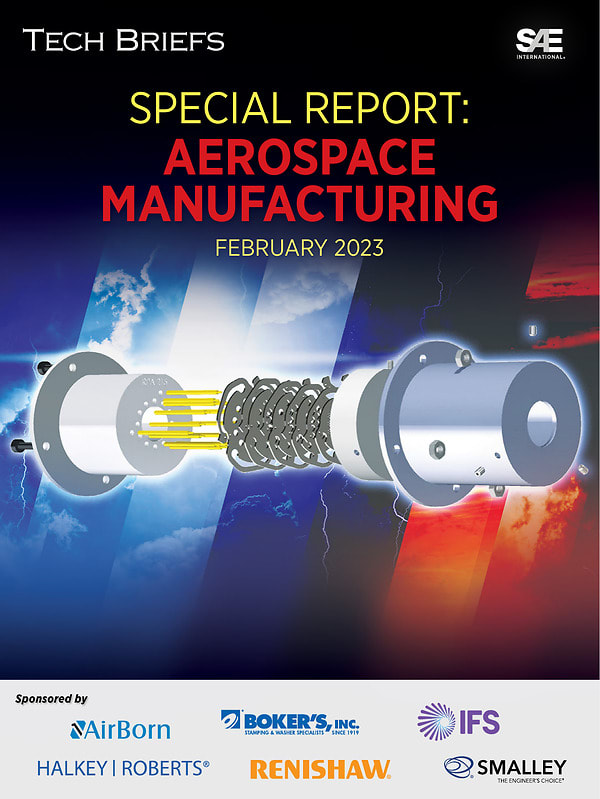
Learn about advances in 3D printing of spacecraft, large-scale aerospace composites manufacturing, cutting tools for tomorrow's sustainable aircraft, and more in this compendium of recent articles from the editors of Aerospace & Defense Technology and Tech Briefs.
Don't have an account?
Overview
The February 2023 Special Report on Aerospace Manufacturing delves into the transformative advancements within the aerospace and defense industry, particularly focusing on the adoption of additive manufacturing (AM) and its implications for design, production, and performance.
One of the key themes of the report is the significant role of AM in lightweighting and part consolidation. The use of advanced superalloy powders for 3D printing allows manufacturers to create complex geometries that were previously unattainable. This capability not only enhances design flexibility but also improves performance metrics through features like intricate internal passageways and support-free structures. The report notes that while the aerospace sector has been cautious in adopting AM due to regulatory concerns surrounding human flight, there have been successful certifications of 3D-printed components, such as those from GE for aircraft engines. This highlights a gradual but promising shift towards integrating AM into commercial aviation.
The report also showcases specific case studies demonstrating the advantages of AM. For instance, a new thruster design made from lightweight titanium instead of Inconel resulted in a component that is significantly lighter, smaller, and more cost-effective than traditional manufacturing methods. This innovation not only reduces material costs but also simplifies assembly and minimizes the risk of operational failures. Companies like Launcher are highlighted for their strategic use of AM in developing low-cost, small-satellite-launch programs, indicating a broader trend of startups leveraging these technologies from inception.
In addition to AM, the report discusses the importance of simulation and advanced software technologies in optimizing factory operations. As the manufacturing landscape evolves, companies are encouraged to adopt new management approaches that complement the capabilities of AM. This includes refining production processes to enhance efficiency and responsiveness to market demands.
The report also touches on the challenges faced by aerospace and defense manufacturers, particularly in contract management and compliance with defense regulations. Enhanced cloud services are presented as a solution to streamline contract reporting and improve operational excellence in defense manufacturing.
Furthermore, the report highlights ongoing innovations in materials and processes, such as new heat treatments that enable 3D-printed metals to withstand extreme conditions, and the development of 3D-printed sensors that could advance weather research. These advancements underscore the potential of AM to not only revolutionize manufacturing but also contribute to broader scientific and technological progress.
Overall, the February 2023 Special Report on Aerospace Manufacturing provides a comprehensive overview of the current state and future potential of the aerospace industry, emphasizing the critical role of additive manufacturing in driving innovation, efficiency, and sustainability. As the industry continues to embrace these technologies, it is poised for significant transformation, paving the way for more advanced and capable aerospace systems.