

Robotics - March 2024
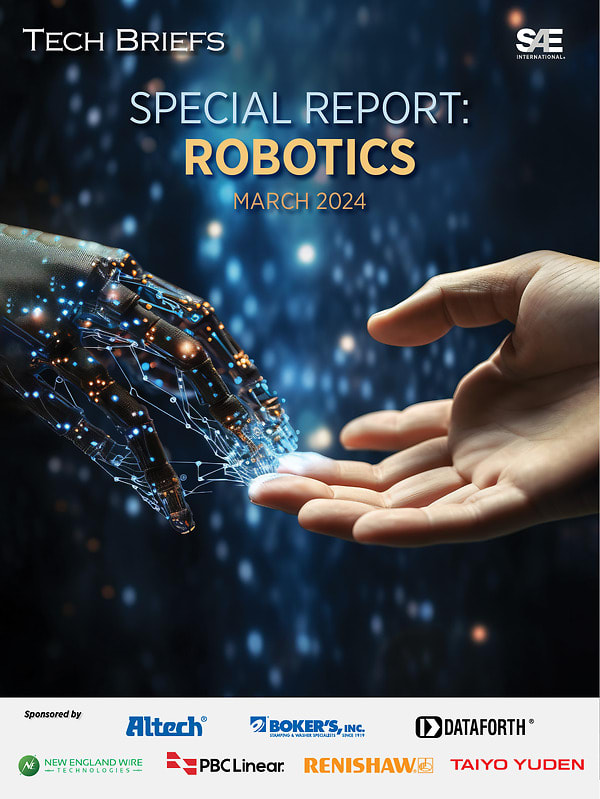
Read about the latest advances in robots for space exploration, healthcare, search & rescue, warehouse automation, and more in this compendium of recent articles from the editors of Tech Briefs, Medical Design Briefs, and Aerospace & Defense Technology.
Don't have an account?
Overview
The March 2024 Special Report on Robotics presents a comprehensive overview of the latest advancements and applications in the field of robotics, emphasizing their transformative potential across various sectors, particularly in healthcare and environmental conservation.
One of the standout features of the report is the exploration of medical robotics, which are revolutionizing healthcare by performing a range of tasks from administrative duties to critical surgeries. These robots enhance efficiency, reduce human error, and improve patient outcomes, showcasing the significant role of technology in modern medicine.
In the realm of environmental conservation, the report highlights a pilot project between ABB Robotics and the non-profit organization Junglekeepers. This initiative utilizes ABB's collaborative robot, YuMi, to automate reforestation efforts in the Amazon rainforest. By employing cloud technology, the project enables remote operation of the robot, which accelerates planting tasks and allows human volunteers to focus on more impactful activities. This innovative approach aims to combat deforestation, a major contributor to climate change, and underscores the importance of integrating technology with conservation efforts.
The report also discusses advancements in machine learning techniques developed by researchers from MIT and Stanford University. These techniques enhance the control of robots, such as drones and autonomous vehicles, in dynamic environments. By enabling robots to adapt to rapidly changing conditions—like slippery roads or strong winds—these innovations improve the safety and efficiency of robotic operations in various applications.
Another notable development is the introduction of the CLARI robot, designed by engineers at the University of Colorado Boulder. This small, shape-shifting robot can transform its form to navigate through tight spaces, making it particularly useful for first responders in disaster scenarios. With a modular design that allows for customization, CLARI represents a significant step forward in creating versatile robotic solutions capable of operating in challenging environments.
The report also features a snake-like robot designed for traversing extreme terrains, which could be applicable in both terrestrial and extraterrestrial exploration. Additionally, it discusses a precision arm for mini robots, a software model that enhances the intelligence of transport robots, and an origami-inspired robot that utilizes a single motor for self-folding and movement.
Overall, the Special Report on Robotics emphasizes the critical role of robotics in addressing contemporary challenges, from healthcare to environmental sustainability. It highlights the collaborative efforts between technology and human expertise, showcasing how innovative robotic solutions can lead to more efficient processes, improved safety, and enhanced quality of life. As the field continues to evolve, the integration of robotics into various sectors promises to drive significant advancements and create new opportunities for the future.











