

Space Technology - May 2024
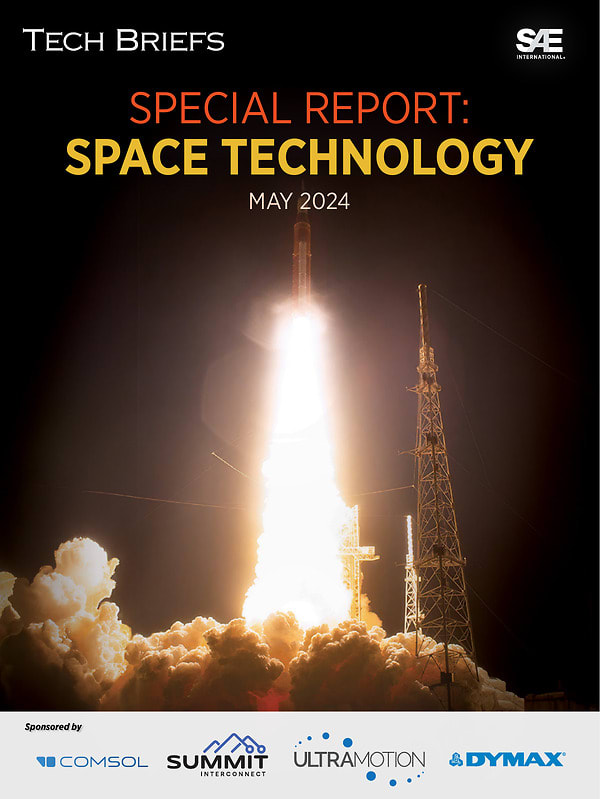
NASA's plan for building landing pads on the moon...the first 3D-printed rocket to reach orbit...MAPLE mission demonstrates wireless power transfer in space. Read about these and other exciting advances in this compendium of articles from the editors of Tech Briefs and Aerospace & Defense Technology.
Don't have an account?
Overview
The May 2024 Special Report on Space Technology presents a comprehensive overview of recent advancements and innovations in the field of space exploration and technology. It highlights key projects, technologies, and methodologies that are shaping the future of space missions.
One of the standout features of the report is the discussion on the Space Solar Power Demonstrator (SSPD-1), developed by Caltech’s Space Solar Power Project (SSPP). This project aims to harvest solar energy in space and transmit it to Earth. A significant breakthrough from this initiative is the Microwave Array for Power-transfer Low-orbit Experiment (MAPLE), which successfully demonstrated wireless power transfer in space. MAPLE utilizes a flexible array of lightweight microwave power transmitters, driven by custom electronic chips made from low-cost silicon technologies. This innovation is crucial for the feasibility of space solar power, as it allows for lightweight and flexible energy transmission arrays that can be efficiently transported to space. The successful transmission of power to receivers in space marks a significant milestone, potentially enabling a new era of energy generation that is not limited by terrestrial constraints such as day-night cycles or weather conditions.
The report also touches on the advancements in rocket and engine manufacturing. Traditional methods of building rockets involve rigid design processes that require early decision-making. However, new approaches are emerging that leverage modern technologies to enhance flexibility and efficiency in design and production. This shift is essential for meeting the demands of the rapidly expanding commercial space market, where reliability and performance in harsh environments are critical.
Another highlight is the James Webb Space Telescope, which has provided stunning images of the universe thanks to its sophisticated 21-foot segmented mirror that autonomously unfurled and assembled itself in space. This capability underscores the importance of advanced engineering and design in modern space exploration.
The report also discusses the role of additive manufacturing in reducing rocket build times, showcasing how 3D printing technologies are being integrated into space applications. This method allows for rapid prototyping and production of complex components, which can significantly streamline the manufacturing process.
Additionally, the report covers various technological advancements, including regolith-polymer 3D printing, conductive carbon fiber polymer composites, and innovative navigation technologies for lunar exploration. These developments are crucial for future missions, particularly as humanity aims to establish a sustainable presence on the Moon and beyond.
In summary, the May 2024 Special Report on Space Technology encapsulates the dynamic landscape of space exploration, emphasizing the importance of innovation, flexibility, and advanced technologies. From solar power transmission in space to the integration of 3D printing in rocket manufacturing, these advancements are paving the way for a new era of exploration and utilization of space resources. The report serves as a testament to the ongoing efforts and collaborations in the field, highlighting the potential for future breakthroughs that could redefine our understanding and capabilities in space.







