The term “submillimeter confocal imaging active module” (SCIAM) denotes a proposed airborne coherent imaging radar system that would be suitable for use in reconnaissance, surveillance, and navigation. The development of the SCIAM would include utilization and extension of recent achievements in monolithic microwave integrated circuits capable of operating at frequencies up to and beyond a nominal radio frequency of 340 GHz. Because the SCIAM would be primarily down-looking (in contradistinction to primarily side-looking), it could be useful for imaging shorter objects located between taller ones (for example, objects on streets between buildings). The SCIAM would utilize a confocal geometry to obtain high cross-track resolution, and would be amenable to synthetic-aperture processing of its output to obtain high along-track resolution.
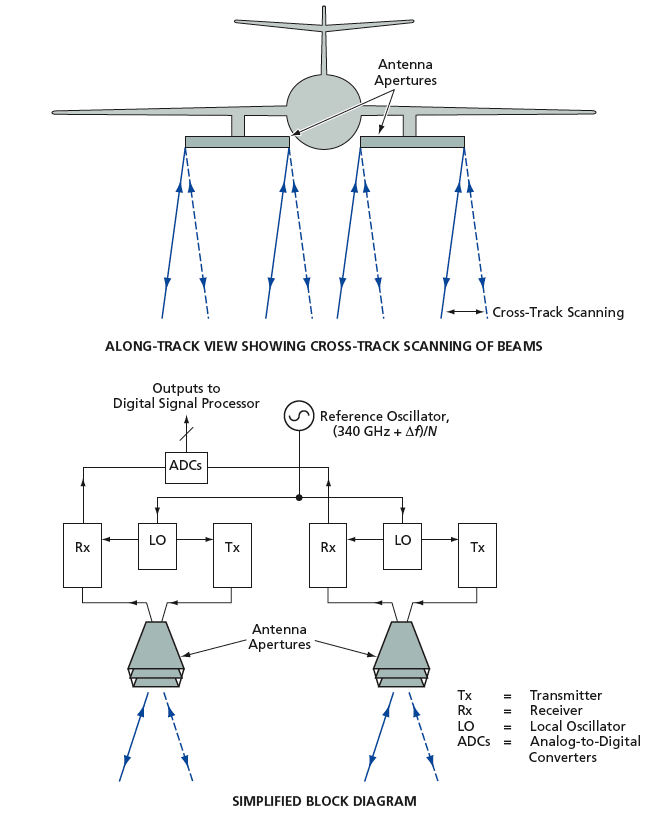
Because duplexers in the form of circulators or transmit/receive (T/R) switches would be lossy and extremely difficult to implement, the antenna apertures would be designed according to a spatial-diplexing scheme, in which signals would be coupled in and out via separate, adjacent transmitting and receiving feed horns. This scheme would cause the transmitted and received beams to be aimed in slightly different directions, and, hence, to not overlap fully on the targets on the ground. However, a preliminary analysis has shown that the loss of overlap would be small enough that the resulting loss in signal-to-noise ratio (SNR) would be much less than the SNR loss associated with the use of a 340-GHz T/R switch.
In each antenna aperture, the receiving and transmitting feed horns would face a reflector structure that would be designed partly according to both a Fresnel-lens principle to minimize antenna volume and partly according to a diffraction-grating principle so that the beam direction in the cross-track plane would become dependent on the signal frequency. The Fresnel surfaces would be confocal paraboloids having focal-length increments of a half wavelength, and the sizes of the Fresnel steps would be chosen to obtain a desired amount of angular deviation for a given amount of frequency tuning. For example, according to one tentative design, sweeping the radio frequency from 335 to 345 GHz would cause the beam to scan a cross-track ground swath 30 m wide from a height of 1 km. Through post-detection processing of the return signals received via the two apertures, a cross-track image resolution of 27 cm would be obtained; in effect, the 30-m cross-track swath could be divided into 111 pixels of 27-cm width. Comparable along-track resolution would be obtained through synthetic-aperture postprocessing.
This work was done by John Hong, Imran Mehdi, Peter Siegel, Goutam Chattopadhyay, and Thomas Cwik of Caltech; Mark Rowell of the University of California, Santa Barbara; and John Hacker of Rockwell Scientific Company LLC for NASA’s Jet Propulsion Laboratory. NPO-42924
This Brief includes a Technical Support Package (TSP).
Submillimeter Confocal Imaging Active Module
(reference NPO-42924) is currently available for download from the TSP library.
Don't have an account?
Overview
The document outlines the Submillimeter Confocal Imaging Active Module (SCIAM), a cutting-edge radar system developed by NASA's Jet Propulsion Laboratory (JPL). This technology operates in the submillimeter wave range, specifically at an operational frequency of 340 GHz, and is designed to be mounted on unmanned aircraft vehicles (UAVs). The primary purpose of SCIAM is to enhance imaging capabilities in various atmospheric conditions, including severe weather, by utilizing synthetic aperture radar (SAR) techniques.
Key features of the SCIAM system include its ability to transmit signals and analyze radar returns, which allows for high-resolution imaging. The system's performance metrics indicate a fair-weather signal-to-noise ratio (SNR) of 52 dB, with a severe weather SNR of over 28 dB. The atmospheric attenuation in severe weather is noted to be 12 dB/km, which highlights the system's resilience in challenging conditions. The UAV operates at an altitude of 1 km, with a swath width of 30 m, and the azimuth and cross-track resolutions are both 27 cm, showcasing the system's precision.
The document also emphasizes the architecture of the submillimeter wave SAR system, which includes components such as Gaussian horn antennas and data conversion and processing units. This architecture is crucial for the effective functioning of the SCIAM system, enabling it to capture detailed images by leveraging the forward movement of the UAV and the number of pixels on its wings.
Additionally, the document serves as a technical support package, providing information under NASA's Commercial Technology Program. It aims to disseminate aerospace-related developments that have broader technological, scientific, or commercial applications. The document includes contact information for further inquiries and emphasizes that the information is subject to export control regulations.
Overall, SCIAM represents a significant advancement in radar technology, with the potential to improve imaging in various applications, including environmental monitoring and disaster response. Its innovative design and capabilities position it as a valuable tool for future aerospace endeavors.