

The Create the Future Design Contest — sponsored by COMSOL, Mouser Electronics, and presented by SAE Media Group — has helped bring out the best technologies for the future throughout its 22-year run.
Much like last year, Create the Future Design Contest 2024, held on November 15 in New York City, had the finalists in each of the seven categories pitch their ideas to a team of judges, who would then choose the Grand Prize winner based on a 20-point scoring system.
The 2024 contest rewarded innovation in seven categories: aerospace & defense, automotive and transportation, electronics, manufacturing and materials, medical, robotics and automation, and sustainable technology. There were two prior rounds of judging to determine the seven finalists — one for each category.
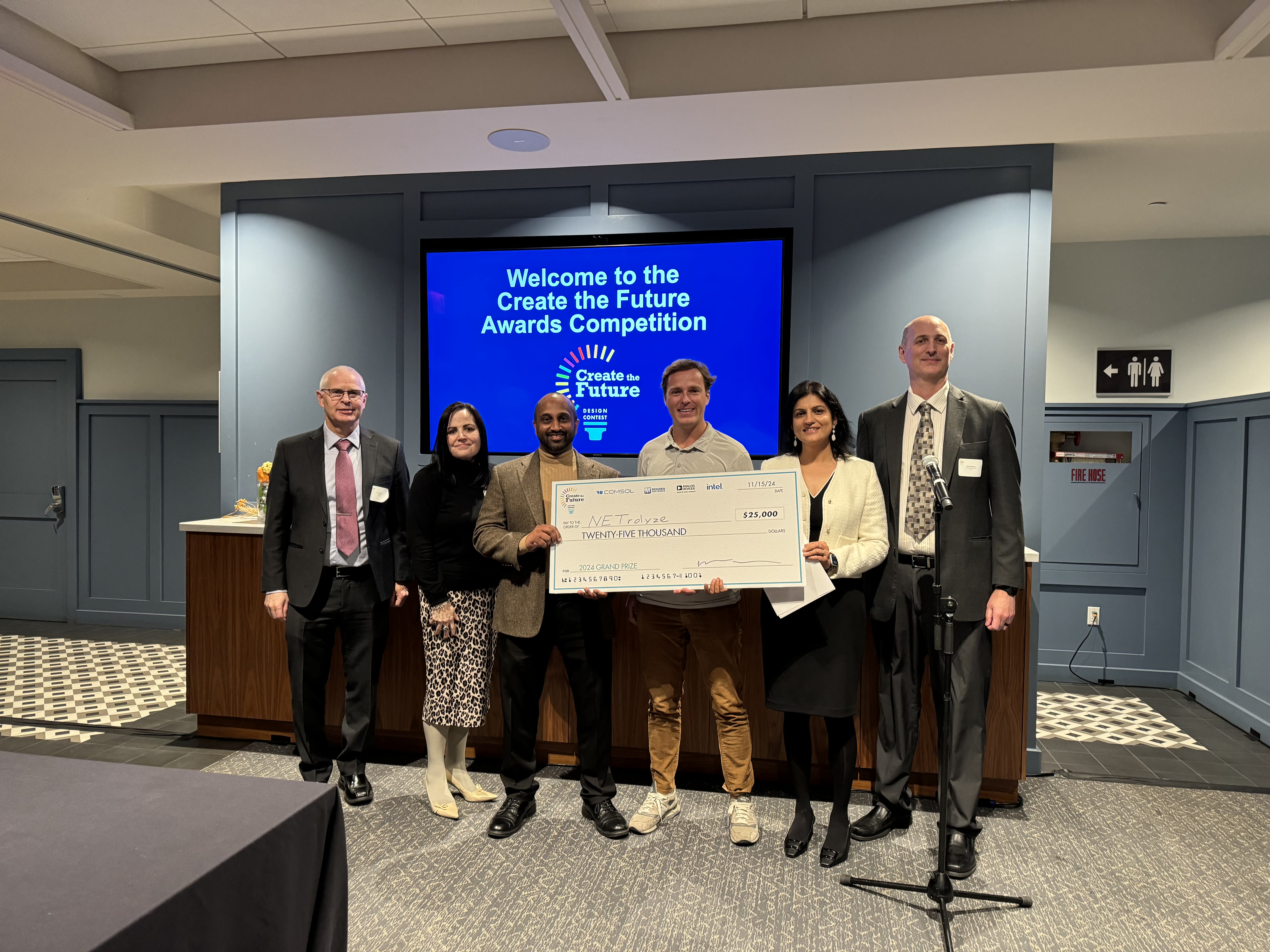
Each finalist had 10 minutes to pitch their idea, followed by a three-minute Q&A with the judges. The top prizes in the 2024 edition — including the Grand Prize winner, NETrolyze, which took home the $25,000 prize, and the winning designs in seven categories, who all took home an HP workstation computer — were awarded at the live event.
“Given how innovative and accomplished the other finalists and their projects were, it is humbling for us simply to be considered alongside them,” said NETrolyze team member Priyan Weerrappuli. “As someone who grew up reading Tech Briefs, winning this Grand Prize feels amazing — and very much like a 'full circle' moment. The prize itself will go a long way toward supporting two pre-clinical studies we are conducting to further advance our therapeutic, NETrolyze, toward the clinic,” he added.
GRAND PRIZE WINNER: NETrolyze — A Novel Immunotherapy for Triple-Negative Breast Cancer
Triple-negative breast cancer (TNBC) is a highly aggressive subtype of breast cancer that poses significant challenges in treatment. The primary problem with TNBC is the lack of effective treatments to stop cancer metastasis, the spread of malignant cancer cells from the primary tumor to distant organs. TNBC tumors exhibit high rates of metastasis and are becoming increasingly more prevalent, disproportionately affecting African American women. The current standard of care strategies, such as notoriously toxic chemotherapy, require weeks to months to demonstrate efficacy and often fail due to tumor resistance. There is currently no therapeutic option that specifically targets and prevents metastasis following the initial detection of TNBC.
A team at the University of Michigan has designed an innovative first-in-class therapeutic injectable that directly targets the metastatic process in TNBC. Their product, NETrolyze, consists of a small molecule loaded into a slow-release gel, designed to continuously fight off metastasis. It systematically targets only the cancerous tumor while preserving the integrity of the body’s overall immune system.
For more information, visit here .
Aerospace & Defense Winner: AlchLight, Laser-Generated Anti-Icing and Anti-Fogging Transparent Materials
The windshields, windows, and covers of aircraft, cars, vehicles, and cameras must endure harsh environments. Snow and ice buildup pose significant risks in cold weather, while fogging can obscure the pilot’s or driver’s view, compromising safety. Icing and fogging on cameras also impact their operational effectiveness. To address these challenges, AlchLight has invented and pioneered a non-coating laser surface processing (LSP) technology that turns regular transparent materials such as glass and polymers superhydrophobic. The altered materials also provide superior anti-icing and anti-fogging capabilities while maintaining high transparency. Moreover, AlchLight has developed the world’s first m-nm surface multi-functionalization workstation that can process a meter-size surface area at an nm resolution on both flat and curved surfaces, which can scale and transfer LSP to the marketplace.
For more information, visit here .
Automotive & Transportation Winner: Transensys Multi-Modal Traffic Detection System
The Transensys Multi-Modal Traffic Detection System aims to dramatically improve traffic congestion issues seen worldwide. The amount of time humans spend on roadways represents a significant portion of our daily lives; we have become so accustomed to it that we don’t even question it. A significant percentage of this time is spent waiting at traffic lights. In the US alone, around 306,000 hours are spent daily by US residents at traffic lights. Current systems to detect traffic are complex, costly, and inaccurate. The Transensys Multi-Modal Traffic Detection System is aims to provide widespread, low-cost, and accurate traffic measurement, dramatically reducing intersection wait times, thus providing huge benefits to people and the environment. The system is based on a key computer vision algorithmic innovation coupled with low-cost sensors (camera and LWIR). The software algorithm is paired with cost-effective IoT (Internet of Things) hardware components. These include both a camera and long-wavelength IR.
For more information, visit here .
Electronics Winner: Thin-Film Thermoelectric Cooling Device
Developed by the Johns Hopkins Applied Physics Laboratory (APL) researchers, the wearable thin-film thermoelectric cooling (TFTEC) device is one of the world’s lightest, thinnest, and fastest refrigeration devices. In a form-factor similar to an adhesive bandage, TFTEC has a high-speed and cooling power density capable of matching the human body’s ability to rapidly sense temperature change, and thus providing intuitive thermal perceptions for those with missing limbs and prostheses. TFTEC was used in noninvasive neuro-simulation trials of several amputee and non-amputee individuals and elicited cooling sensations in the phantom limb of all participants, whereas traditional thermoelectric technology only did so in half of the participants. The successful interaction between TFTEC and the human interface demonstrates a significant step towards a reality in which advanced human-machine systems deliver complex neuro-sensory feedback for a variety of applications including prosthetics, virtual reality, pain management, and beyond.
For more information, visit here .
Manufacturing & Materials Winner: RHOBARR™ Barrier Dispersions Platform
The innovative RHOBARRTM line of high-performance waterborne coating products for recyclable paper-based packaging offers award-winning technologies that provide barrier against oil and grease, fatty acids and mineral oil, and hot/cold liquids, along with additional packaging properties such as heat seal, film flexibility, and block resistance. RHOBARRTM Barrier Dispersions are applied to paper/board as an aqueous dispersion, then dried to form ultra-thin (95 percent fiber recovery rate in internal testing (Voluntary Standard for Repulpability from the Fibre Box Association (FBA)), internal cradle-to-grave life cycle analyses validating significant improvements over extrusion-coated paper, and iv) external validation of ~30 percent bio-renewable carbon content (Beta Labs according to ASTM-D6866).
For more information, visit here .
Robotics & Automation Winner - AstroAnt: A Miniature Symbiotic Robotic Serving on the Outside Surfaces of Spacecraft, Rovers, and Landers for Inspection and Diagnostic Tasks
Future in-space operations — across low-Earth orbit (LEO), lunar missions, and out to Mars — will heavily leverage robotics to improve systems performance, reduce risk to human crews, and contribute to novel mission capabilities. Robots have long been used for remote operations such as supporting space missions. Expanding beyond large, cost-intensive robotic platforms, this novel approach from the MIT Media Lab proposes spacecraft environment monitoring, both internal and external, with small, low-cost swarm robots. The “AstroAnts” are small robots for inspection and diagnostic tasks on external spacecraft surfaces, both in orbit and on planetary surfaces. These multifunctional, autonomous, wheeled, robotic swarm units can traverse a wide range of surfaces, sense and interact with their environment, and cover extensive territory.
Each robot features a modular design with varying sensor payloads that can be tailored based on custom mission requirements. Many AstroAnt robots can form an “On-body” sensor network for a spacecraft. By doing inspection sensing from the external surface, the data collected from the robots can be used to monitor the real-time performance of the host mothership.
For more information, visit here .
Sustainable Technology Winner: Cosmetic Silica Upcycled from Rice Husk as Natural Alternative to Microplastic Powders
The personal care market is seeking innovative cosmetic ingredients that feature high sustainability profiles, excellent optical and sensory properties, and adhere to regulatory standards. Current regulations limit the use of several cosmetic powders in cosmetic products due to their classification as microplastics, so there was a need to develop an alternative powder that could replace those cosmetic powders. EcoSmooth™ Rice Husk Cosmetic Powder is a silica from rice husk waste origin that can offer similar optical and sensorial performance than Polymethylmethacrylate (PMMA) powder and Nylon-12 powder. Contrary to PMMA and Nylon-12, this material can be dispersed in the water or the oil phase of the cosmetic emulsions and therefore performs well in a wide variety of skin care (cream), color cosmetic (foundation) and hair care (dry shampoo) formulations.
For more information, visit here .
Transcript
00:00:00 upop is our medical category finalist uh nrol Li a normal immunotherapy for triple negative breast cancer and we have with us Sam ker and pran Bly will be presenting the idea of theic category hi I'm pran this is Sam and we're here from extrinsic immunity Therapeutics to talk about nutralize um before we begin to sort of level set I want to reframe what cancer is we
00:00:39 typically think of cancer as a process of uncontrolled cell division and that sort of inevitably blinks up this idea of this image of size and sort of intuitively viscerally we react to larger tumors as being worse smaller tumors as potentially being better but if you actually look at what accounts for mortality in cancer it's actually not just the presence of a a tumor it's
00:01:03 tumor spread it's the process of metastasis and metastasis Remains the the underlying cause of death in about 90% of deaths from solid tumors and that statistic is sort of captured here so if you look at the 5year survival rate for someone who's diagnosed with localized breast cancer that tends to be around 90% whereas people who are diagnosed with metastatic
00:01:29 disease it it's quite a bit lower but if you look at the therapeutic landscape most if not all of the Therapeutics that are on the market Target the actual process of cell division so the goal is to kill dividing cells and the act of trying to Target metastasis is is still not a therapeutic possibility and that's really where
00:01:53 where naturalize comes in so a lot of our work is based on experiments that were done within the last seven years uh and what what basically has been found is that in a mouse model of triple negative breast cancer if you implant these tumors within the mamory fat pads or the the breast uh tissue of the mouse these triple negative breast tumors
00:02:17 will uh sort of attract neutrophils one of the early responders in the immune system and these neutrophils release a material within the uh tumor micro environment that's referred to as nests neutr extracellular traps and this material for whatever reason seems to promote metastasis what's interesting is that this initial work found that if you
00:02:40 prevent nutrifil infiltration if you prevent net formation or if you just degrade these nets locally all of these approaches are successful and sufficient to prevent or delay metastasis and that's really where nrtis comes in to sort of emphasize what the value proposition here is if you think of um patients who are are diagnosed with a tumor the average time between tumor
00:03:07 detection surgery is about 40 days um can feel like quite a bit longer if you're the one who's been diagnosed um I had my mother go through this feels like quite a bit of time even if it's just 10 days between diagnosis and and beginning of intervention there remains a lack of existing therapies targeted therapies that can Target uh tumors especially in
00:03:30 triple negative breast cancer and so most patients actually end up cycling between multiple therapies so you'll be on one therapy for some amount of time you'll develop resistance and then you'll cycle to a new therapy and the median duration of the first line therapy is between 4.4 and 6 months um second line therapy tends to be a little bit less and so what we have basically
00:03:50 done is we formulated an FDA approved small molecule drug that's currently used for other indications into a slow release gel and that gel we can then inject near the T site and it leeches out this drug and this drug then degrades Nets locally and the sort of broad objective is to Target the tumor extend treatment window for each patient and ultimately to save patient
00:04:18 lives so what gets us really excited about Nets is actually the impact it can make so the broad impact and really the number of people can reach so up to 70% of women with triple negative breast cancer could directly benefit from naturalize and we know that this is the right product for the right Market really based off of three pillars so the first is this Blockbuster Revenue
00:04:38 potential uh naturalized contends to be north of a $1 billion Market opportunity in a growing Market um it's high reimbursement potential so because this is a first in-class drug um insurers are more likely to pay for it which means there's high value on access and lastly accelerated approval um so because triple negative breast cancer is seen as a high unmet need area by the FDA um
00:05:02 almost all Therapeutics that have walked this path before have been granted some accelerated approval uh talking about commercialization there's some highlights that we want to point out so first we see this as having a very broad customer base really any general hospital that uh does uh cancer screening services would be a great
00:05:22 proponent for metalize um we're going into an untapped industry we really are a oneof one Nets oncology product we also integrate seamlessly with the standard of care so we work hand inand with existing Therapeutics to really not require a huge overhaul of the system so upon commercialization immediate impact and protection we have IP around the gel as well as some other IP around
00:05:46 Diagnostics and we also have licenses to exclusively commercialize this IP when we look at the competitive landscape so we want to show how we're differentiated between what's out there and what is currently the standard of care and so there's really two subs sectors of competitors we'd want to look at the first are these direct competing compounds and so these are pine or
00:06:07 jubilance pad for inhibitor so these are still in the clinic or being tried for new indications but we really kind of beat out these competitors for three reasons the first is that they are non-tumor targeting so any effect they have on Nets is indirect the third is that therefore for a different therapeutic area so not cancer they're looking at you know cystic fibrosis
00:06:28 investigating autoimmune disease and third and finally which is the biggest one they're not designed like we are to not to leave the immune system unimpaired and so naturalize beats out the competition in those three ways and then we want to look at the existing landscape right now the standard of care so these are therapies that are on the market so Kuda Talina and what we really
00:06:50 find is that these aren't really competitors they're more synergistic compounds things that can be co-formulated with Metalized to actually make our therapeutic and their therapeutic work better together and we're currently doing research right now to prove out that uh hypothesis uh the leadership team who's actually going to bring this product to
00:07:07 the market so pron and I are co-founders um pron brings 10 years of research and development in the net space he's American Cancer Society fellow and a PhD in biomedical engineering myself um background's in Biochemistry I was in industry for drug development for a while now I'm getting my MBA at Michigan we also have a great leadership team uh uh leading biost statisticians senior
00:07:29 scientists clinicians at the University of Michigan as well as a full Advisory Board who's brought multiple drugs from Academia into industry and we also have a CMC partner so we are negotiating with latitude Pharmaceuticals who can actually make this scale this drug and actually realize its potential a short-term road map as well so we've built out key milestones for
00:07:50 the next two years to get to an indd phase that is submitting paperwork so I can be first and human so right now we are working on our first pilot it's in the lab right now we have ice with tumors in them right now being studied and analyzed um so these are our efficacy studies on the horizon as well we have pharmacology and toxicology studies but looking more longterm how
00:08:10 we're going to create a better future is a seven-year road map um so like I was saying today we're in preclinical we're really working with non-dilutive sources prize money from things like create the future non-dilutive grants like NCI and NSF to um build out and accelerate our R&D with the ultimate goal within 7 years to get to phase 2 which which is kind of the inflection point where we
00:08:31 hope to partner with a established player a large pharmaceutical company to really expand and uh realize its potential so with that thank you again for having us in New York we'll open up for questions uh thanks questions questions so the mechanism of actually you explained that briefly that that's
00:08:58 fascinating I think it's very new field maybe not for you with the with the Nets but it's obviously a physiological evolutionary mechanism right right and so I think it has antimicrobial effects and some effects so the question would be if you disrupt it or if you stop it or influence it can you speculate about side effects yeah so this material it turns out I don't know if I so the
00:09:21 material it turns out to be beneficial in wound healing and it tends to be beneficial to prevent or delay infection which is why our goal is really to Target that material only around the tumor and not to suppress sort of systemic immunity within the tumor we have hypotheses based on sort of evolutionary biology for why it might show up in these tumors the tumors so it
00:09:41 doesn't just apply to breast tumors we've seen it with other tumor cell lines as well and we're sort of exploring that space now the tumors that seem to react to it are from tissues that are outward facing so facing the inner surface of the lung the outer surface of the ductal surface the salivary land so we think maybe these tissues are sort of evolved to
00:10:00 recruit immune cells when needed and this is maybe a mechanism that the tumor hijacks to then allow these tumor cells to kind of Escape through either new vascularization or other mechanisms that are still know next question um just a couple of things your competitive landscape slide is very interesting right um it looked like you
00:10:22 were identifying other potential cancers that would be able to be treated with this gen um can you comment about that and whether or not you would need a different type of molecule or you could use the exact same molecule on the different ones and then following on get this one in um the FDA you talk to them yet and if so are they targeting you for
00:10:50 fast tracking in any way we actually just sent emails to the FDA to start scheduling these these early meetings so we haven't heard back yet but this was a couple of weeks old um the first question so in terms of the exact molecule the molecule Works through a charge interaction so it's it's not based on enzymatic activity it's not sensitive to a lot of things that those
00:11:12 sorts of molecules might be and so for example the the mechanical properties of the pancreas will be different from the mechanical properties of breast tissue versus other tissues right and so we may need to work on the gel formulation to kind of tweak it for the type of tissue you're injecting into but we think the molecule itself should should be okay and do you think the organs are
00:11:33 going to be tolerant of the gel injections so far they have at least in the breast uh experiments we've started in in Mouse models they we haven't seen any adverse reaction to the the gel have you looked at anything else other than breast and or in vro we've looked at pancreas salivary gland ovarian lung U Saras but in actual animal models we've only we focus just on the breast issue
00:11:58 for now and the results in those other tissues the tissue so what we're looking for so what seems to happen in the in the tumors that sort of metastasize when this particular is present the tumors tend to recruit more and more neutrophils and what we find is in vro when you cult your tumor cells with they upregulate the production tra Cy
00:12:22 inflammatory cyto of pcsf and we think there's kind of a positive feedback loop that might be driving this influx so in vitro to identify other tissues that might respond we're basically culturing those tumor cells with the material to see if they upregulate the production and there subsets of all of these cancers that that react in the same way we're done with the question thank
00:12:46 you [Applause]










