


Once a staple of science fiction, humanoid robots are rapidly becoming a reality. Designed to mimic human appearance and behavior, these robots are poised to revolutionize sectors such as manufacturing, logistics, healthcare, hospitality, and customer service.
“A humanoid is a robot that’s intelligent, has semantic understanding of its environment, as well as one that’s very versatile and you can communicate with. We will see human-like characteristics in all kinds of robot forms,” said Mark Raibert, Founder, former CEO, and now Chairman of Boston Dynamics and Director of Robotics and AI Institute. “Working closely with the physical and intelligence is where the real progress will be made,” he added. Raibert was speaking at Dassault Systèmes’ 3DEXPERIENCE World 2025 held in Houston, TX, in February.

One of the primary factors fueling humanoid robot adoption is the global labor shortage, particularly in industries requiring repetitive or physically demanding work. As populations age, humanoid robots offer a solution to workforce gaps, particularly in logistics, retail, hospitality, and elder care to reduce the burden on humans.

Several tech giants and robotics firms are leading the charge in humanoid robot development. Boston Dynamics has made headlines with Atlas, a highly agile humanoid capable of advanced locomotion and object manipulation. Tesla’s Optimus is an AI-powered humanoid designed for repetitive and dangerous tasks in factories and warehouses.
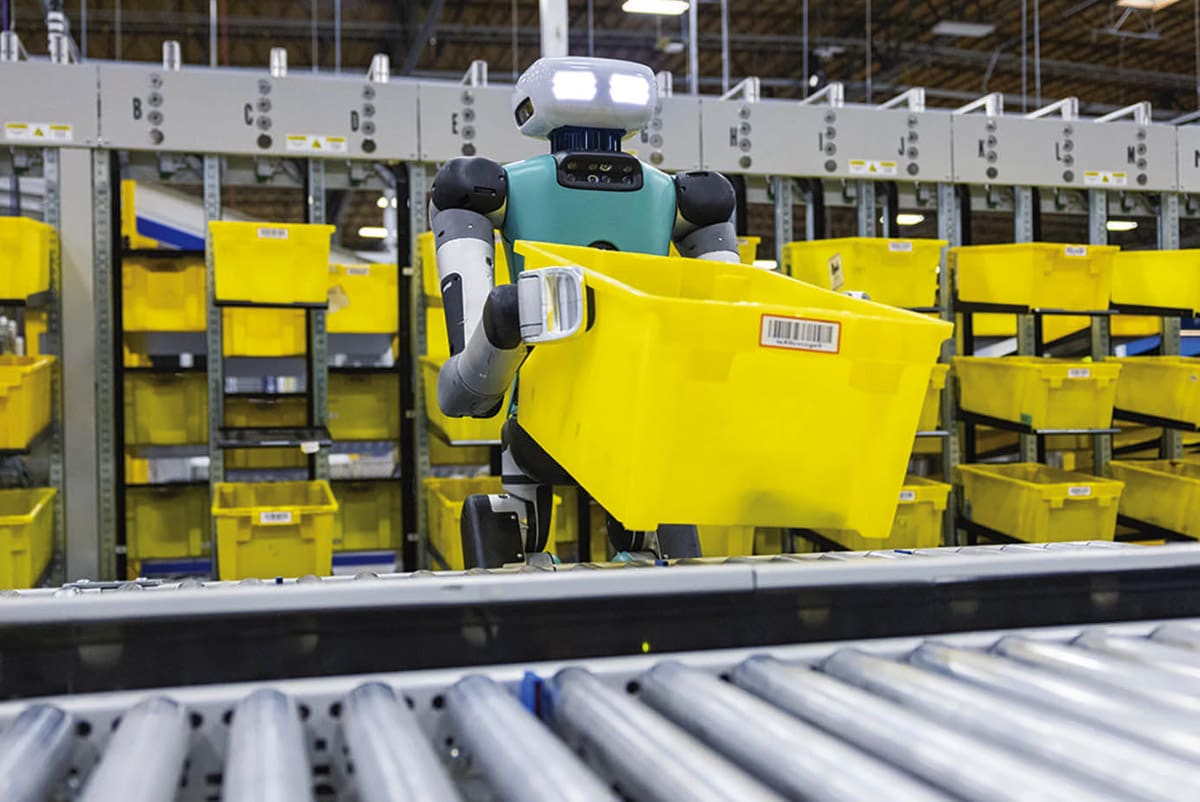
Meanwhile, Agility Robotics’ Digit, a bipedal robot focused on warehouse logistics, is already being tested for real-world applications. Apptronik has partnered with Jabil Inc., a global manufacturing and supply chain systems provider, to build its Apollo humanoid robots and integrate them into Jabil’s manufacturing operations. Companies like Figure AI and Sanctuary AI are also making strides in developing multi-purpose humanoid robots with human-like dexterity and intelligence.
With advancements in AI, machine learning, robotics, and sensors the global humanoid robot market is expected to experience exponential growth in the coming years. According to Markets and Markets, the humanoid robot industry is projected to reach $17.3 billion by 2027, growing at a compound annual growth rate of 52.1 percent from 2022.
Despite their immense potential, humanoid robots face several challenges before they can achieve mainstream adoption. In this article, two industry executives — Melonee Wise, Chief Product Officer of Agility Robotics and Barry Phillips, Chief Commercial Officer of Apptronik — share their insights about the current state and future outlook for humanoid robots.
Tech Briefs: What factors are driving rapid advancements in the development of humanoid robots today and how are these influencing their design and functionality?

Melonee Wise: There are two main factors driving humanoid adoption and development today: economical and technological. With respect to economics, there are more than one million unfilled material handling positions in logistics and manufacturing in the U.S. alone. Despite a decade of throwing AMRs (wheeled robots) at the problem, the situation is getting worse, not better.
On the technology front, new sensor technology is changing what’s possible for us to do — manipulate, sense, and see. In addition, the industry needs to continue to push the envelope for robots with more advanced vision sensing in the near term, and advances in proprioception.
Barry Phillips: Humanoid robots can solve many challenges the world faces such as aging populations, persistent labor shortages, and shrinking workforces. We believe that Apollo can improve humans’ quality of life by solving these issues. At Apptronik, addressing human challenges is integral to our mission and is reflected in Apollo’s design and development. Apollo is uniquely designed to foster comfortable interaction by focusing on an approachable visual design alongside highly functional AI technology. Humanoid robots should be part of “team human” — collaborating and supporting humans in their work and lives.
Tech Briefs: What challenges do engineers and developers face when creating humanoid robots, particularly in ensuring safety, efficiency, and ethical AI integration?

Wise: One of the biggest challenges today, especially for AI, is lack of standards and how AI fits into the existing safety framework. There is a lot of clarity around machine safety and robot safety, but not for dynamic robots like humanoids. That’s why we are helping to create the new ISO/TC 299 standard. This has always been a challenge for the robotics industry, not just with respect to humanoids. People expect their robots to be superhuman. Competing with sci-fi has its pros and cons, but you have to remember that C-3PO was a person in a suit, not an autonomous humanoid.

Phillips: Safety, efficiency, and ethics are top of mind for our team when developing and deploying humanoid robots in real-world environments. We are a part of the committee that is developing safety standards for humanoid robots that will ensure that humanoid robots are collaborative and can work alongside people doing the jobs that people do not want to do. In the near term, all of our humanoid robots will work behind safety lasers with clear instructions for those working around them. Apollo humanoid robots are unmatched from an energy efficiency perspective. Apptronik’s design includes a heritage of unique actuation, or motor, technology that unlocks the highest level of energy efficiency. This combined with Apollo’s swappable battery design ensures the highest level of operational efficiency. We’re driven by the belief that robots can make the world a better place. Our ethos is deeply rooted in creating ethical, human-centric solutions. We’ve designed Apollo to not only tackle repetitive tasks but also to enrich human lives.
Tech Briefs: How is AI being integrated into humanoid robots to enhance their capabilities, and what role does machine learning play in making them more adaptable and interactive?

Wise: Right now, we are integrating AI into humanoids at the reasoning layer; but only where it doesn’t impact safety. When we look at using machine learning and other learning-based methodologies for our robots, we have to make sure that they are performant. Many people look at AI as the magical solution. Unfortunately, many of the AI methodologies are still falling below the reliability bar. Our customers are looking for, and deserve, 98 percent reliability or higher. So, when we integrate AI capabilities into our platform, they have to meet that reliability bar.
Phillips: Generative AI was a massive unlock for task learning and enhancing human-robot interactions. It removes the ceiling on what’s possible and creates a whole new frontier for what these robots can do. Prior to leveraging AI for tasks, humanoid robots were confined only to tasks such as box or tote manipulation. By using AI for the training of tasks, humanoid robots can also do dexterous tasks such as assembly, picking objects, packing, and other more difficult tasks that require fine motor skills. AI enables humanoid robots to understand the physical world and learn to complete the repetitive tasks in the physical world that humans don’t want to do.
Tech Briefs: What do you see as the biggest hurdles in deploying humanoid robots in everyday environments like homes and workplaces, and how are companies addressing these obstacles?
Wise: Workplaces are much easier to define. I would almost set that environment aside as something that is already well understood. Companies just have to follow the standards and execute. Getting humanoid robots in the home is a much bigger battle. For starters, every home is different. There are a lot of idiosyncrasies between people’s homes that are hard to train for. One person’s bowl is another’s ashtray, for example.
Phillips: Collaboration is key to advancing humanoid robots in every type of environment, but especially as these robots are deployed first in healthcare environments and eventually to the home. Apptronik collaborates with innovative AI leaders like Google Deep-Mind, bringing together best-in-class resources and talent in artificial intelligence with a cutting-edge humanoid robot platform. Additionally, the cost of humanoid robots will need to decrease in order to meet the price point needed for a home environment. With the number of actuators, or motors, in a humanoid robot, the ability to leverage linear actuation is absolutely key in reducing the price to a level that enables mass adoption.

Tech Briefs: Looking ahead, how do you envision humanoid robots transforming industries and households, and what societal shifts do you think this will bring about?
Wise: We are focused on our customer needs right now in the warehouse, logistics, and manufacturing industries. One of our primary goals is full collaborative safety — where Digit can work side by side with people on the production floor. We’re also working on expanding the payload and charging capacity. In the future, we see moving to light industrial spaces such as the back of a grocery store, hotel, or hospital. Humanoid robots deployed in public spaces are much further afield.
Phillips: By taking on dull, dirty, and dangerous tasks, humanoid robots will contribute to societal shifts that benefit humanity across work and personal life. In the near term, this will take place in logistics and manufacturing where Apollo can assist with the repetitive tasks that humans really don’t want to do. One example of one of the most impactful areas for humanoid robots in the future is eldercare. Humanoid robots in eldercare is a North Star goal we’ve been working toward since Apptronik’s inception. Apollo can not only address critical labor shortages in eldercare but also change how we experience the aging process. Humanoid robots can help people age with dignity and extend our quality of life into our later years.
Tech Briefs: When do you foresee humanoid robots becoming part of our daily lives?
Wise: From a workforce point of view, robots are already part of our daily lives. With respect to homes, outside of single purpose robots I’m not convinced that there will be a general-purpose humanoid robot in my house during my lifetime. We are far more likely to see advances and adoption of single-purpose home robots than general purpose humanoids. For robots to be in a home, we must get to the point where we trust robots to, for example, carry children up a flight of stairs. That’s a very high bar.
Phillips: We’ve reached an inflection point with humanoid robot development — all technological pieces are in place, and now we are focused on training the robots for commercialization and deployment. But this is just the beginning, similar to the trajectory of personal computers in the 1980s. We foresee humanoid robot adoption gradually increasing over the next decade moving from industrial environments to healthcare to eldercare and then eventually to the home. Currently, Apptronik is working with commercial partners like Mercedes-Benz and GXO, where we will automate tasks such as kitting, picking, packaging and, assembly.
This article was written by Chitra Sethi, Editorial Director, SAE Media Group. For more information visit www.agilityrobotics.com or www.apptronik.com .







