The United States population is older than it has ever been. Today, the country’s median age is 38.9, which is nearly a decade older than it was in 1980. And the number of adults older than 65 is expected to balloon from 58 million to 82 million by 2050. The challenge of caring for the elderly, amid shortages of care workers, rising health care costs, and evolving family structures, is an increasingly urgent societal issue.
To help address the eldercare challenge, a team of MIT engineers is looking to robotics. They have built and tested the Elderly Bodily Assistance Robot, or E-BAR, a mobile robot designed to physically support the elderly and prevent them from falling as they move around their homes.
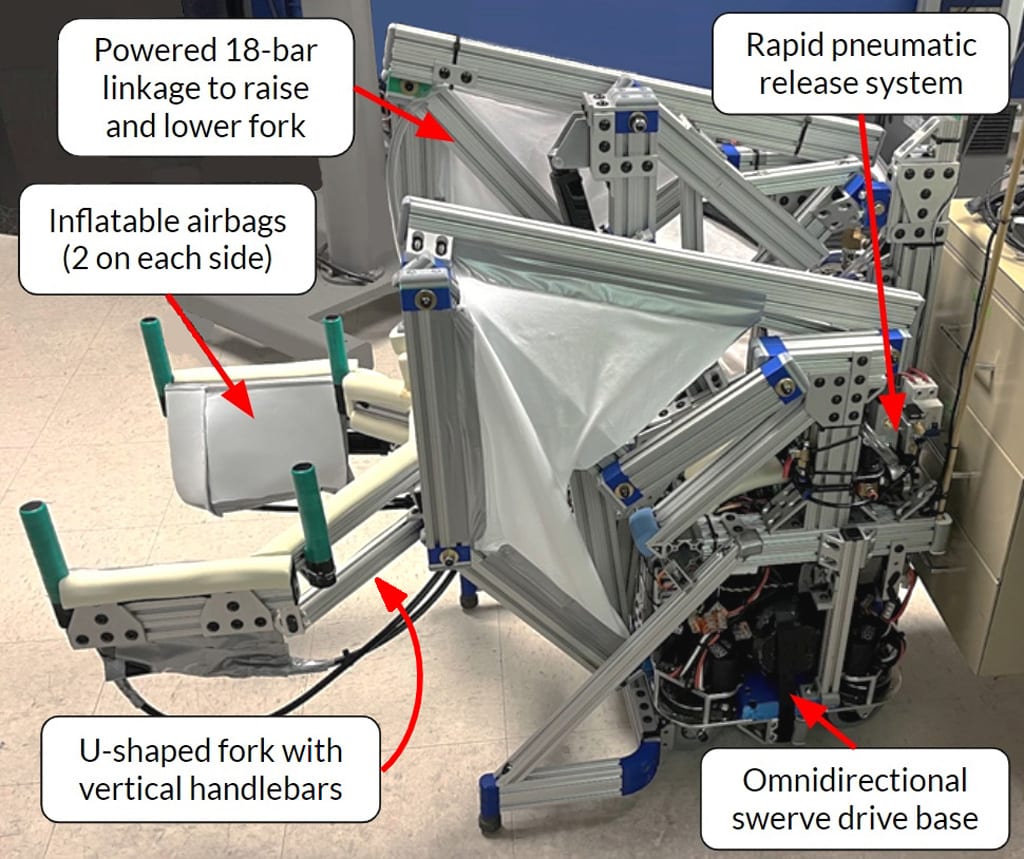
E-BAR acts as a set of robotic handlebars that follows a person from behind. A user can walk independently or lean on the robot’s arms for support. The robot can support the person’s full weight, lifting them from sitting to standing and vice versa along a natural trajectory. And the arms of the robot can catch them by rapidly inflating side airbags if they begin to fall.
With their design, the researchers hope to prevent falls, which today are the leading cause of injury in adults who are 65 and older. “Many older adults underestimate the risk of fall and refuse to use physical aids, which are cumbersome, while others overestimate the risk and may not exercise, leading to declining mobility,” said Harry Asada, the Ford Professor of Engineering at MIT. “Our design concept is to provide older adults having balance impairment with robotic handlebars for stabilizing their body. The handlebars go anywhere and provide support anytime, whenever they need.”
In its current version, the robot is operated via remote control. In future iterations, the team plans to automate much of the bot’s functionality, enabling it to autonomously follow and physically assist a user. The researchers are also working on streamlining the device to make it slimmer and more maneuverable in small spaces.
“I think eldercare is the next great challenge,” said E-BAR designer Roberto Bolli, a graduate student in the MIT Department of Mechanical Engineering. “All the demographic trends point to a shortage of caregivers, a surplus of elderly persons, and a strong desire for elderly persons to age in place. We see it as an unexplored frontier in America, but also an intrinsically interesting challenge for robotics.”
Transcript
No transcript is available for this video.