

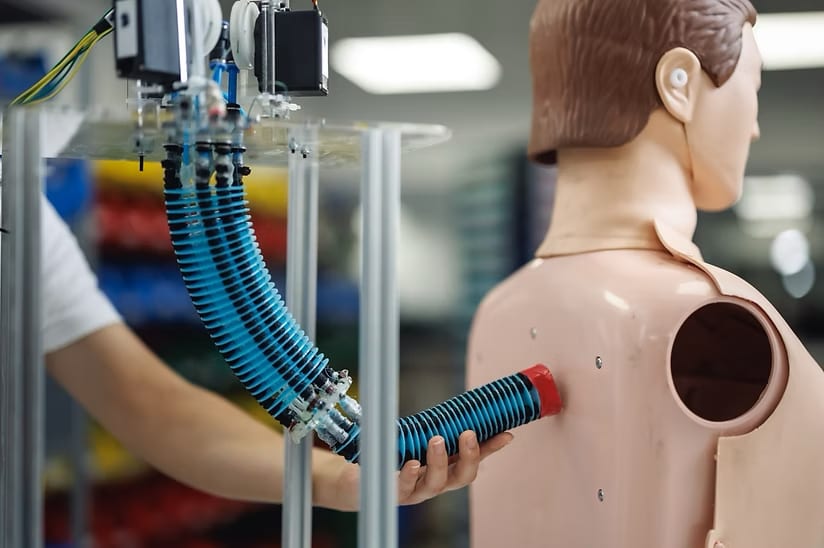
Singapore-MIT Alliance for Research and Technology’s (SMART) Mens, Manus & Machina (M3S) interdisciplinary research group, and National University of Singapore (NUS), alongside collaborators from Massachusetts Institute of Technology (MIT) and Nanyang Technological University (NTU Singapore), have developed an AI control system that enables soft robotic arms to learn a wide repertoire of motions and tasks once, then adjust to new scenarios on the fly without needing retraining or sacrificing functionality. This breakthrough brings soft robotics closer to human-like adaptability for real-world applications, such as in assistive robotics, rehabilitation robots, and wearable or medical soft robots, by making them more intelligent, versatile and safe.
Unlike regular robots that move using rigid motors and joints, soft robots are made from flexible materials such as soft rubber and move using special actuators — components that act like artificial muscles to produce physical motion. While their flexibility makes them ideal for delicate or adaptive tasks, controlling soft robots has always been a challenge because their shape changes in unpredictable ways. Real-world environments are often complicated and full of unexpected disturbances, and even small changes in conditions — like a shift in weight, a gust of wind or a minor hardware fault — can throw off their movements.
Despite substantial progress in soft robotics, existing approaches often can only achieve one or two of the three capabilities needed for soft robots to operate intelligently in real-world environments: using what they’ve learned from one task to perform a different task, adapting quickly when the situation changes, and guaranteeing that the robot will stay stable and safe while adapting its movements. This lack of adaptability and reliability has been a major barrier to deploying soft robots in real-world applications until now.
In a study titled “A general soft robotic controller inspired by neuronal structural and plastic synapses that adapts to diverse arms, tasks, and perturbations,” recently published in Science Advances, the researchers describe how they developed a new AI control system that allows soft robots to adapt across diverse tasks and disturbances. The study takes inspiration from the way the human brain learns and adapts and was built on extensive research in learning-based robotic control, embodied intelligence, soft robotics and meta-learning.
Here is an exclusive Tech Briefs interview, edited for length and clarity, with Co-Corresponding Author Professor Cecilia Laschi, Principal Investigator at M3S, Provost’s Chair Professor, Department of Mechanical Engineering at the College of Design and Engineering and Director of the Advanced Robotics Centre at NUS.
Tech Briefs: What was the biggest technical challenge you faced while developing this AI control system?
Laschi: Controlling soft robots implies new methods and techniques with respect to the well-known robot control techniques. AI is used for soft robot control, in terms of machine learning techniques that can help a control system to learn the robot mechanics and dynamics. The challenges were that developing learning-based control systems relies on setting up the proper learning system large enough to solve the control problem, small enough to need an affordable learning effort.
Tech Briefs: Can you explain in simple terms how it works please?
Laschi: Machine learning can help control robots, but of course a learning phase is needed for the system to teach the robot needed characteristics as well as the task to accomplish. In most cases, learning is done offline and the system works properly once the learning phase is completed. Online learning is also possible, to promptly adapt to task and environmental conditions, but requires some re-learning that may be long. In our work, the control system is based on two layers, so that learning can be done both offline and online. This is inspired by biological synapses between neurons. Some of them are structural and encode features of a general nature, irrespective of the task the robot will accomplish. Others can promptly reorganize themselves during task execution. Based on structural synapses, online learning does not need to be a complete relearning, so it can be faster and help our robot to adapt promptly to new conditions. This is shown in several experiments, for example by changing the weight of the tip while the robot is executing a given trajectory, as well as by disturbing the robot with an external air flow.
Tech Briefs: Do you have any set plans for further research/work/etc.? If not, what are your next steps?
Laschi: The controller developed in this work can be applied to diverse soft arms and can adapt to diverse environmental conditions. For those reasons, in the future we envisage the application of this control system to more robots. The work can be extended to more morphologies than the arm, as well.
Tech Briefs: Do you have any advice for researchers aiming to bring their ideas to fruition?
Laschi: A key aspect of today's research is interdisciplinarity. Robotics itself is interdisciplinary by nature, and soft robotics even more. A key quality young researchers should focus on is open-mindedness and the capability of understanding and integrating knowledge from diverse fields.










