

Christian Sforza, Nadine Oliynyk,
Tyler West, Brandon Ko
University of Waterloo
Ontario, Canada
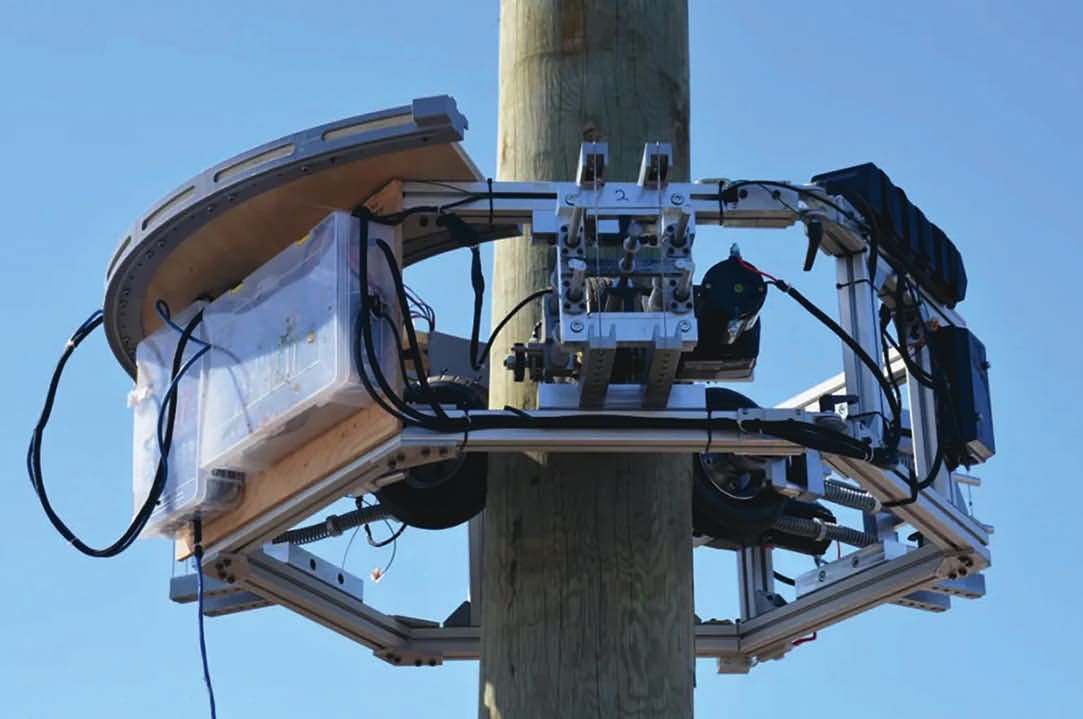
With a goal in mind to modernize utility industry practices, enhancing efficiency, safety, and precision, while keeping the interest and wellbeing of utility workers in mind, a team at the University of Waterloo has developed Woodpeckr — semi-autonomous robot designed to climb and drill wooden utility poles during the electrical line installation process.
As the world trends toward electrification, the grid must be able to keep up, demanding an increase in construction and demonstrating the need for a more resilient grid. Further, with the advent of climate change, storms, and major weather events, old infrastructure needs to be replaced at increasing rates. Current processes require lineworkers to climb poles manually or stop traffic to reach heights via a bucket truck.

“The idea for our robot came out of our final year engineering design project at the University of Waterloo. We were actively looking for projects that aligned with our team’s skillset of building robotics and landed on this idea after learning about how dangerous the job of a lineworker is. We were inspired to create a device that could make the job of a lineworker easier and safer at the same time,” said Tyler West.
The device consists of a three-wheel system that wraps around a pole for climbing and forms a platform on which tools can be mounted. On the platform, a 180-degree track positions a drill angularly, enabling through holes to be drilled at any angle while ensuring safety, accuracy, and efficiency. The passive suspension ensures the device can hold itself and its payload up during operation, while resisting rough wind and weather conditions.
“The challenges we faced in developing this robot largely came from the fact that this was a custom and unique design that we made from the ground up,” said West, adding that they “went through several iterative design cycles to integrate different sub systems across mechanical, electrical, and software engineering. We had to learn how to machine many custom components ourselves and we had to do it all on a tight timeline to build and test the device in just under two months.”
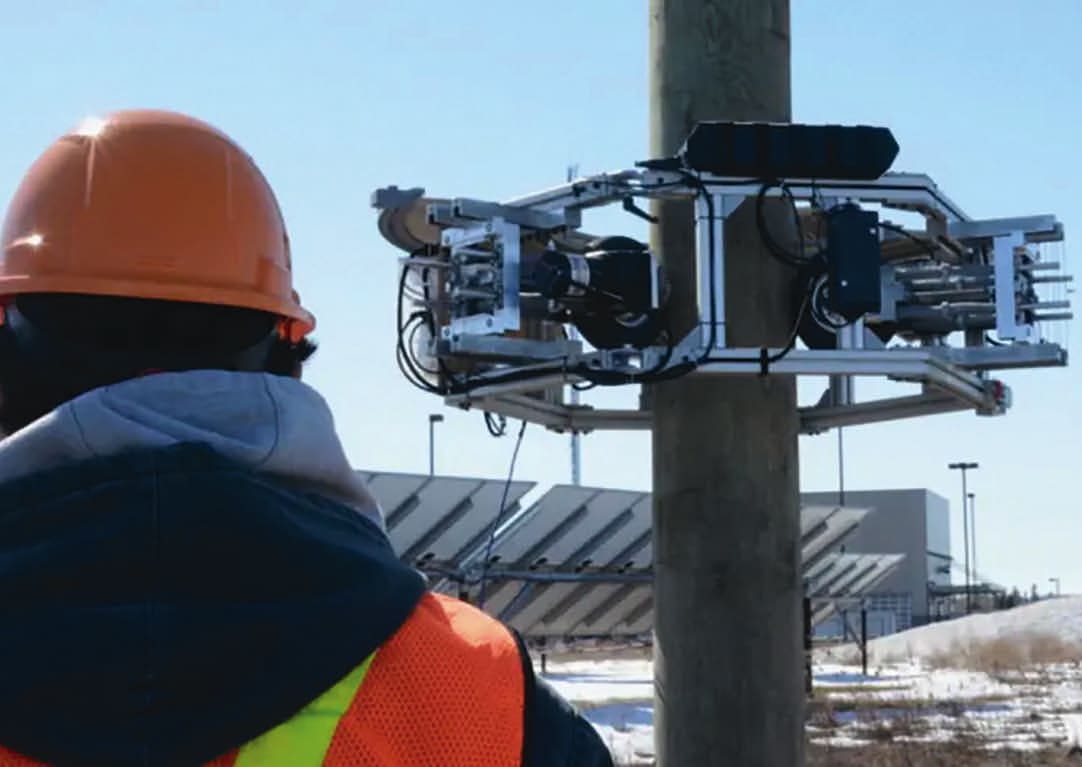
“We are still relatively far from commercialization. At this stage we need to do a major redesign to lightweight the device, build out features to make it easier for lineworkers to use in the field, and apply the learnings we had from building the first prototype to get it to a commercial-ready state,” said West.
There are many applications with different attachments that could enable the robot to do different functions on utility poles. Some examples include drilling poles, wrapping poles in fire-resistant mesh, installing insulators/conductors on poles, and inspecting poles,” he added.
For more information, visit here .











